


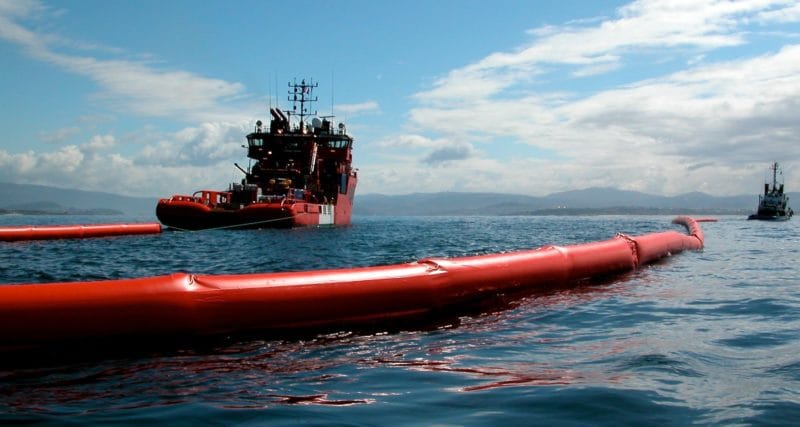
This week, the Kenya Maritime Authority, the Kenya Ports Authority, and the Oil Spill Mutual Aid Group convened a five-day Tier 2 Emergency Oil Spill Response Training bringing together representatives from Kenya, Uganda, and Rwanda. The programme culminates in a live field deployment exercise—a simulated spill response that will test whether classroom lessons survive contact with saltwater, wind, and the inevitable chaos of an emergency.
It would be easy to file this under routine capacity building. That would be a mistake. What is happening in Mombasa this week is one of the more consequential acts of regional maritime diplomacy Kenya has undertaken in years—and it deserves to be understood as such.
The Tier 2 Gap Is Where Disasters Live
To grasp why this training matters, one must understand the tiered architecture of oil spill preparedness. Tier 1 is the operator’s immediate response—the terminal, the tanker, the facility. Tier 3 is the national, government-led mobilisation for catastrophic events. Tier 2 sits uncomfortably in the middle: the medium-scale spill that exceeds a single operator’s capacity but does not yet trigger a full national emergency.
Tier 2 is where institutional failure is most likely, because it demands coordination across multiple actors—port authorities, government regulators, private oil companies, neighbouring states—without the clarity of command that a full national mobilisation provides. The IMO’s OPRC Model Courses designate Level Two training for “Supervisors and On-Scene Commanders (Tactical),” the personnel who must translate strategy into action at the water’s edge . This is the level where decisions are made under time pressure with incomplete information, where a containment boom deployed thirty minutes late means oil on a mangrove root or a turtle nesting beach.
Kenya has been building toward this capability for years. The National Marine Spills Response Contingency Plan, launched in late 2025, designates KMA as the Competent Oil Spill Authority and formalises coordination through a Marine Spills Preparedness and Response Coordination Charter . KMA Board Chairman Ahmed Kolosh disclosed that the Authority and its partners—including OSMAG, KPA, Kenya Pipeline, and the Norwegian Coastal Administration—have trained approximately 1,000 responders . The current workshop is the next increment in that accumulated capacity.
OSMAG Is the Quiet Institutional Innovation
The involvement of the Oil Spill Mutual Aid Group deserves particular attention, because OSMAG represents a model of public-private cooperation that is unusually well-suited to the realities of developing-country maritime governance.
Founded in 1992 as the National Oil Spill Response Committee and renamed in 1999, OSMAG is a not-for-profit society of oil marketing companies that maintains a joint Tier 2 response capability for Kenyan coastal waters and Lake Victoria . Its roughly 140 members include international and national oil companies, a pipeline operator, a power producer, and a railway operator . What makes OSMAG notable is the way Kenyan regulation has been designed to sustain it: companies seeking licences to import, export, or store petroleum products near the shoreline must demonstrate Tier 2 response capability, which in practice means joining OSMAG .
This is a mutualistic arrangement. The regulator drives membership, ensuring the organisation’s financial sustainability through economies of scale. The organisation, in turn, provides the response capacity the regulator can rely upon . In a region where project-based funding for disaster preparedness is chronically unreliable, this model creates something rare: a self-sustaining institutional capability that does not depend on the next donor grant cycle.
OSMAG’s track record is not theoretical. It has responded to a 350-tonne crude oil spill in Mombasa in 2005, a 35-tonne heavy fuel oil spill at Makupa Causeway in 2010, and a 10-tonne spill into Makupa Creek from a shore tank overfill . These are modest incidents by global standards. But they are precisely the kind of events that, mishandled, become the training data for future catastrophes.
The Regional Dimension Is Not Decorative
The inclusion of Uganda and Rwanda in this training reflects a geographic reality that is often obscured by the coastal focus of maritime policy. Kenya’s oil spill risk is not confined to its 536 kilometres of Indian Ocean coastline. The Port of Mombasa is the primary gateway for petroleum products destined for Uganda, Rwanda, and beyond. The pipeline infrastructure, the tanker traffic, and the storage facilities that serve the landlocked hinterland create a spill risk corridor that runs from the coast to the Great Lakes region.
OSMAG’s mandate explicitly extends to Lake Victoria . The East African Community has been developing maritime rescue coordination centres in Kisumu, Mwanza, and Entebbe, with German funding of €15 million directed toward pollution control on the lake . A spill in Kisumu or Mwanza would not respect the border that runs through the lake’s waters. The responders trained this week in Mombasa may one day be deployed on a shoreline hundreds of kilometres inland.
There is also a broader regional architecture under construction. The Nairobi Convention is developing a regional oil spill contingency plan for the Western Indian Ocean, expected to be finalised in the coming period . The Indian Ocean Commission has been facilitating information-sharing through the Regional Maritime Rescue Coordination Centre in Seychelles. During the MASEPOLREX 25 exercise last year, which simulated a tanker collision off the Tanzania-Kenya border, Mauritius and Madagascar reportedly offered equipment and personnel . The direction of travel is clear: national response capacity is necessary but insufficient. The region is building the habit of mutual assistance.
What the Field Exercise Will Reveal
The fifth-day field deployment is the crucible. Tabletop exercises and classroom sessions build knowledge. Live deployments expose the gaps that no presentation can address: the radio that does not interoperate, the boom that tangles in the wrong current, the logistics chain that assumes a warehouse is stocked when it is not.
Kenya’s own history offers cautionary lessons. A 1981 UNEP report on the region noted that Mombasa was the only port in East Africa with an established oil spill response plan, and that its equipment inventory was modest: 1,500 metres of containment boom, a few tonnes of dispersant, a 20-tonne skimmer . Four decades later, the institutional framework is vastly more sophisticated. But the fundamental question remains the same: when the alarm sounds, can the system actually deliver?
The MASEPOLREX 25 exercise tested national and regional mobilisation at scale. An Indian Ocean Commission representative praised Kenya’s “well-structured national oil spill contingency plan, organised response systems, and appropriate equipment” and suggested other countries might replicate the model . That is welcome recognition. But praise from partners is not the same as demonstrated performance under pressure. The field exercise this week is a smaller, more focused test—Tier 2 rather than Tier 3—and its value lies precisely in its granularity. It will reveal whether the supervisors and on-scene commanders who complete this training can actually command.
The Economic Logic Beneath the Environmental Logic
It is tempting to frame oil spill preparedness as an environmental protection issue, and it is. But the economic stakes are equally urgent and arguably more politically salient.
The Principal Secretary for Shipping and Maritime Affairs, Aden Millah, noted at the launch of the National Contingency Plan that Kenya’s growing seaborne trade—the expansion of Mombasa, the growth of Lamu and Kisumu, the relocation of the Kipevu Oil Terminal—has heightened spill risk . The logic runs in both directions. A major spill would devastate the marine ecosystems on which fisheries and tourism depend. It would also disrupt port operations, trigger insurance liabilities, and damage the reputation of Kenyan ports as reliable and responsible destinations.
For a country positioning itself as a regional maritime hub, the credibility of its environmental response capability is not a soft concern. Shipowners, charterers, and insurers assess port risk. A jurisdiction that cannot demonstrate credible Tier 2 response capability is a jurisdiction that pays a premium—in insurance costs, in diverted traffic, in diminished negotiating leverage.
The Unfinished Work
For all the institutional progress, hard questions remain. The National Contingency Plan is new; its operational effectiveness is untested at scale. The regional contingency plan under the Nairobi Convention is still being finalised. The MASEPOLREX exercise was a simulation, however realistic. The training this week is preparation, not proof.
What Kenya has built is a framework: a competent authority, a contingency plan, a Tier 2 organisation with a sustainable membership model, and a growing cadre of trained responders. What it has not yet demonstrated is that the framework functions seamlessly when a real spill occurs—when the weather turns, when communications fail, when the nearest boom is in the wrong warehouse and the on-scene commander must improvise.
That is why the fifth-day field exercise matters more than the preceding four days of instruction. It is the moment when the abstraction of preparedness meets the specificity of response. If it goes well, Kenya will have earned a measure of confidence. If it exposes gaps, that is also valuable—provided the gaps are closed before the next alarm is real.
The maritime domain rewards preparation and punishes complacency with a severity that is difficult to exaggerate. Kenya’s investment in Tier 2 response capacity is an acknowledgment of that reality. The region’s participation in this training is an acknowledgment that no country can afford to face that reality alone.
The author is a policy analyst focusing on maritime governance and African economic development. The views expressed are the author’s own.