


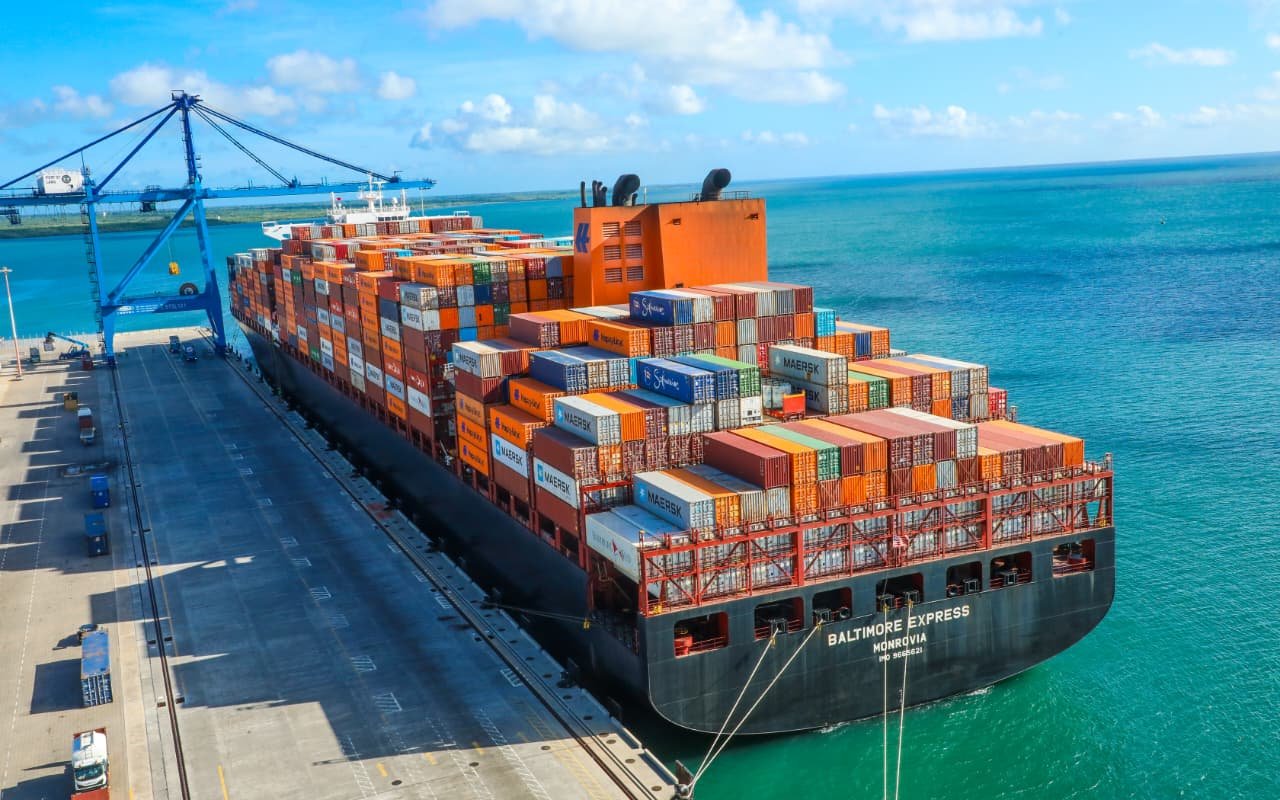
What makes this achievement even more significant is that the call was not ceremonial. The vessel undertook specialised operations involving the repositioning of dangerous cargo in compliance with International Maritime Organization regulations—work that demands technical competence, operational discipline, and confidence in port safety systems. This sends a powerful message to international shipping lines: Lamu is not merely a backup facility or a symbolic infrastructure project. It is a functioning deep‑sea port, capable of sophisticated maritime operations.
Captain Abdulaziz Mzee’s comparison of Lamu to major global ports such as Singapore, Rotterdam, and Hamburg may sound ambitious to some, but it is rooted in an undeniable reality: natural depth matters enormously in modern shipping economics. The Port of Lamu possesses one of the greatest natural maritime advantages on the African coastline—a naturally deep harbour of approximately 17.5 metres. Across the continent, ports spend billions on continuous dredging simply to remain competitive. Dredging is expensive, environmentally sensitive, and operationally disruptive. Lamu’s geography gives Kenya a rare competitive advantage that cannot easily be replicated elsewhere in the region.
This is why the latest vessel call should force policymakers to think beyond ordinary port operations. Lamu is no longer just a Kenyan port; it has the potential to become a regional transshipment powerhouse connecting East Africa, the Horn of Africa, the Gulf region, and the wider Indian Ocean trade network. If properly integrated with rail, highways, logistics parks, and regional trade frameworks, the port could transform cargo movement patterns across multiple landlocked economies.
Yet infrastructure alone is never enough. History is full of modern ports that failed to unlock their potential because governments neglected the surrounding ecosystem required for trade growth. The true test for Kenya now lies in whether national planning can match the scale of maritime opportunity emerging in Lamu. The road and rail connections linked to the LAPSSET Corridor must move from political speeches to operational urgency. Investors require certainty. Shipping lines require cargo volumes. Manufacturers require industrial zones. Freight forwarders require efficient customs systems. A world‑class port without world‑class hinterland connectivity risks becoming an underutilised monument rather than a transformative economic engine.
Equally important is the need for Kenya to aggressively market Lamu internationally. Global shipping decisions are driven by confidence, predictability, and commercial incentives. Ports do not compete on infrastructure alone; they compete on efficiency, turnaround time, security, and policy stability. Kenya must therefore ensure that bureaucratic inefficiencies, overlapping regulations, and institutional rivalries do not undermine the strategic advantage the port naturally possesses.
There is also a broader geopolitical dimension. The Indian Ocean is becoming one of the most consequential economic and strategic regions in the world. As trade routes shift and supply chains diversify, nations with deep‑water maritime infrastructure will command increasing influence in regional commerce. Lamu gives Kenya an opportunity to position itself as a serious maritime state—not merely a coastal economy dependent on traditional trade routes.
Critics of the Lamu project often focused narrowly on immediate cargo volumes during its early years, ignoring how major ports historically evolve. Few globally dominant ports reach full utilisation immediately after construction. Maritime infrastructure is built not only for present demand but for future trade realities. The arrival of the MV Nagoya Express and now the even larger MV Baltimore Express suggests that shipping lines are beginning to recognise Lamu’s long‑term strategic value.
The steady rise in vessel calls, combined with the Kenya Ports Authority’s investment in modern cargo handling equipment, signals momentum rather than stagnation. What matters now is consistency. Ports build reputations over time through reliability, efficiency, and uninterrupted service delivery.
The significance of this moment extends beyond one ship or one port call. It represents the emergence of a new maritime frontier for East and Central Africa. For too long, Africa has adapted itself to the limitations of outdated infrastructure. Lamu reverses that pattern. It is infrastructure built ahead of demand, designed for the next generation of global commerce.
As vessels continue growing larger and maritime trade becomes increasingly concentrated around ports capable of handling mega‑ships efficiently, Kenya may discover that the boldest decision it ever made was not building the Port of Lamu—but believing early enough in what the future of shipping would become.