


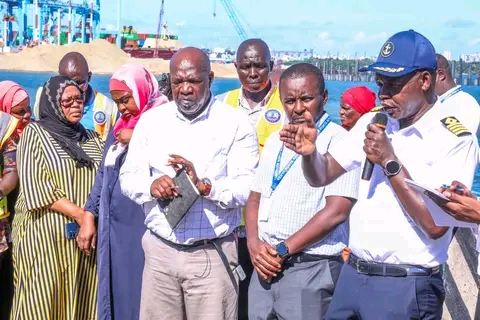
At first glance, the recent engagement between Kenya Ports Authority (KPA) leadership and employees at the Port of Mombasa might seem like routine internal management. But for Kenya’s maritime future, it carries profound significance. Over two days of interaction with staff across all operational levels, KPA CEO William Ruto emphasized a principle often overlooked in discussions of ports, infrastructure, and logistics: modern ports are not built by cranes, berths, or technology alone. They are built by people.
The Port of Mombasa’s latest performance figures prove the point. Cargo throughput rose to 45.45 million metric tons, up from 40.99 million the previous year, while container traffic exceeded 2.11 million TEUs. These are not just statistics for annual reports. They signal a port system growing more efficient, more competitive, and more influential within regional trade networks. Behind every container handled, every vessel turnaround improved, and every logistics chain streamlined stands a workforce whose discipline, technical competence, and institutional commitment ultimately determine success or failure.
For years, public discourse on African ports has fixated on infrastructure expansion. Governments proudly launch new terminals, acquire modern equipment, and announce ambitious corridor projects. Kenya itself has invested heavily in port modernization, road and rail connectivity, and digital systems. But infrastructure without a motivated workforce is like a ship without a crew—impressive to behold, yet incapable of fulfilling its mission.
That is why Captain Ruto’s focus on workers’ welfare deserves serious attention. Across many African state corporations, management often treats labor as a cost to be controlled, not a strategic asset to be developed. That attitude breeds disengaged employees, poor customer service, industrial strife, and declining productivity. Ports, however, operate in a fiercely competitive international environment where delays, inefficiencies, and labor instability can quickly drive shipping lines and cargo owners to alternative gateways.
Today, the Port of Mombasa competes not only with regional neighbors but with an emerging network of African maritime hubs vying for dominance over continental trade corridors. Ports like Dar es Salaam, Djibouti, and Durban continue to invest aggressively in efficiency, logistics integration, and customer retention. Shipping lines no longer remain loyal to geography alone. They follow speed, reliability, lower turnaround times, and predictable operations.
In this context, workforce morale becomes a strategic economic issue—not merely an HR concern. A motivated dock worker, marine pilot, crane operator, planner, or logistics officer directly affects vessel turnaround times, cargo evacuation, and customer confidence. When management and labor pursue shared institutional goals, ports become engines of national competitiveness. When distrust prevails, operational disruptions become inevitable.
Equally important is the symbolic value of direct engagement between management and employees. Large institutions often suffer from bureaucratic distance, where strategic decisions are made in boardrooms disconnected from operational realities. Employees become passive recipients of directives rather than active contributors to transformation. By creating forums where workers can directly engage management on strategy, performance targets, and welfare concerns, KPA appears to be fostering a culture of inclusion and accountability—essential for long-term sustainability.
This matters because the maritime industry is entering a period of profound global change. Automation, artificial intelligence, green shipping regulations, and shifting supply chains are redefining port operations. African ports that fail to invest simultaneously in technology and human capital risk obsolescence—even after expensive infrastructure projects. Kenya cannot afford to treat maritime labor development as secondary to physical expansion.
The Port of Mombasa’s growing cargo volumes also carry broader geopolitical and economic weight. The port serves not only Kenya but also Uganda, Rwanda, South Sudan, the eastern Democratic Republic of Congo, and parts of northern Tanzania. Its efficiency directly affects regional trade costs, industrial competitiveness, and economic integration across East and Central Africa. Every improvement at Mombasa strengthens Kenya’s strategic position as the region’s logistical heartbeat.
Yet success should not breed complacency. Rising throughput is encouraging, but sustaining growth requires continuous reforms. Congestion management, hinterland connectivity, customs coordination, inland container depot efficiency, and maritime security remain critical challenges. Equally urgent is preparing the next generation of Kenyan maritime professionals—people capable of operating increasingly sophisticated port systems and vessels.
This is where the conversation on workers’ welfare must evolve beyond salaries and conditions of service. In a modern maritime economy, welfare must also include continuous professional development, technical training, international certification opportunities, and clear career progression pathways. A port that invests in its workforce builds institutional memory, operational stability, and innovation capacity.
Kenya’s maritime sector has historically celebrated infrastructure while neglecting the human ecosystem needed to sustain it. Yet the world’s greatest ports—from Singapore to Rotterdam—did not become global giants by geography or infrastructure alone. They succeeded because they built highly skilled, disciplined, and motivated workforces, supported by long-term institutional planning.
The message emerging from the Port of Mombasa is therefore an important one. Kenya’s maritime future will not be secured by concrete alone. It will depend on whether the nation can build a port culture rooted in professionalism, accountability, innovation, and respect for labor.
If Kenya truly intends to become a leading maritime and logistics power in Africa, it must recognize a simple truth: the most important equipment in any port is not the crane or the ship-to-shore gantry. It is the human being operating it.