


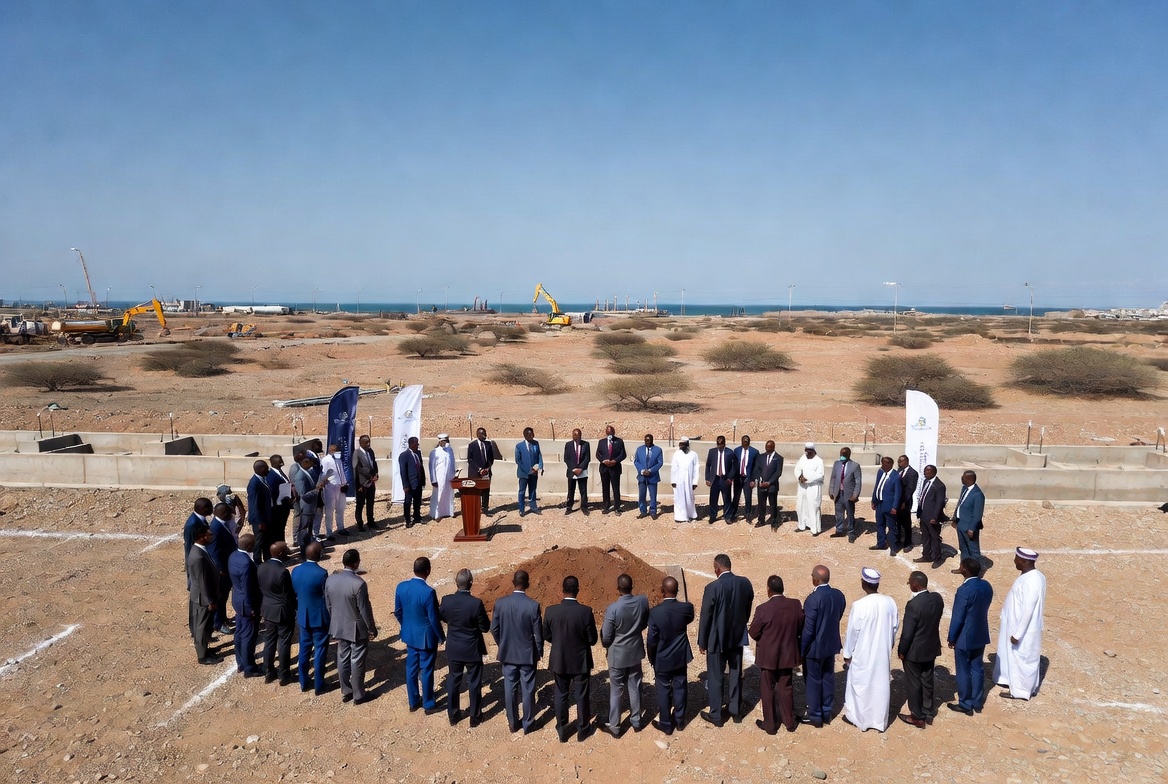
In the arid expanses of the Damerjog corridor, south of Djibouti City, a quiet but consequential transformation is underway. Ground has broken on the Fuelstor Terminal—a $160 million multi-product fuel storage and logistics hub with a capacity of approximately 400,000 metric tons for petroleum products, LPG, and edible oils.
Backed by the Salaam Group and constructed by Moroccan firm Somagec, the facility is expected to be completed in about 20 months. It represents tangible progress in Djibouti’s long-held ambition to evolve from a critical logistics waypoint into a regional energy hub.
This is not yet the grand 300,000-barrel-per-day (bpd) crude oil refinery once heralded in partnership with Saudi Arabia through the Ajyal Petroleum & Energy Company—a $12.7 billion vision for which a cornerstone was laid in 2024. But it is a pragmatic and necessary first step: building storage, jetties, and supporting infrastructure in the Damerjog Industrial Development Zone that can eventually underpin full-scale refining. Djibouti is playing the long game—and it is a game worth watching.
Strategic move in a volatile region
Djibouti sits at one of the world’s most vital maritime chokepoints, guarding the Bab el-Mandeb Strait and the entrance to the Red Sea. With global shipping disrupted by Houthi attacks and rising Middle East tensions, the value of reliable regional storage and redistribution cannot be overstated.
East African nations—Ethiopia foremost among them, but also Kenya, Uganda, and others—remain heavily dependent on distant imports. Supply shocks translate directly into higher fuel prices, inflation, and economic fragility.
The Fuelstor Terminal, alongside ongoing port and jetty developments by partners like Marsa Maroc, positions Djibouti as a buffer and balancer. It enhances energy security, supports bunkering ambitions, and creates a multimodal gateway—by port, road, and potentially rail—into the Ethiopian hinterland and beyond. In an era of friend-shoring and supply chain resilience, this is smart infrastructure diplomacy.
Anticipated economic impact
For a small nation of roughly one million people with limited natural resources, leveraging geography is existential. Successful execution could deliver: (a) Jobs and skills transfer during construction and operations; (b) Diversified revenue beyond traditional port services and foreign military bases; and (c) Catalytic effects for broader industrialization in Damerjog—power plants, ship repair, manufacturing, and eventually the larger refinery.
The larger Ajyal-led refinery, if realized at scale, would be transformative: producing fuels for local and regional markets, reducing import dependency, and generating significant employment. Even partial realization would mark a leap forward.
Critics may point to execution risks—financing hurdles in a geopolitically tense region, project delays common to mega-infrastructure in Africa, and competition from other East African initiatives (such as refinery plans in Kenya or Tanzania). Environmental concerns around oil infrastructure in a fragile ecosystem also warrant serious attention, as do governance questions around transparency and local benefit-sharing.
Yet these are challenges to be managed, not reasons for cynicism. Djibouti has demonstrated competence in delivering major port and free zone projects. With partners ranging from Saudi interests to Moroccan engineering expertise and African investment groups, the foundations for success exist.
Model for the Horn
This moment offers a broader lesson for the Horn of Africa and the continent. True development often begins not with grand rhetoric but with functional, bankable infrastructure that solves immediate problems—storage and logistics—while enabling future ambition—refining and value addition.
Djibouti is betting that energy infrastructure, married to its unmatched location, can drive industrialization in a region long defined by aid dependency and volatility.
Skeptics will note the gap between announcements and shovels in the ground on the full refinery. Optimists see the Fuelstor groundbreaking as proof of momentum. Both perspectives have merit, but the trajectory is clear: Djibouti is methodically building the pieces of an energy and logistics ecosystem that could redefine its role in East Africa for decades.
The region—and global investors—should pay attention. In a world hungry for stable supply chains and diversified energy nodes, Djibouti’s Damerjog vision is not just a national project. It is a strategic contribution to African resilience. If executed with discipline, transparency, and environmental care, it could become a textbook case of turning geography into prosperity.
The editorial board applauds this forward momentum and urges all stakeholders—Djiboutian authorities, international partners, and neighbors—to ensure the benefits flow broadly to local communities while upholding the highest standards of sustainability and governance. The Red Sea is watching.
Ends