


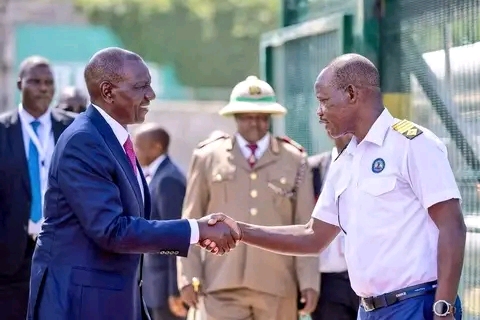
At first glance, the arrival of the renowned research vessel Dr. Fridtjof Nansen at the Port of Mombasa—accompanied by President William Samoei Ruto’s tour of the ship—might appear to be little more than a ceremonial occasion. But beneath the pageantry lies a decisive statement about Kenya’s maritime ambitions, its commitment to scientific leadership, and its growing recognition that the future of ocean governance cannot be left to chance.
The President’s reception by Kenya Ports Authority Chief Executive Officer Capt. William Ruto at the port underscores a strategic shift: Kenya is no longer content to treat its coastline merely as a corridor for imports and exports. In an era when oceans are becoming central to economic growth, climate resilience, food security, and geopolitical influence, the country must fully embrace its identity as a maritime nation.
The Dr. Fridtjof Nansen is no ordinary vessel. Named after the legendary Norwegian explorer, scientist, and humanitarian, the ship embodies decades of international collaboration in marine research and fisheries management. Through its scientific missions, it has helped coastal nations across the globe map fish stocks, assess marine biodiversity, monitor ecosystem health, and understand the profound impacts of climate change on ocean resources.
For Kenya, hosting this vessel carries exceptional significance. It arrives at a moment when the country is actively expanding its Blue Economy agenda while confronting escalating threats: overfishing, marine pollution, coastal degradation, and the mounting effects of climate change on marine ecosystems. Sound policy must be anchored in sound science—and that is precisely where research platforms like the Nansen become indispensable.
The visit also highlights a deepening partnership between Kenya and Norway in maritime affairs. Norway has long been a global leader in marine science, sustainable fisheries management, shipping, and ocean governance. Through this collaboration, Kenya stands to gain immensely—from technology transfer and capacity building to scientific training and knowledge sharing. The relationship is a model of how diplomacy can translate into tangible developmental gains.
Beyond fisheries, the Nansen’s presence underscores the urgent need for evidence-based decision-making across the entire maritime sector. As Kenya invests heavily in port infrastructure, maritime transport, offshore resources, and coastal tourism, scientific data must remain at the core of planning. Development that sidelines environmental sustainability ultimately erodes the very resources upon which economic prosperity depends.
The Port of Mombasa provides the ideal backdrop for this message. As East and Central Africa’s premier maritime gateway, the port serves millions across the region. Yet modern ports are no longer evaluated solely by cargo throughput or vessel turnaround times. They are increasingly judged by their environmental stewardship, sustainability practices, and ability to coexist harmoniously with surrounding marine ecosystems. The presence of the Nansen is a timely reminder of that evolving standard.
The engagement between President Ruto, Capt. William Ruto, and the crew and scientists aboard the Nansen sends a powerful signal: Kenya intends to align economic growth with environmental responsibility. This alignment is not optional—it is essential if the country is to realize the full potential of its Blue Economy without compromising the inheritance of future generations.
Importantly, this event should galvanize greater investment in Kenya’s own marine scientific capabilities. International partnerships are valuable, but sustainable progress demands strong domestic institutions. The country must continue to strengthen universities, research centres, fisheries departments, hydrographic services, and maritime training institutions. Kenyan scientists and researchers must be equipped with the resources to generate homegrown knowledge about the nation’s marine environment.
The timing could not be more relevant. Across Africa, maritime resources are increasingly recognized as strategic assets capable of driving economic transformation. Yet many coastal states continue to grapple with inadequate data on fish stocks, marine habitats, and ocean health. Without robust information, governments struggle to combat illegal fishing, manage resources effectively, or respond to environmental threats. Kenya has a historic opportunity to position itself as a regional leader in marine science and ocean governance.
The visit of the Dr. Fridtjof Nansen should therefore be viewed not simply as a diplomatic engagement or a presidential tour, but as a powerful reminder of the indispensable relationship between science and policy. It demonstrates that sustainable maritime development cannot be built on assumptions; it must be grounded in research, innovation, and international collaboration.
As Kenya advances its vision for a thriving Blue Economy, the lessons embodied by the Nansen are unmistakable: the future of the ocean depends on understanding it, protecting it, and managing it wisely. The country’s maritime aspirations will be measured not only by the scale of its ports or the volume of its trade, but by its unwavering commitment to preserving the marine resources that sustain livelihoods, food security, and economic growth.
In that sense, the sight of Kenya’s leadership aboard one of the world’s most respected marine research vessels is far more than a photo opportunity. It is a symbol of a nation awakening to the truth that the prosperity of tomorrow will increasingly be determined by the stewardship of its oceans today.