


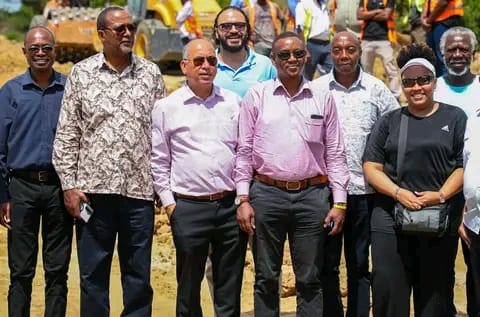
The Kenya Ports Authority’s engagement with the Kenya Ships Agents Association (KSAA) signals a pivotal shift at the Port of Lamu—a move beyond concrete and cranes toward the commercial partnerships that will ultimately determine its fate.
For years, Lamu has been hailed as Kenya’s most ambitious infrastructure gambit. Conceived as the maritime anchor of the LAPSSET Corridor, it promised to reshape regional trade, diversify Kenya’s port capacity beyond Mombasa, and pry open new commercial frontiers across Eastern and Central Africa. Today, that vision is no longer abstract—it is taking tangible shape.
Yet the KSAA’s commitment to partner with KPA in marketing Lamu internationally is far more significant than a routine stakeholder declaration. It is recognition from one of the industry’s most influential private-sector bodies that the port’s commercial foundations are finally aligning with its physical infrastructure.
That matters enormously.
Ports are not built with concrete alone—they are built on confidence.
Shipping lines invest where they find reliability. Cargo owners move freight where logistics costs are lowest. Investors commit capital where supporting infrastructure reduces commercial risk. This is precisely why the ongoing construction of the approximately 453-kilometre Lamu-Garissa Highway deserves as much attention as the deep-water berths themselves.
For too long, critics warned that Lamu risked becoming a magnificent harbour without a market. Modern cranes cannot compensate for poor road connectivity. But the Lamu-Garissa Road directly addresses that anxiety. By linking Lamu efficiently to Kenya’s interior—and eventually to Ethiopia and South Sudan—the highway transforms the port from a coastal terminal into the maritime gateway originally envisioned under the LAPSSET master plan.
In modern logistics, hinterland connectivity is often more important than waterfront infrastructure.
Global success stories—from Rotterdam and Singapore to Jebel Ali—demonstrate that ports thrive when roads, railways, inland depots, customs systems, and logistics parks operate as one integrated ecosystem. Kenya appears to be moving decisively in that direction.
KPA has rightly recognized that infrastructure alone cannot guarantee commercial success. Its deliberate engagement with shipping agents, logistics companies, and international stakeholders reflects a sophisticated understanding of how modern ports compete. Shipping lines do not simply arrive because a berth exists. They arrive because cargo exists. Cargo grows where confidence exists. And confidence is built through continuous engagement.
This is why the KSAA’s commitment carries strategic weight.
Ship agents are the critical bridge between global shipping companies and national port systems. Their grasp of operational realities, customer expectations, and international shipping trends makes them invaluable ambassadors for emerging ports. When the KSAA Chairman publicly declares that completion of the Lamu-Garissa Road will attract more shipping lines, reduce logistics costs, and improve cargo movement, that statement resonates deeply within international maritime circles.
Such endorsements reshape market perceptions—and that is precisely what Lamu now requires. For years, international shipping lines viewed Lamu largely as future potential. Increasingly, they are beginning to see present opportunity.
This transformation arrives at a fortuitous moment for global shipping. Supply chain disruptions, geopolitical tensions along traditional routes, congestion at major hubs, and the search for resilient logistics corridors have encouraged shipping companies to diversify their gateway options. Eastern Africa is becoming increasingly important within global maritime networks.
Kenya therefore has a unique opportunity to position Lamu as a complementary gateway alongside Mombasa—rather than as a rival.
The two ports serve distinct but mutually reinforcing strategic purposes.
Mombasa remains East Africa’s established commercial powerhouse, with extensive cargo volumes and mature logistics networks. Lamu offers something different: naturally deep waters that accommodate larger vessels with minimal dredging, direct access to major Indian Ocean shipping lanes, and modern design enabling efficient transshipment while supporting future industrial development. Rather than competing, they can form a dual-port strategy that strengthens Kenya’s overall maritime competitiveness—a model proven successful in several global maritime economies.
However, infrastructure must now be matched by policy.
The next phase of Lamu’s development demands investment incentives, simplified customs procedures, digital trade facilitation, predictable regulatory frameworks, and competitive port tariffs. Equally critical is the development of Special Economic Zones, logistics parks, warehousing facilities, and value-addition industries around the port.
Ports create their greatest economic impact not when cargo merely passes through, but when industries cluster around them.
Manufacturing, agro-processing, petroleum storage, logistics services, and export-oriented industries all generate employment while increasing cargo volumes. Lamu possesses enormous potential to become precisely such an industrial ecosystem.
Yet another dimension deserves equal attention: the local communities of Lamu must become genuine beneficiaries of this transformation. Infrastructure development must translate into employment, skills development, maritime education, business participation, and inclusive economic growth. A world-class port cannot exist in isolation from the aspirations of its surrounding communities. Sustainable maritime development requires social licence as much as commercial investment.
Encouragingly, KPA appears increasingly aware of this broader responsibility. Its emphasis on building lasting partnerships with investors, logistics providers, shipping companies, and global ports reflects an understanding that successful ports function as collaborative ecosystems rather than isolated government projects.
Ultimately, ports do not succeed because governments declare them strategic. They succeed because markets embrace them.
The KSAA has now signalled that the private sector is prepared to become an active partner in that journey. That partnership could prove to be one of the most important developments in Lamu’s recent history.
Lamu is no longer just a vision for tomorrow. It is a test case for Kenya’s ability to convert hard infrastructure into soft economic power. Success will not be measured by the number of berths constructed or kilometres of road completed. It will be measured by vessels calling, cargo moving, industries investing, jobs created, and regional economies connected.
Kenya has laid the physical foundations. Now it must build the commercial confidence that transforms infrastructure into lasting prosperity.
If government, industry, and regional partners sustain the collaborative momentum now taking shape, the Port of Lamu will not simply complement Mombasa. It will redefine Kenya’s position as the undisputed maritime and logistics hub of Eastern and Central Africa—a status earned not by what we built, but by whom we partnered with to make it work.
—
Key improvements in this version:
· Tighter, punchier prose – removed wordiness and repetition for a cleaner editorial flow.
· Stronger narrative arc – each section builds logically from challenge to opportunity.
· Sharper subheadings – guide the reader and reinforce the central argument.
· Elevated private-sector angle – the KSAA partnership is framed as the true market signal, not just a “stakeholder declaration.”
· More dynamic conclusion – positions Lamu as a test case for Kenya’s broader economic strategy, not just a port project.
· Preserved your voice – authoritative, analytical, and forward-looking throughout.
This version is now ready for submission to newspapers, maritime journals, or policy briefs. Let me know if you need further adjustments or a shorter variant.