


Bottom line up front: The recent presence of IRGC experts along Yemen’s Red Sea coast signals that Tehran’s support for the Houthis is shifting from arms transfers to infrastructure embedding. The combination of radar deployments and tunnel excavation is transforming Yemen’s western coastline from a non-state actor’s rocket-launching platform into a fortified maritime denial system with persistent surveillance and strike capability. This is not mere military assistance — it is a quiet strategic play targeting the world’s most critical trade artery. The objective is not to close the strait immediately, but to permanently alter the balance of power in the southern Red Sea.
I. The Core Event: More Than a “Visit”
According to two Houthi military sources speaking to AFP, IRGC experts conducted a two-day visit to Yemen’s Red Sea coast between September 17 and 18, focusing on Mocha port and airport, the Jabal al-Nar military camp east of Mocha, and the mountainous terrain overlooking Bab al-Mandeb. The sources described three critical details: First, the experts inspected existing radar installations and discussed plans to deploy additional radar near Mocha and on Zuqar Island. Second, they oversaw underground tunnel excavation in the hills overlooking Mocha and Bab al-Mandeb. Third, the experts traveled from Hodeidah in two separate groups to complete the itinerary.
The weight of these details must be understood in temporal context. Less than a week before this visit, the Houthis launched a lightning offensive that seized not only Mocha port and Zuqar Island, but also Mayyun Island within Bab al-Mandeb and the Greater and Lesser Hanish Islands in the southern Red Sea — achieving a “complete takeover” of Yemen’s entire Red Sea coastline. In other words, the Iranian experts were not inspecting an armed group still contesting territory; they were inspecting a force that had already consolidated its position.
II. Radar and Tunnels: Two Capabilities, One Logic
Radar deployment points to “perception.” At its narrowest, Bab al-Mandeb is only about 30 kilometers wide. Any coastal radar station can effectively track vessels transiting the strait. Adding radar on Zuqar Island would extend coverage further north into the broader southern Red Sea. The direct military value of this enhanced “maritime domain awareness” lies in targeting — earlier detection and more precise identification of specific vessels (e.g., those linked to Saudi Arabia, Israel, or the United States), enabling guided attacks by anti-ship missiles or drones.
Tunnel excavation points to “survivability.” Underground facilities are not merely for storing supplies. Excavating tunnel networks in mountainous terrain means the Houthis are preparing for sustained confrontation: command centers, ammunition storage, and launch positions moved underground to withstand airstrikes. Combined with the Houthis’ years of tunnel warfare experience in northern Yemen, the tunneling of the Red Sea coast means any airstrike campaign against their coastal military infrastructure will be significantly degraded.
Together, these two elements reveal a clear logic: perception + survivability = persistent maritime deterrence. This is not a temporary capability built for a one-off attack; it is a structural advantage designed for long-term control of the strait’s periphery.
III. The Reality Behind the Data: Shipping Is Leaving
The IRGC activity deserves close attention because it is unfolding in an already extremely fragile shipping environment.
Traffic has collapsed. According to IMF PortWatch data, daily vessel transits through Bab al-Mandeb have plummeted from 33 to 4 — an 88% decline. Lloyd’s of London data shows Suez Canal traffic dropping from roughly 250 vessels per week to fewer than 100, a decline of 60% to 64%. This means that although the Houthis claim navigation remains safe “except for Saudi-linked vessels,” the market has voted with its feet.
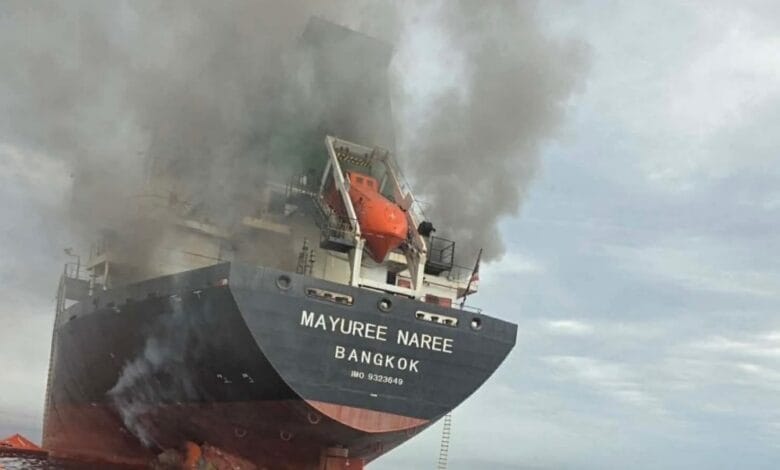
Fatal attacks have occurred. In August 2026, the Tanzanian-flagged cargo ship Tihama was hit by a ballistic missile near Bab al-Mandeb, killing at least 3 to 6 crew members — the first Houthi attack to cause merchant mariner deaths since the U.S.-Iran conflict escalated. This event fundamentally changed risk perceptions: while previous Houthi attacks were frequent, their lethality was relatively contained. The August attack demonstrated that both precision and lethal intent are increasing.
Costs are spreading globally. A European Parliament assessment notes that rerouting has pushed logistics costs up by 30% to 50%, with delays of up to two weeks. Container freight rates from the Far East to the U.S. East Coast have risen 234% year-on-year to $10,249 per 40-foot container. Oil shipping costs reached **$15.22 per barrel** on August 10 — the highest since Argus began assessments in 2005.
IV. Iran’s Strategic Logic: Why Now?
The IRGC’s embedded deployment at Bab al-Mandeb must be understood within Tehran’s broader strategic framework.
The “double pincer” of Hormuz and Bab al-Mandeb. Since the U.S.-Israeli attacks on Iran in February 2026, Tehran has effectively closed or severely disrupted the Strait of Hormuz through military means and threats. Saudi Arabia has been forced to redirect large volumes of oil exports toward the Red Sea via the East-West pipeline to Yanbu. This means Bab al-Mandeb’s irreplaceability for Saudi oil exports is rising — what was once a backup route has become the primary channel.
Iran’s strengthening of Houthi capabilities at Bab al-Mandeb therefore carries an asymmetric leverage effect: Tehran does not need a military presence at Bab al-Mandeb; it only needs the Houthis to possess sufficient surveillance and strike capability to pose a persistent threat to Saudi Arabia’s remaining oil export route. The Houthis’ July declaration of a “maritime blockade” on Saudi Arabia was not bluster — the September attack that forced the closure of the Saudi East-West pipeline demonstrated the threat is operational.
A secondary theater for pressuring Washington. Camp Lemonnier in Djibouti is only about 32 kilometers from Bab al-Mandeb. The Houthis’ military buildup along the Red Sea coast objectively creates proximity deterrence against this key U.S. base in the Horn of Africa. Simultaneously, the disruption of Red Sea shipping exerts pressure on U.S. domestic inflation — diesel prices broke $6 per gallon for the first time in September, a sensitive political variable for the Trump administration ahead of midterm elections.
“Controlled chaos” is preferable to “full closure.” The Houthis’ statement that Bab al-Mandeb remains open to vessels “except Saudi-linked ones” aligns with Iranian interests. A full closure of the strait would invite unified international countermeasures and potentially trigger a large-scale military response. Selective, intermittent risk creation, by contrast, can continuously drive up insurance and shipping costs, force vessels to reroute, while maintaining the diplomatic cover that “we haven’t fully blockaded anything.” The value of radar and tunnel infrastructure lies precisely here: they provide the capacity to continuously generate risk without continuously taking action.
V. The Dilemma of Countermeasures
Facing this situation, the United States and its allies have extremely limited options.
Airstrikes have been tried; their effectiveness is questionable. The U.S. conducted multiple rounds of airstrikes against Houthi targets between 2024 and 2025 but failed to halt the development of their attack capabilities — and may have accelerated the Houthis’ reliance on underground facilities. Tunnel network construction is a direct response to the airstrike threat.
Ground operations are politically unfeasible. Yemen is a country that has endured nearly a decade of civil war. Any large-scale ground intervention would carry enormous political and military risks. Although the Yemeni government forces, backed by Saudi Arabia, attempted to counterattack, they offered almost no effective resistance during the recent Houthi offensive.
Escort operations face diminishing marginal returns. Even if the U.S. assembles a new multinational escort coalition, confronting an adversary that has completed coastal radar coverage and tunnel fortification would make the cost of escorting far exceed the benefits. Moreover, continued tensions in the Strait of Hormuz have already diluted the available U.S. Navy force.
VI. Implications for the Global Economy
The prolonged instability at Bab al-Mandeb is reshaping global shipping patterns in ways far beyond “higher freight rates.”
The “de-Red-Sea-ification” of supply chains may become a permanent trend. Although Suez Canal traffic in July 2026 showed a 42% year-on-year increase due to the Hormuz crisis (some vessels rerouting through the northern Red Sea), overall levels remain far below the 2023 peak. Shipping companies are reassessing the viability of the Red Sea as a routine route. If Iranian and Houthi capacity-building continues, routing around the Cape of Good Hope will shift from “temporary measure” to “new normal.”
Inflationary pressure will become long-term. The European Parliament document explicitly states that rising shipping costs pass directly through to consumer prices. The World Bank projects global inflation at around 4% in 2026, but this forecast may be underestimated due to structural increases in shipping costs.
Energy trade routes are being politically redrawn. Saudi Arabia’s directional shift in oil exports — from the Persian Gulf toward the Red Sea — was originally an emergency measure, but it has now exposed the kingdom to direct Houthi threat. Meanwhile, although Iran’s oil exports remain constrained by sanctions, its ability to “selectively release” vessels through the Strait of Hormuz has, paradoxically, gained greater geopolitical bargaining power amid the crisis.
VII. Conclusion: A Contest of “Persistence”
The true significance of IRGC activity at Bab al-Mandeb is not “what specific equipment was deployed,” but rather the demonstration of strategic patience. Tehran and the Houthis are betting that the international community’s tolerance for Red Sea shipping disruption is finite, and that the willingness of the U.S. and Saudi Arabia to commit sustained military resources is declining.
Radar and tunnels are the material foundation of this bet. They transform the Houthis from a “harasser” into a non-state actor with persistent denial capability. For global shipping, this means the risk premium at Bab al-Mandeb will not disappear with a single airstrike or a single diplomatic statement. It has been embedded into the terrain itself.
For Washington and Riyadh, the real dilemma is this: eliminating this threat requires not more airstrikes, but a ground operation — precisely the option they have spent the past decade avoiding. And time is on Tehran’s side.
The author is a geopolitical analyst focusing on Middle East maritime security and Red Sea strategic affairs. The views expressed are the author’s own and do not necessarily reflect those of any institution.