


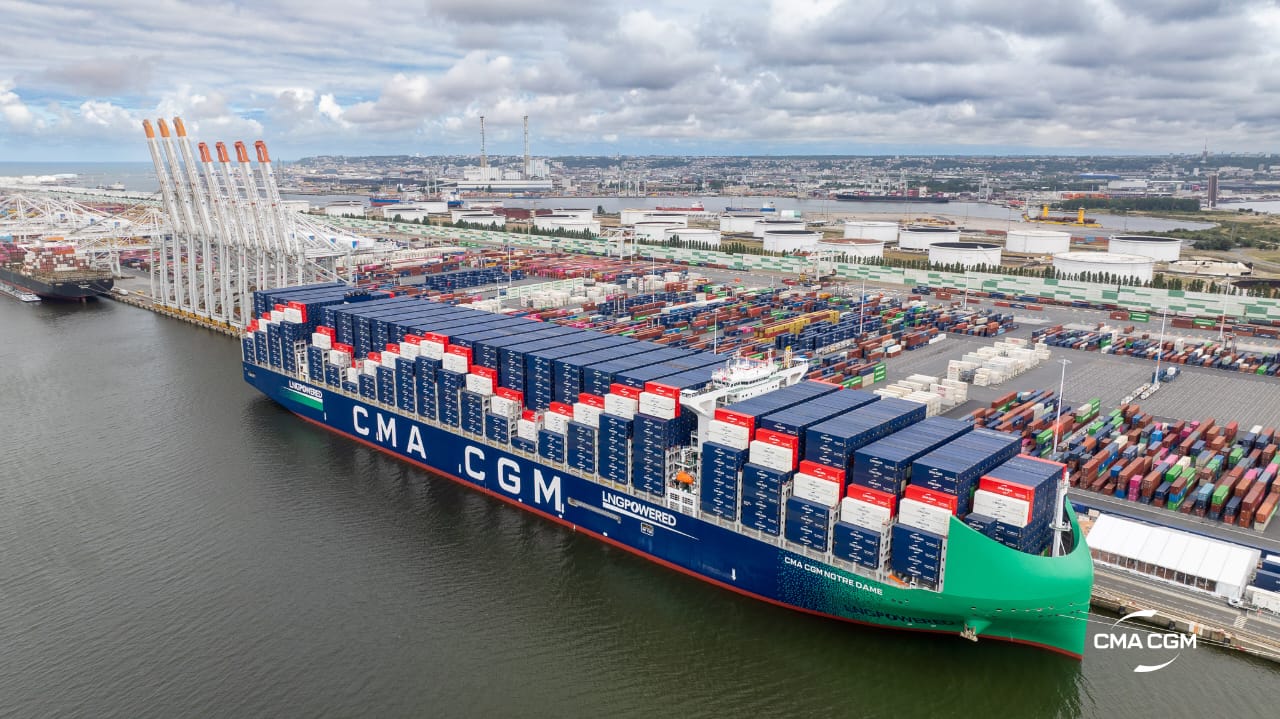
The CMA CGM Notre Dame, a 24,212 TEU liquefied natural gas (LNG) dual-fuel containership nearly 400 metres long and over 61 metres wide, is more than a floating warehouse. Delivered in 2026 as the largest LNG-powered containership under the French flag and the first of a ten-vessel series, it embodies the industry’s relentless pursuit of scale, efficiency, and lower emissions. Equipped with AI-assisted navigation, extensive reefer capacity (around 1,600 plugs), aerodynamic features, and an 18,600 m³ LNG tank designed for Asia-Europe autonomy, the vessel represents a genuine technological leap. Yet the LinkedIn post from Lloyd’s Maritime Institute rightly frames the deeper question: as containerships push beyond 24,000 TEU, what constitutes the biggest challenge—port infrastructure, operational complexity, safety, or environmental performance?
The answer is not singular. These dimensions are tightly interlocked. Ultra-large container ships (ULCS, or Megamax-class vessels) deliver undeniable economies of scale on the high seas, but they transfer diseconomies of scale ashore and expose systemic vulnerabilities across the maritime logistics chain.
Scale’s Double Edge: Economies at Sea, Pressures Ashore
The commercial logic remains powerful. On the Asia-Europe trades—the Notre Dame’s French Asia Line rotation of roughly 102 days, calling at ports such as Shanghai, Singapore, Le Havre, Rotterdam, and Hamburg—larger vessels reduce unit costs for fuel, crewing, and capital per TEU when utilisation is high. Industry data shows the top of the fleet clustered around 24,000 TEU (with some MSC vessels slightly higher), and orderbooks continue to favour this size class. Cascading effects push slightly smaller ships into secondary trades, theoretically optimising the global network.
But theoretical capacity meets operational friction in ports. Berth length, channel and berth depth (often requiring drafts approaching or exceeding 16 metres), crane outreach and height, yard space, and hinterland connections have not scaled uniformly with vessel size. Many terminals, especially common-user facilities, face multi-year, capital-intensive upgrades that lag behind ship deliveries. The post-pandemic period already revealed how peak cargo discharges from these giants can overwhelm labour, trucking, and storage, producing longer port stays that erode the very economies of scale that justified the ships. Studies and industry analyses consistently note longer dwell times for ULCS compared with smaller vessels, turning “efficient” ships into sources of schedule unreliability when ports cannot match their intensity.
Only a limited number of deep-water hubs worldwide can fully accommodate these vessels without constraints. Secondary ports risk marginalisation or forced, costly adaptation as larger ships cascade downward. The result is a concentration of traffic into fewer hubs, reinforcing hub-and-spoke patterns while straining those hubs further. Infrastructure is therefore not merely a supporting actor; it is a binding constraint that can nullify seaborne efficiency gains.
Operational Complexity and the Human-Technology Interface
Scale amplifies complexity. Coordinating the discharge and loading of tens of thousands of containers, managing reefer power and monitoring, sequencing yard operations, and integrating with rail, road, and barge connections demands precision that digital tools and AI can support but cannot fully replace. The Notre Dame’s suite of digital technologies and energy-management systems for reefers illustrates the industry’s response: smarter vessels that optimise navigation, fuel use, and onboard systems.
Yet operational complexity extends beyond the ship. Terminal operating systems, real-time data sharing across stakeholders, and labour coordination must keep pace. When large vessels arrive off-schedule or in clusters, yard planning collapses and landside bottlenecks cascade. Predictive tools help, but they depend on high-quality data, interoperability, and trained personnel—scarce resources in many regions. The skills shortage noted across shipping and ports compounds the problem: operating and maintaining these technologically dense vessels and terminals requires continuous upskilling.
Safety: Managing Extreme Dimensions and Consequences
Safety risks grow with size. Navigating a 400-metre vessel in confined waters, through canals such as Suez, or during berthing demands exceptional situational awareness, tug support, and pilotage. Structural integrity under heavy weather or heavy loading, fire or container-stack stability issues, and the sheer consequences of a grounding or collision involving such a concentrated volume of cargo elevate the stakes. Digital navigation aids and AI can reduce human error, but they introduce new dependencies—cybersecurity, system reliability, and the risk of over-reliance.
Regulatory frameworks and classification societies have adapted, yet the industry must continually stress-test emergency response, salvage capability, and liability regimes for vessels whose cargo value on a single voyage can run into the billions of euros. Safety is therefore inseparable from infrastructure (adequate turning basins, deeper channels) and operational discipline.
Environmental Performance: Progress with Caveats
LNG dual-fuel propulsion is a meaningful step. Compared with conventional heavy fuel oil, LNG sharply reduces sulphur oxides, particulate matter, and nitrogen oxides, and lowers CO₂ emissions. The Notre Dame and its sisters are designed for further gains via bio-LNG or, eventually, synthetic e-methane. Features such as aerodynamic windshields, optimised hull forms, and smart energy systems for reefers reinforce efficiency. CMA CGM’s broader Net Zero by 2050 ambition and the French-flag commitment (including seafarer recruitment) signal strategic intent.
However, LNG is transitional, not zero-carbon. Methane slip remains a concern, although newer engine technologies (including exhaust recycling systems) have made significant reductions. Lifecycle emissions depend heavily on the upstream methane supply chain and whether the fuel is fossil or renewable. True decarbonisation will require scalable green fuels—methanol, ammonia, hydrogen, or advanced biofuels—alongside energy-efficiency measures, slow steaming where viable, and operational optimisation. Larger ships can improve carbon intensity per TEU when full, yet they concentrate environmental risk and demand corresponding infrastructure for alternative-fuel bunkering. Ports that cannot supply low- or zero-carbon fuels will constrain the environmental upside of these vessels.
Environmental performance therefore intersects with all other challenges: infrastructure for bunkering and shore power, operational practices that maximise efficiency, and safety standards for new fuel systems.
Interdependence and the Path Forward
No single factor dominates in isolation. Port infrastructure limitations force operational workarounds that raise complexity and safety risks while limiting the environmental benefits of efficient large ships. Conversely, technological advances on vessels can ease some pressures if ports and supply chains modernise in parallel. The Notre Dame series illustrates both the achievement—French-flagged, technologically advanced, lower-emission capacity on a critical trade lane—and the unfinished business of system-wide adaptation.
Carriers will continue ordering at this scale while the economics favour it, especially amid fuel-price volatility and regulatory pressure. Ports and governments must accelerate coordinated investment in depth, cranes, digitalisation, and alternative-fuel readiness, ideally through public-private partnerships that share risk. Regulators should maintain technology-neutral pathways that reward actual emissions reductions rather than locking in any single fuel. Industry stakeholders need deeper data sharing and standardisation so that digital tools deliver network-level, not just vessel-level, optimisation. Training pipelines for seafarers, terminal operators, and engineers must expand.
The biggest challenge is ultimately systemic alignment. Ultra-large vessels like the CMA CGM Notre Dame prove that naval architecture and marine engineering can deliver extraordinary capacity with improving environmental credentials. The harder task is ensuring that the ports, operations, safety systems, and fuel ecosystems evolve at a comparable pace. Without that synchronisation, the next generation of container shipping risks becoming a story of magnificent ships constrained by the world they serve. The industry’s ability to close that gap will determine whether scale remains a competitive advantage or becomes a structural liability.
Andrew Mwangura is a maritime analyst and shipping industry commentator. The views expressed are the author’s own.