


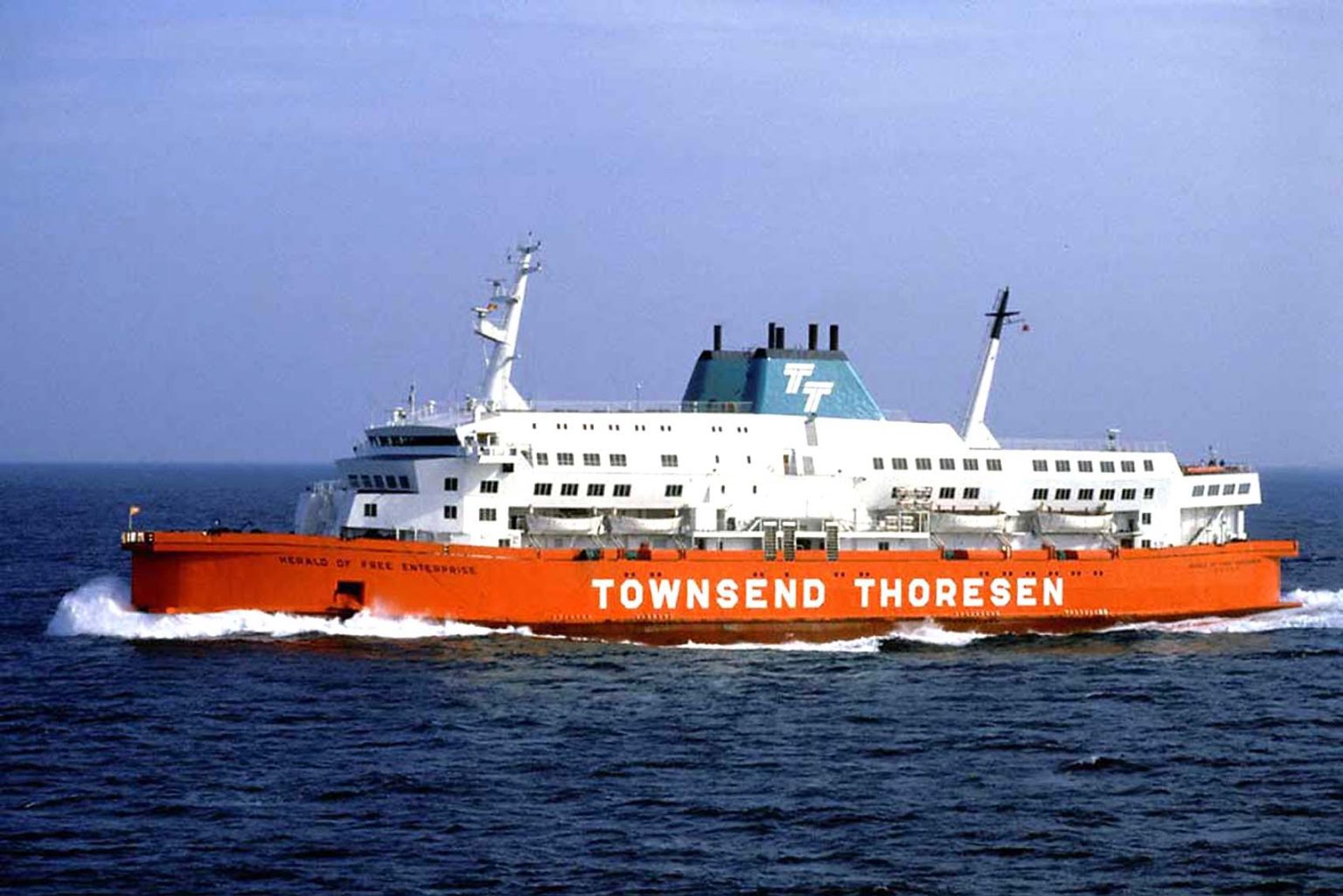
On the evening of March 6, 1987, the roll-on/roll-off ferry Herald of Free Enterprise slipped her berth at Zeebrugge, bound for Dover. Within minutes of clearing the harbor, she lay on her side in the frigid shallows. Nearly 200 people perished in one of Britain’s worst peacetime maritime disasters.
The immediate cause was brutally simple: her bow doors were gaping open. Seawater surged onto the vehicle deck, the free-surface effect gutted her stability, and the ship capsized in roughly 90 seconds. The deeper cause, however, was far more corrosive—a culture that treated critical safety barriers as optional.
The numbers vary in popular memory, but the official inquiry fixed the scale: 459 passengers and 80 crew were aboard; 193 souls were lost. Most died not from the impact, but from hypothermia or drowning, trapped inside the half-submerged hull as she heeled over. The weather was calm. The sea was flat. The enemy was not the elements—it was human systems.
A Chain of Ordinary Failures
The disaster is a textbook case of how minor lapses align into catastrophe. The assistant bosun, tasked with closing the bow doors, was asleep in his cabin. The chief officer failed to verify they were secured before leaving the vehicle deck. The master sailed without positive confirmation that his ship was seaworthy. The bridge lacked indicator lights to show door status. There was no effective system of permits, formal handovers, or isolation protocols that treated the open bow doors as a critical hazard rather than a routine inconvenience.
Once underway, water poured onto the open deck at an alarming rate. The shifting mass of water reduced the ship’s metacentric height (GM) to near zero, inducing a severe heel that proved unrecoverable. The subsequent emergency response was hampered by inadequate command structures, poor lighting, and procedures that had never been realistically tested against a sudden, catastrophic flooding event.
These were not exotic technical failures. They were the predictable result of normalized deviance—doors routinely left open until after departure to save minutes, incomplete shift handovers, and a management culture that dismissed requests for simple bridge indicators as unnecessary or frivolous.
“A Disease of Sloppiness”
The formal investigation, led by Mr. Justice Barry Sheen, did not stop at individual negligence. While he found the master, chief officer, and bosun at fault, he reserved his most damning judgment for the owners, Townsend Car Ferries (Townsend Thoresen). “From top to bottom,” Sheen wrote, “the body corporate was infected with the disease of sloppiness.”
The board had failed to grasp its responsibility for safe management. Clear written instructions on critical duties were absent. Warnings and suggestions from sea staff—including repeated requests for door-status indicators—were ignored or ridiculed. Overloading, inconsistent manning, and poor shore-to-ship communication were routine. This was not a case of a few “bad apples.” It was an organisational system that incentivised speed and cost-cutting while treating the verification of critical barriers as someone else’s problem. Permits, where they existed, were treated as paperwork rather than control systems. Assumptions replaced confirmation. Handovers omitted essential status information. Emergency drills did not stress-test real command and control.
Regulatory Shockwaves
The disaster forced tectonic change. In 1988, the IMO adopted SOLAS amendments requiring bridge indicators for bow doors and water-level detection in ro-ro spaces. Further amendments strengthened damage stability standards (the “SOLAS 90” criteria) and fueled the push for the International Safety Management (ISM) Code. The UK bolstered its investigation capability and ferry-specific regulations. Indicator lights, CCTV monitoring, robust passenger accounting, and formal safety management systems became the norm rather than the exception.
These were hard-won improvements, paid for in lives. The open vehicle deck of a ro-ro ferry remains inherently vulnerable to free-surface flooding; design and operational controls must therefore be correspondingly rigorous. The Herald showed what happens when they are not.
Enduring Lessons for Seafarers and Managers
The practical lessons are as acute today as they were in 1987:
· Critical barriers require positive verification, not assumption or “it has always been fine.”
· Shift handovers must explicitly cover permits, isolations, and residual risks. Incomplete communication is a latent failure waiting for a trigger.
· A permit is a control system, not a rubber stamp. Closing the loop with independent checks is non-negotiable.
· Drills must test actual emergency performance—command, communications, flooding response, and evacuation under realistic pressure—not merely satisfy a checklist.
· Shore management cannot abdicate responsibility. If masters repeatedly flag a problem and the response is indifference, the organisation is already compromised.
These principles extend far beyond ferries. Any high-hazard operation that depends on human performance—openings, isolations, handovers, status confirmation—faces the same risks when “sloppiness” becomes cultural.
Safety Is Systems That Work
The Herald of Free Enterprise was not an act of God or an unforeseeable freak event. It was the product of design assumptions that left the vehicle deck vulnerable, operational practices that normalized open doors, and a management system that failed to enforce basic verification. The ship’s final resting place in shallow water was a grim piece of luck that limited the death toll; had she gone down in deeper water, the tragedy would have been even worse.
Nearly four decades on, the core message endures. Safety is not the absence of previous accidents. It is the presence of systems that actively detect and correct the ordinary human and organisational failures that, left unchecked, align into disaster.
The price of forgetting that lesson was paid on a calm March evening just outside Zeebrugge. Our collective obligation is to ensure it is never paid again.