


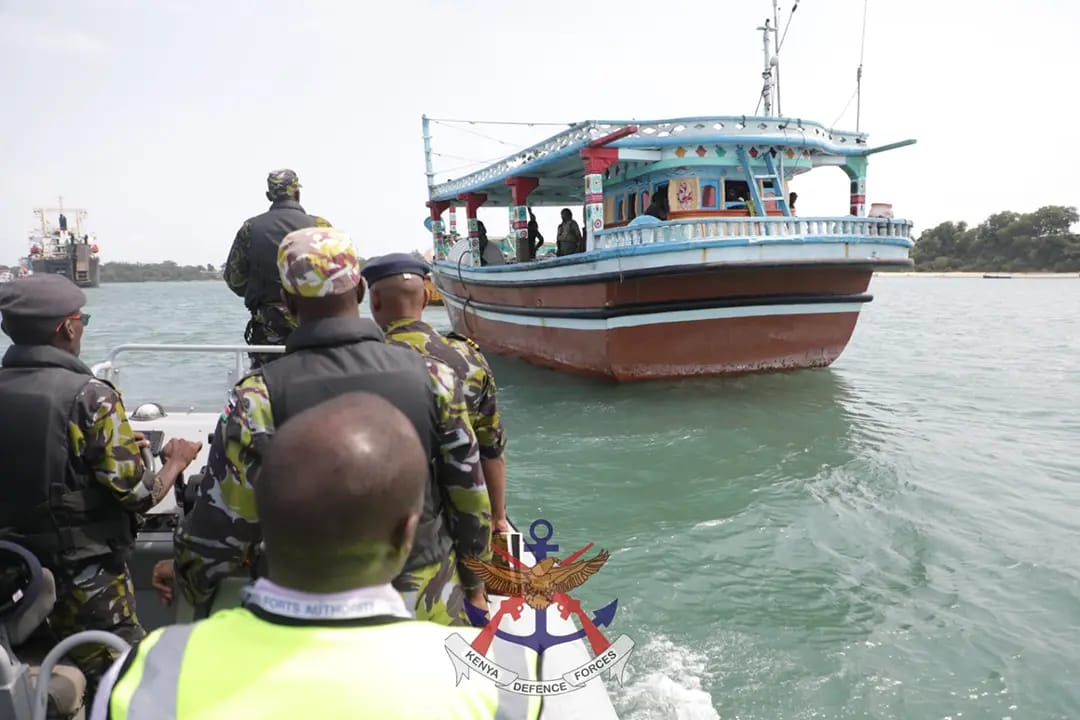
In October 2025, the Kenyan Navy intercepted a modest fishing boat 340 nautical miles off the coast of Lamu. The vessel, the MV Mashallah, bore no registration marks, flew no flag, and appeared unremarkable—a ghost on the water. Yet aboard, authorities discovered over one metric ton of 98%-pure methamphetamine, valued at $63.4 million. Six Iranian nationals were detained. The boat, authorities confirmed, was bound for Kenya.
This single seizure exposes a crisis that spans two of Africa’s most strategically vital maritime basins: the Western Indian Ocean and the Gulf of Guinea. From the coast of Somalia to the shores of Nigeria, small, unregistered vessels have become the silent enablers of a sprawling criminal economy. They traffic drugs, arms, and wildlife; they plunder fisheries; they launch pirate attacks; and they fuel insurgency. And across both regions, governments are struggling to keep pace.
The Invisible Workhorses of Crime
The unregistered vessel is a criminal’s ideal asset. It leaves no paper trail, evades port state controls, and blends seamlessly into the dense coastal traffic of dhows, pirogues, fishing skiffs, and artisanal boats that ply African waters daily. As Willis Okumu, senior researcher at the Institute for Security Studies, observes, “Criminals often operate small vessels without visible national identification to conceal their ownership and easily transport illegal goods.”
This anonymity fuels a diversified criminal portfolio that transcends regional boundaries.
Western Indian Ocean: A Nexus of Drugs, Piracy, and Arms
Drug trafficking remains the most visible manifestation. East Africa, once a transit hub for illegal narcotics, is now becoming a destination market for methamphetamine and heroin. The MV Mashallah seizure was not an isolated incident; it was part of a pattern that includes large-scale interceptions off the coasts of Tanzania, Mozambique, and the Seychelles.
Off the coast of Somalia, unregistered dhows have been repurposed as “mother ships,” launching pirate attacks against merchant vessels and smuggling weapons to al-Shabaab, the Islamist militant group that continues to destabilize the Horn of Africa. In 2023 alone, security forces intercepted a vessel carrying over 2,000 AK-47 rifles destined for al-Shabaab in international waters between Iran and Yemen—a route historically used for arms trafficking to Houthi rebels, who are themselves suspected of supporting the Somali terror group.
Yemen’s Iranian-backed Houthis have deepened their entanglement with al-Shabaab, raising the specter of a more sophisticated maritime arms pipeline. The convergence of state-sponsored proxy warfare and non-state criminal enterprise transforms the Western Indian Ocean into a complex threat environment where the small vessel is the common denominator.
Gulf of Guinea: Piracy, Oil Theft, and Illicit Goods
Eight thousand kilometers to the west, the Gulf of Guinea tells a parallel story—though with its own deadly inflection. The region has long been the global epicenter of maritime kidnapping and armed robbery at sea. According to the International Maritime Bureau, the Gulf of Guinea accounted for over 90% of global seafarer kidnappings in recent years, with unregistered skiffs and speedboats serving as the primary platforms for attack.
But piracy is only one layer. The Gulf is also a theater for large-scale oil theft—or “illegal bunkering”—enabled by small, unmarked tankers that tap pipelines, siphon crude, and disappear into the labyrinthine creeks of the Niger Delta. Nigeria alone loses an estimated $3 billion to $8 billion annually to oil theft, much of it transported on unregistered vessels that evade detection by blending with legitimate traffic.
These same vessels carry smuggled weapons to armed groups in the Sahel and Gulf of Guinea states, including Boko Haram and Islamic State West Africa Province (ISWAP). They transport cocaine from South America destined for European markets—West Africa has become a key transshipment point, with unregistered fishing trawlers often used to meet mother ships off the coast. They also carry stolen timber, ivory, and pangolin scales to Asian markets, mirroring the wildlife trafficking networks observed in the Indian Ocean.
Piracy’s Resurgence and Geopolitical Ripple Effects
Regional instability has created a permissive environment for maritime crime across both basins.
In the Western Indian Ocean, the disruption of shipping routes in the Red Sea and Gulf of Aden—driven by Houthi attacks on commercial traffic—has forced vessels to take longer, more costly detours around the southern tip of Africa. This rerouting has inadvertently re-opened opportunity spaces for Somali pirates. After years of relative quiet, incidents spiked sharply in April 2025, with seven attacks recorded that month alone. By late August, the Indian Navy, the UK Maritime Trade Operations Centre, and the Horn of Africa Maritime Security Centre had logged 29 Somali piracy incidents.
In the Gulf of Guinea, a similar dynamic is at play. The decline of international naval presence—as Western navies redirect assets to the Red Sea and the Indo-Pacific—has created a security vacuum. Local navies, underfunded and overstretched, are left to patrol vast maritime domains with aging equipment. Pirates and oil thieves have exploited this gap, pushing attacks further offshore and into increasingly brazen operations.
The Silent Ecological Emergency
Beyond security, unregistered vessels are devastating Africa’s blue economy through illegal, unreported, and unregulated (IUU) fishing—a crisis that affects both regions with equal severity.
Western Indian Ocean
Somalia alone loses an estimated $300 million annually to IUU operations. Zanzibar, a semiautonomous Tanzanian archipelago, loses approximately $415 million each year—a staggering figure for an economy deeply dependent on fisheries. Kenya, Tanzania, Mozambique, and Madagascar report similar losses, with foreign-flagged but unregistered vessels often operating with impunity in exclusive economic zones.
Gulf of Guinea
The story is no less dire. West Africa loses an estimated $2.3 billion annually to IUU fishing, according to the Food and Agriculture Organization. Unregistered trawlers from Asia and Europe, operating under flags of convenience, deplete fish stocks that sustain millions of coastal livelihoods. In Nigeria, Ghana, and Côte d’Ivoire, artisanal fishermen report dwindling catches and increasing competition from industrial-scale illegal operators. The use of prohibited gear, including bottom trawls and dynamite fishing, destroys marine habitats and kills juvenile fish, threatening the long-term viability of fisheries.
The ecological and economic impacts are inseparable from security. As legal fishing grounds empty, desperation grows, and vulnerable coastal populations become more susceptible to recruitment by criminal networks, pirate gangs, or extremist groups. The unregistered vessel, in this sense, is not merely a delivery mechanism for contraband—it is a driver of human insecurity.
Wildlife Trafficking: A Shared Scourge
Smaller, unregistered vessels are also used to illegally transport wildlife from Africa to Asian markets—a practice that flourishes in both regions.
In the Western Indian Ocean, Okumu notes that these vessels are used to smuggle turtles from Madagascar and rhinoceros horns from northern Mozambique to larger ships in the Indian Ocean. The Comoros, Seychelles, and the Tanzanian coast serve as transit points for shark fins, sea cucumbers, and rare shells.
In the Gulf of Guinea, similar networks operate along the coast from Senegal to Angola. Unregistered pirogues transport ivory from Central Africa to ports in Nigeria and Benin, where it is loaded onto larger vessels bound for Southeast Asia. Pangolin scales—the world’s most trafficked mammal—move along the same routes, often concealed in fishing vessels that evade customs inspections.
These trafficking networks are increasingly interconnected. Intelligence suggests that the same criminal syndicates that move narcotics across the Indian Ocean also coordinate wildlife shipments in the Gulf of Guinea, leveraging overlapping logistics and corrupt port officials to sustain their operations.
The Nexus of Terrorism and Maritime Crime
Across both regions, unregistered vessels serve as a logistical lifeline for terrorist and insurgent groups.
In the Western Indian Ocean, al-Shabaab relies on maritime supply chains to import weapons, explosives, and fuel. The 2023 interception of a vessel carrying 2,000 AK-47 rifles destined for the group underscores the scale of these operations. Similarly, ISIS-affiliated groups in northern Mozambique—the so-called Ahlu Sunnah Wa-Jama (ASWJ)—have used small boats to resupply their insurgent camps along the Cabo Delgado coast, often operating from the Mafia Archipelago and other offshore islands.
In the Gulf of Guinea, Boko Haram and ISWAP have been linked to smuggling networks that move weapons and ammunition through the Lake Chad basin and along coastal creeks. Nigerian authorities have repeatedly intercepted unregistered vessels carrying arms from Cameroon and Equatorial Guinea, destined for insurgent strongholds in the northeast. The porous maritime borders of the Gulf of Guinea make such trafficking difficult to detect and even harder to interdict.
The overlap between terrorism and organized crime is not coincidental. As Okumu has argued, “Although drug trafficking is the most visible manifestation, these vessels support a vast criminal economy” that finances and sustains armed groups across the continent.
Limited Patrolling Capacity: The Structural Weakness
Across both basins, limited patrolling capacity exacerbates the problem. Vast maritime jurisdictions stretch beyond the reach of naval resources, and unregistered vessels exploit these gaps with impunity.
Western Indian Ocean
The Combined Maritime Forces, a multinational naval partnership, operates in the region but focuses primarily on counter-piracy and counter-terrorism. Fisheries enforcement, wildlife trafficking, and drug interdiction often fall to national navies with limited budgets and aging fleets. Kenya, Tanzania, and Mozambique have made strides in recent years, but their capabilities remain far from sufficient to police their exclusive economic zones.
Gulf of Guinea
The Gulf of Guinea faces even greater challenges. The Yaoundé Architecture, a regional framework for maritime security established in 2013, has improved information-sharing and coordination, but implementation remains uneven. Many West African navies lack the vessels, fuel, and training to conduct sustained patrols. The region’s maritime domain is vast—stretching from Senegal to Angola—and the criminal networks that operate within it are agile, adaptive, and well-resourced.
A 2024 report by the Stable Seas organization found that less than 10% of the Gulf of Guinea’s maritime domain is effectively patrolled, leaving the vast majority of waters open to exploitation. The same report noted that unregistered vessels account for the majority of illegal activities in the region, underscoring the urgency of targeted interventions.
A Path Forward: Regional Intelligence and Community Surveillance
Okumu has called for a “sustained regional strategy” that “combines regional and state intelligence with community-led surveillance.” This dual approach is critical—and it applies equally to both maritime basins.
Community-Led Surveillance
Community-led surveillance—rooted in the knowledge of local fishermen, port workers, and coastal residents—can identify suspicious vessels before they reach high seas. It is cost-effective, culturally embedded, and difficult for criminals to evade. When paired with state intelligence and regional information-sharing mechanisms, it creates a layered defense that closes the gaps criminals currently exploit.
In the Western Indian Ocean, the Jahazi Project—launched in September 2025 by Ascending Africa, a pan-African organization—offers a promising model. The project brings together Comoros, Kenya, Madagascar, Mauritius, Mozambique, Seychelles, Tanzania, and Zanzibar in a coordinated effort to combat illegal fishing and strengthen maritime security. The first phase will target coastal areas near Kenya, Mozambique, and Tanzania, establishing community-driven marine conservation zones and supporting joint surveillance patrols.
“The Blue Economy has enormous potential for East Africa, but this promise is at risk,” Michael Mallya, a project spokesperson, told the International Collective in Support of Fishermen. “With the Jahazi Project, we are committed to joining forces, intensifying efforts, and ensuring that our oceans remain abundant for future generations.”
Gulf of Guinea Parallels
Similar initiatives are taking root in the Gulf of Guinea. The Benin-led “Operation Prosperity” has demonstrated the value of joint patrols and information-sharing among West African navies. The Gulf of Guinea Maritime Security Strategy, adopted in 2021, provides a framework for cooperation, but funding and political will remain inconsistent.
Community engagement offers a cost-effective complement to naval operations. In Nigeria’s Niger Delta, local fishermen have partnered with the Nigerian Navy to report suspicious vessels and activities. These grassroots efforts have led to several successful interdictions, though they remain localized and under-resourced.
Vessel Registration and Tracking
A more ambitious approach involves mandatory vessel registration and tracking systems. For small vessels—often less than 10 meters in length—cost-effective tracking technologies such as satellite-based Automatic Identification Systems (AIS) can now be deployed at scale. While not a silver bullet, such systems would make it significantly harder for unregistered vessels to operate anonymously.
Regional port state controls also require strengthening. Harmonized inspection protocols, shared databases of suspicious vessels, and coordinated enforcement actions could dramatically reduce the operational space for unregistered ships.
Conclusion: The Cost of Inaction
The MV Mashallah was not an anomaly; it was a warning. The one metric ton of methamphetamine it carried was valued at over $63 million—enough to fuel addiction, corruption, and violence across East Africa. But beyond the headline-grabbing seizure lies a deeper truth: unregistered vessels are the infrastructure of a maritime criminal economy that spans the entire African coastline, from the Horn to the Gulf.
They carry drugs to Kenya and cocaine to Nigeria. They smuggle weapons to al-Shabaab and Boko Haram. They steal oil from the Niger Delta and fish from Somali waters. They traffic ivory from Central Africa and pangolin scales from West Africa. They are the common denominator in a web of threats that undermines sovereignty, threatens lives, and strips coastal communities of their future.
Africa cannot afford to treat these vessels as a secondary concern. The same anonymous dhows that evade fisheries patrols in the Indian Ocean may tomorrow launch a pirate attack or offload weapons to an extremist group—just as the same unmarked skiffs that siphon crude in the Gulf may next week deliver arms to insurgents in the Sahel. The interconnectedness of these threats demands an interconnected response—one that fuses intelligence, community engagement, and regional cooperation.
The sea has always been a source of livelihood and connection for Africa. It has also, increasingly, become a highway for crime. The continent now faces a choice: continue to police the symptoms, or address the vessel itself. If the latter path is taken, the solution lies not in more ships alone, but in smarter surveillance, stronger partnerships, and a recognition that the smallest boats often carry the largest risks.
The views expressed in this article are solely those of the author and do not necessarily reflect the official policy or position of any government agency or institution.