


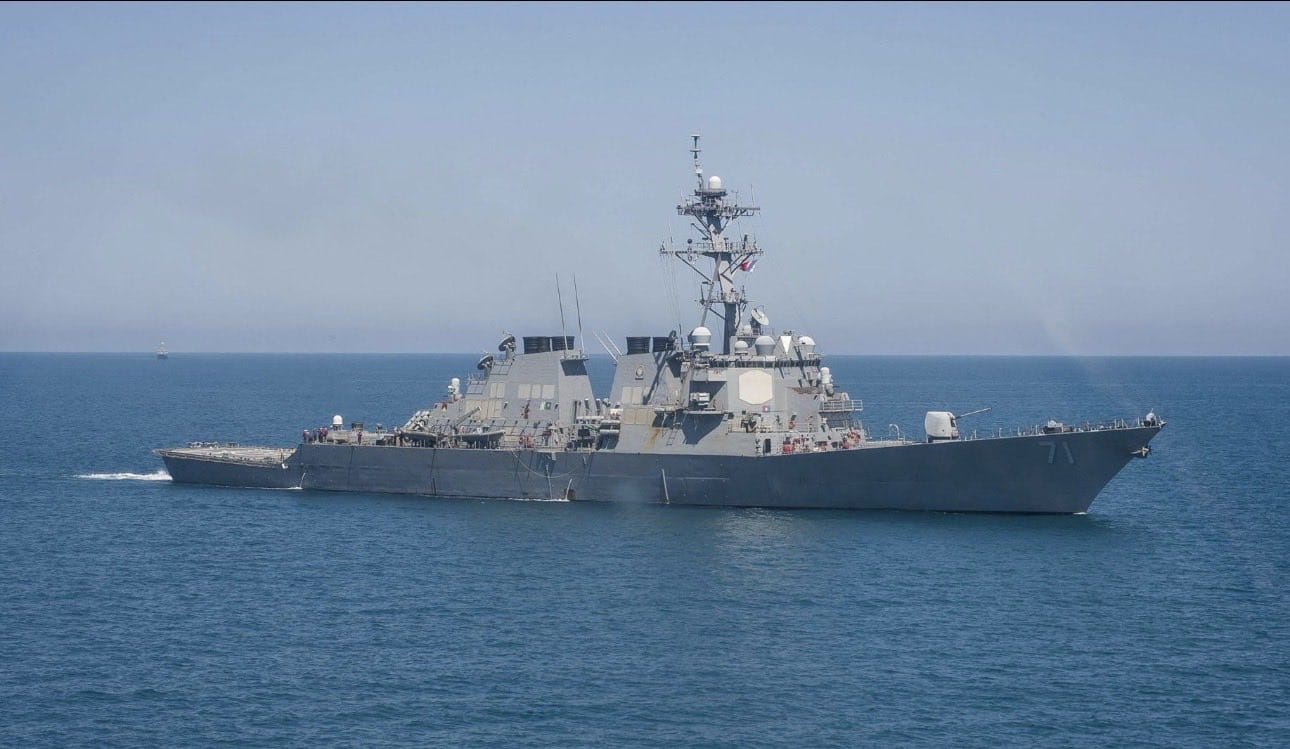
The arrival of the USS Ross (DDG-71) in Mombasa on September 5 is being presented as a routine port visit. On the surface, that description is accurate. The Arleigh Burke-class guided-missile destroyer needs rest, resupply, maintenance, and engagement with a partner navy. Yet the timing, the ship’s recent operational history, and the broader strategic context make the stop far more revealing than a simple liberty call.
The Ross is no ordinary patrol vessel. It is a multi-mission Aegis destroyer designed for air defence, anti-surface and anti-submarine warfare, and sustained blue-water operations. It deployed in late March 2026 as part of the George H.W. Bush Carrier Strike Group (Carrier Strike Group 10). Since April, it has operated in the U.S. Fifth Fleet area of responsibility, supporting Operation Epic Fury and the associated maritime blockade against Iran. U.S. Central Command imagery from late August still showed the ship conducting flight operations in the region. Its presence in Kenya now places a front-line combatant—fresh from high-tempo Middle East duty—under Sixth Fleet operational control in East African waters.
Mombasa as a Logistics Node
A U.S. warship making a scheduled port call allows the crew to recover while the ship undergoes voyage repairs and logistics. U.S. Navy procurement records confirm that voyage-repair work for the Ross was arranged in Mombasa, covering tasks such as lagging and insulation replacement, valve corrections, and heavy-lift support. This is not ceremonial diplomacy. Mombasa is providing tangible maintenance and sustainment support to a deployed American combatant after months of operations farther north.
The practical utility is clear. Access to reliable regional ports enables the Navy to maintain readiness without the long transit back to traditional hubs. For Kenya, hosting such work builds technical familiarity, generates local economic activity, and deepens operational ties with the world’s most capable navy.
The Western Indian Ocean’s Growing Importance
Kenya sits astride maritime routes that link East Africa to the Red Sea, Gulf of Aden, Arabian Peninsula, and the wider Indian Ocean. These sea lanes carry energy, containers, and bulk cargo critical to global trade. Instability around the Bab el-Mandeb, residual piracy risks, trafficking networks, and the persistent threat from al-Shabaab and ISIS affiliates make the Western Indian Ocean a zone of enduring concern.
Washington values partners who can help monitor activity, interdict illicit flows, protect commercial shipping, and contribute to regional stability. Nairobi gains access to training, technology, intelligence cooperation, and maritime-security capabilities that would be prohibitively expensive to develop alone. The relationship is mutually reinforcing. Kenya participates regularly in Exercise Cutlass Express, the U.S.-sponsored multinational maritime-security exercise focused on the East African coast and Western Indian Ocean. That exercise builds capacity against illicit sea-based activity and improves interoperability among partners. The Ross visit sits squarely inside this established pattern of cooperation.
Strategic Weight Without Overstatement
It would be a mistake to interpret the Mombasa stop as evidence that Kenya is being drawn into the U.S.-Iran confrontation. There is no indication Kenya is participating in Operation Epic Fury or the blockade. Official statements from both the U.S. Navy and the U.S. Embassy in Nairobi frame the visit around the longstanding security partnership, shared interests in regional stability, and the practical need for logistics and crew rest. The more defensible reading is straightforward: a high-end U.S. destroyer coming off demanding Middle East operations is using a trusted Kenyan port for sustainment while Washington continues to invest in its relationship with Nairobi.
At the same time, the platform itself carries weight. An Arleigh Burke-class destroyer is a sophisticated sensor and weapons node. Its presence signals U.S. attention to the Western Indian Ocean at a moment when the region is becoming more contested. Chinese naval activity has grown steadily. People’s Liberation Army Navy escort task forces maintain a near-continuous presence in the Gulf of Aden, and Chinese warships have made technical stops in Mombasa in recent years. Ports and maritime infrastructure across the region are objects of competition. Kenya’s ability to host both U.S. and Chinese vessels underscores its strategic autonomy while also highlighting why reliable partners matter to Washington.
Why Kenya Matters
For the United States, Kenya remains one of the most capable and willing security partners in East Africa. Cooperation spans counterterrorism, maritime domain awareness, training, and logistics access. For Kenya, the partnership delivers concrete benefits: professional military education, equipment support, intelligence sharing, and the prestige and practical advantages of working with a first-tier navy. The relationship is transactional in the best sense—each side gains capabilities and influence it could not easily secure alone.
The Ross visit is another data point in a longer trend. Mombasa is evolving into a more important logistics and security node in the Western Indian Ocean. Kenya’s strategic value to Washington extends beyond the fight against al-Shabaab and beyond East Africa itself. It sits at the intersection of energy routes, commercial shipping, great-power competition, and regional stability challenges. A guided-missile destroyer that has just supported major operations in the Middle East docking in Mombasa is not a coincidence of the sailing schedule. It is a quiet acknowledgment of that geography and of the partnership required to operate effectively across it.
The surface story remains correct: this is a scheduled port visit. The deeper story is that the United States continues to treat Kenya as a serious maritime partner at a time when the Western Indian Ocean is no longer a strategic afterthought.
Andrew Mwangura is a maritime analyst and commentator on regional trade, maritime education and training, security, and logistics in the Gulf of Guinea, Gulf of Aden and the Western Indian Ocean.