


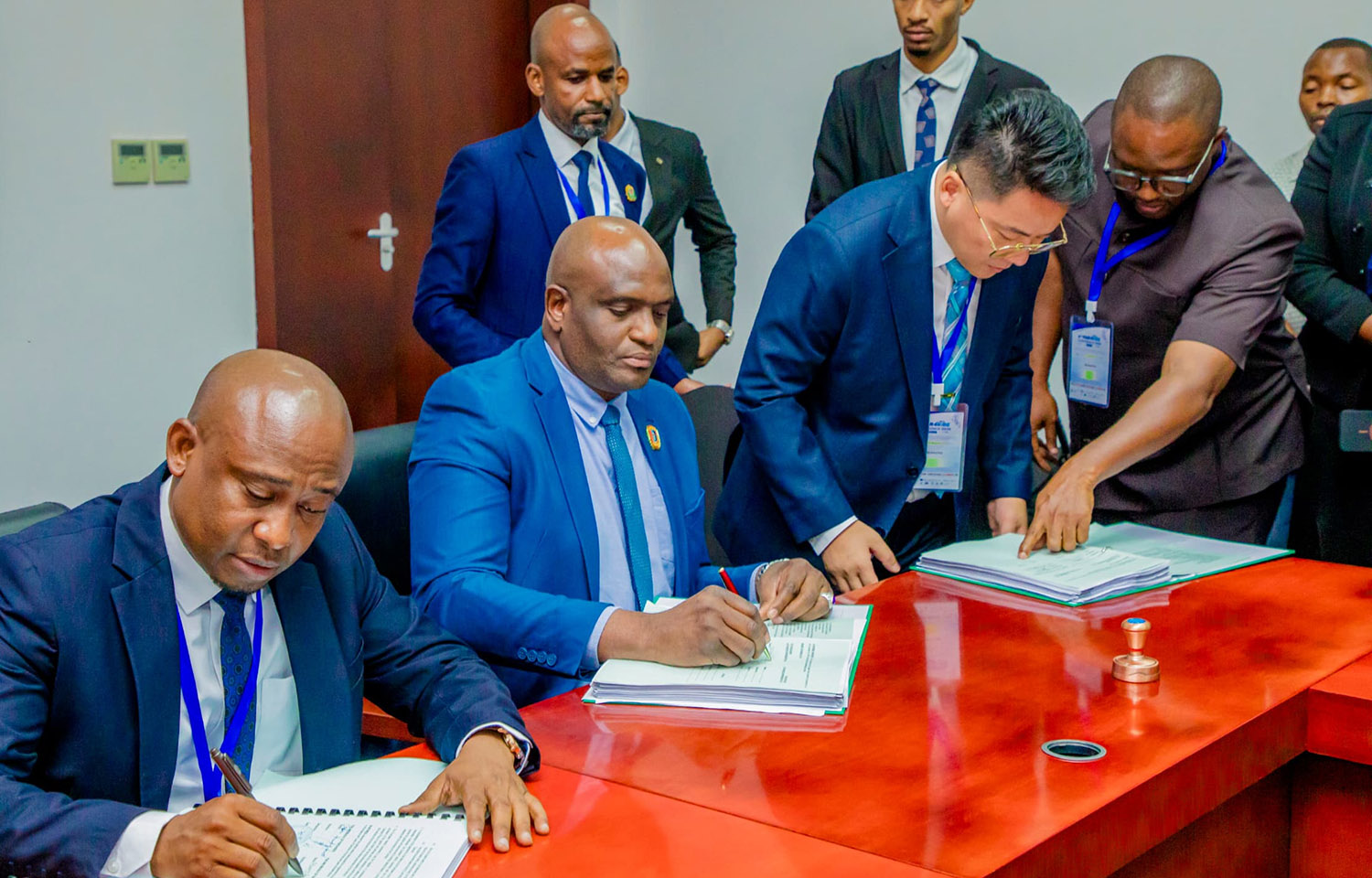
Tanzania has taken a concrete step toward asserting greater control over its vast Exclusive Economic Zone by awarding a Chinese shipyard the contract to build three deep-sea fishing vessels. The deal, signed by the state-owned Tanzania Fisheries Corporation (TAFICO) with Rongcheng Xinyang Shipbuilding Co., a subsidiary of Weihai Jinyang Shipbuilding, forms part of the International Fund for Agricultural Development’s Agriculture and Fisheries Development Programme. It is a logical, even overdue, move for a country whose marine resources have long been under-exploited by its own fleet and over-exploited by others. Yet the choice of partner, the broader pattern of Chinese involvement in Tanzania’s blue economy, and the persistent gaps in skills, enforcement, and governance raise uncomfortable questions about whether this is genuine capacity-building or another chapter in Africa’s familiar story of foreign-enabled resource extraction.
Tanzania’s EEZ covers roughly 223,000 square kilometres and holds significant tuna and other high-value pelagic stocks. Total fish production sits around 600,000 metric tons, well short of domestic demand estimated at 1.3 million tons. Deep-sea operations have historically been dominated by foreign vessels—many Chinese, Spanish, and others—while local capacity has been limited to artisanal and near-shore efforts. The Deep Sea Fisheries Management and Development Act, now about six years old, was designed precisely to address inadequate vessels, weak surveillance, and illegal, unreported and unregulated (IUU) fishing. Revenue from deep-sea licences has been modest: in the 2025/2026 fiscal year, permits generated about TZS 7.5 billion against a higher target. TAFICO and the Deep Sea Fishing Authority (DSFA) plan six vessels in total—four for the mainland and two for Zanzibar—to change that equation, create jobs, generate licence revenue, and improve food security.
The Chinese connection is not isolated. China Harbour Engineering Company has nearly completed the Kilwa Masoko fishing harbour, Tanzania’s first modern large-scale facility capable of handling deep-sea vessels, cold storage, processing, and an expected annual throughput of 60,000 tonnes. That project has generated local construction jobs and skills transfer, and it is frequently framed as Belt and Road cooperation delivering tangible infrastructure. Pairing a Chinese-built port with Chinese-built vessels creates a coherent, if dependent, logistics chain.
There is a darker recent history that cannot be ignored. Investigations by the Environmental Justice Foundation have documented systemic problems with Chinese distant-water vessels in the Southwest Indian Ocean, including Tanzanian waters: shark finning (explicitly banned under Tanzanian regulations), under-reporting, absconding from inspections, and labour abuses. Some vessels linked to companies such as Shandong Zhonglu returned to Tanzanian waters after earlier suspensions. Tanzania’s own audits and parliamentary reports have highlighted substantial losses from IUU fishing more broadly, weak vessel registration, and limited enforcement capacity. Granting Chinese firms a larger role in building the national fleet therefore carries reputational and practical risk: the same industrial ecosystem accused of depleting stocks and flouting rules is now positioned as the solution.
Proponents will correctly note that ownership of the vessels will rest with Tanzanian state entities, that IFAD financing imposes development conditionalities focused on inclusive food systems and resilience, and that the alternative—continued reliance on foreign-flagged fleets—has delivered limited local benefits. A domestically controlled fleet can, in principle, increase domestic catch share, support value-addition onshore, and strengthen the government’s bargaining position when issuing future licences. President Samia Suluhu Hassan has already launched Tanzania’s first deep-sea vessel (Japanese-built) and spoken of reclaiming resources long dominated by outsiders. The new Chinese vessels extend that logic.
Yet hardware alone will not solve the soft constraints. DSFA has openly acknowledged shortages of skilled manpower to operate vessels in the EEZ. Without aggressive, sustained training programmes, Tanzanian crews risk remaining junior partners on vessels that are Tanzanian-flagged but Chinese-maintained and perhaps Chinese-crewed in key roles. Maintenance, spare parts, and dry-docking capabilities are also thin; dependence on the builder’s after-sales network could lock in long-term costs and technology ties. Sustainability is another open question. Adding industrial capacity without corresponding investments in science-based quotas, electronic monitoring, observer programmes, and port-state measures risks simply accelerating local overcapacity or displacing effort into already stressed near-shore zones.
Small-scale fishers, who still supply the overwhelming majority of Tanzania’s catch, have reason for wariness. Industrial modernisation elsewhere in Africa has sometimes squeezed artisanal operators through competition for space, baitfish, or markets, or by driving debt-financed “modernisation” schemes that leave communities worse off. Tanzania’s own experience with boat distribution programmes has produced mixed results, including higher operating costs and pressure toward riskier or illegal practices. The AFDP’s inclusive framing is welcome, but delivery will determine whether coastal communities become partners or bystanders.
The strategic dimension also matters. China’s distant-water fleet is the world’s largest, driven by depleted domestic stocks and state support. Expanding shipbuilding and port footprints in Africa helps secure both supply and influence. Tanzania is not unique; similar patterns appear across West Africa and the Indian Ocean. For Dar es Salaam, the calculus is pragmatic: Chinese firms offer competitive pricing, financing pathways, and speed that Western or Japanese alternatives may not match at the same scale. The risk is gradual erosion of policy autonomy if debt, technology lock-in, or political goodwill become the price of continued access to Chinese capital and markets.
A responsible path forward requires more than signing ceremonies. Tanzania should insist on meaningful technology and skills transfer clauses, local content requirements for crew and maintenance, and independent monitoring of the vessels’ operations once delivered. Licence revenue and catch data must be transparently published. The government should accelerate investments in surveillance—patrol vessels, satellite monitoring, and regional cooperation through the Indian Ocean Tuna Commission—so that the new fleet becomes a tool of sovereignty rather than a symbol of it. Diversifying future vessel procurement across suppliers would reduce concentration risk. Above all, the blue economy strategy must prioritise science-based management over volume maximisation; the EEZ is finite, and depleted stocks help neither Chinese shipyards nor Tanzanian fishers.
Tanzania is right to build its own deep-sea capacity. Leaving the EEZ to foreign fleets was never a viable long-term strategy. Choosing Chinese builders is a rational commercial decision given the alternatives on offer. But rationality is not the same as strategy. Without rigorous attention to skills, enforcement, sustainability, and diversified partnerships, the three vessels risk becoming expensive monuments to ambition rather than engines of lasting national wealth. The fish are there. Whether Tanzanians will ultimately own the value they generate remains the harder question.