


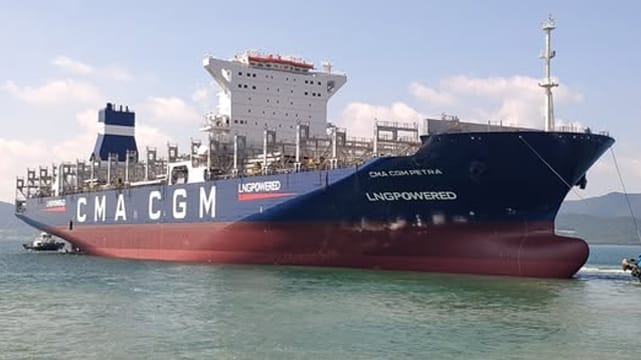
The declaration of General Average (GA) on the CMA CGM Petra is not merely another casualty notice in the shipping press. It is a sharp reminder that the centuries-old principle of shared sacrifice still governs modern container shipping—and that many cargo interests remain dangerously unprepared for it.
On or about 22–23 August 2026, the French-flagged, LNG-dual-fuel containership CMA CGM Petra (approximately 8,000–8,048 TEU, delivered late 2024) suffered a cargo-hold fire while transiting the Strait of Malacca on the KILIMA Asia–East Africa service, en route from Singapore toward Lamu, Kenya, with further calls including Mombasa and Dar es Salaam. The crew initially contained the blaze; professional salvors—reportedly SMIT under a Lloyd’s Open Form arrangement—assisted with firefighting. No crew injuries or pollution were reported. The vessel later proceeded to Port Klang, Malaysia, where roughly 450 containers are being discharged for inspection. In mid-September 2026, CMA CGM formally declared General Average and appointed Albatross Adjusters as average adjusters. Cargo interests must now provide GA security before their cargo can be released.
This is the second CMA CGM containership fire in the Malacca Strait within about a year, following the CMA CGM J. Madison incident in August 2025. It fits a broader pattern of container-ship fires that insurers, the World Shipping Council, and industry bodies continue to flag as a persistent threat—often linked to misdeclared or inadequately packed hazardous cargo, including lithium batteries and other high-risk goods.
What General Average Actually Means
General Average is one of the oldest doctrines in maritime law. Under the York-Antwerp Rules, incorporated into most bills of lading, a GA act occurs when an extraordinary sacrifice or expenditure is intentionally and reasonably made or incurred for the common safety, to preserve the property involved in a common maritime adventure from peril. Classic examples include jettisoning cargo to lighten a vessel or, more commonly today, the extraordinary costs of firefighting, salvage, and deviation to a port of refuge.
The losses and expenses are then shared proportionally among all parties whose property was at risk and was saved—ship, cargo, and sometimes freight or bunkers—based on their arrived values. The average adjuster calculates the contributions. Until security is provided, typically a GA bond plus a cash deposit or insurer’s guarantee, the carrier can exercise a possessory lien and withhold delivery. The process can take months or years; interim cash deposits are common while the final adjustment is prepared.
In the Petra case, the extraordinary costs include professional salvage, firefighting support, deviation, and the inspection and discharge of hundreds of containers. Even cargo completely undamaged by fire, heat, smoke, or water can be required to contribute. That is the equitable logic of GA: those who benefit from the successful preservation of the adventure share the cost of the measures that saved it.
Practical Consequences for Cargo Interests
For shippers, consignees, and freight forwarders with cargo on the Petra, the immediate practical effects are clear:
· Release of cargo is blocked until GA security is posted.
· Physical damage risks remain. Fire, heat, smoke, and firefighting water can affect containers far from the seat of the fire.
· Delays compound. The vessel missed scheduled calls; East Africa-bound cargo faces weeks or longer of disruption.
· Additional costs may arise beyond pure GA contributions—survey fees, storage, on-forwarding, and potential particular average claims.
· Insurance is not automatic cover. Cargo insurance policies typically respond to GA contributions if the policy is properly worded and the peril is covered, but deductibles, exclusions, policy limits, and claims procedures matter. Insurers often provide the required guarantee, yet the cargo owner must still engage promptly and correctly.
Freight forwarders who simply “move boxes” without educating customers about these risks are exposed—commercially and reputationally. As the original LinkedIn post correctly noted, a competent logistics service does more than transport cargo; it helps customers understand and manage the risks along the way.
Why This Keeps Happening—and What Must Change
Container-ship fires are not rare anomalies. They remain a leading cause of major casualties, driven by the volume and complexity of modern cargoes, inadequate declaration of dangerous goods, and the practical limits of firefighting on large vessels. The Petra—a nearly new LNG-powered ship on a relatively standard trade—shows that modern design and dual-fuel technology do not eliminate the risk.
Industry responses have focused on tighter rules for lithium batteries, charcoal, and other high-risk cargoes, better detection systems, and improved crew training. Those efforts are necessary but insufficient without parallel action on the commercial and insurance side:
· Pre-shipment education must become standard. Forwarders and carriers should systematically explain GA, the need for adequate cargo insurance, and the practical steps required after a casualty before cargo is booked.
· Insurance arrangements must be verified, not assumed. “We have insurance” is meaningless without confirming that the policy covers GA contributions, provides for security in the required form, and involves an insurer prepared to act quickly.
· Documentation discipline matters. Prompt notice, preservation of rights, and early engagement with adjusters, surveyors, and insurers protect recovery prospects and speed release.
· Risk allocation in contracts must be clear. Bills of lading, booking notes, and insurance certificates should leave no ambiguity about who bears GA exposure and how security will be handled.
The Petra incident also underscores a structural tension: the carrier incurs the immediate extraordinary costs to save the common adventure, then recovers proportionally from cargo. That allocation is intentional and equitable under maritime law. Complaints that “undamaged cargo must still pay” miss the foundational principle. The alternative—leaving the entire cost on the shipowner—would create perverse incentives and higher freight rates for everyone.
A Call for Realism, Not Complacency
General Average is not an archaic curiosity. It remains highly relevant precisely because modern containerships carry enormous aggregate values and face real, recurring perils. The CMA CGM Petra declaration is a live case study in how that principle operates in 2026.
Cargo owners who treat insurance as a checkbox, and forwarders who treat risk communication as optional, will continue to be surprised when the next fire, grounding, or salvage operation triggers a GA call. Those who treat maritime risk as a core part of the logistics conversation—explaining the rules, verifying cover, and preparing contingency processes—will protect their customers, their own businesses, and the integrity of the supply chain.
The Strait of Malacca fire on the Petra has already produced extraordinary costs that will be shared. The more lasting cost will be measured in how many in the industry still treat General Average as someone else’s problem.
Andrew Mwangura is a maritime safety and security analyst.