


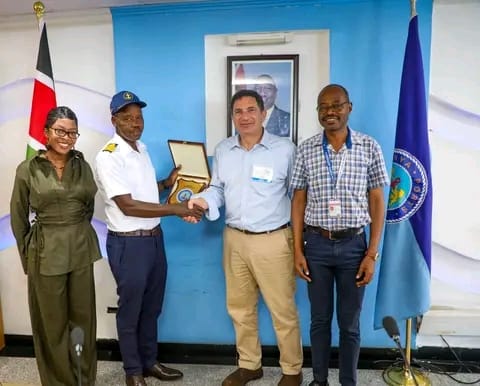
The recent visit by beneficiaries of the National Committee on U.S.-China Relations Program to the Port of Mombasa was far more than an educational tour. It was a powerful affirmation that Kenya’s premier seaport has emerged as a globally recognized exemplar of how international cooperation, strategic leadership, and sustained investment can transform maritime infrastructure into a catalyst for regional prosperity.
In welcoming the delegation, Kenya Ports Authority Chief Executive Officer Capt. William Ruto underscored an important reality: the remarkable transformation of the Port of Mombasa has been made possible through productive partnerships with nations across the world, including the United States and China. These partnerships should not be viewed through the narrow lens of geopolitical competition. Rather, they demonstrate that when countries collaborate around shared economic interests, the ultimate beneficiaries are citizens, businesses, and regional economies.
For decades, the Port of Mombasa has served as the maritime gateway for Kenya and the wider East and Central African region. Today, it connects more than 300 million people across Kenya, Uganda, Rwanda, Burundi, South Sudan, the eastern Democratic Republic of Congo, and northern Tanzania to global markets. As international trade continues to evolve, ports are no longer merely points where ships load and discharge cargo. They have become sophisticated logistics ecosystems that determine the competitiveness of entire economies.
The Port of Mombasa has embraced this transformation with remarkable success. Massive investments in modern berths, container terminals, road and rail connectivity, cargo handling equipment, digital technologies, and port automation have significantly enhanced operational efficiency. Vessel turnaround times have improved, cargo dwell time has reduced substantially, and the port now handles record volumes of cargo while maintaining higher standards of safety, security, and environmental stewardship.
These achievements did not occur by accident. They are the product of deliberate planning, visionary leadership, and sustained international cooperation. China has played an instrumental role in financing and supporting major transport infrastructure that links the port to the hinterland, while the United States has continued to support trade facilitation, institutional capacity building, private sector development, and investment promotion. Together, these complementary partnerships have strengthened Kenya’s logistics ecosystem and reinforced the Port of Mombasa’s status as one of Africa’s leading maritime gateways.
Capt. William Ruto was therefore right to reaffirm the Kenya Ports Authority’s commitment to fostering strategic international collaborations. In today’s interconnected global economy, no modern port develops in isolation. The world’s most successful ports—including Singapore, Rotterdam, Busan, and Dubai—have all benefited from strong international partnerships, technology transfer, and knowledge exchange. Mombasa is increasingly following this successful trajectory.
The visit by Schwarzman Scholars alumni under the National Committee on U.S.-China Relations Programme also highlights another important dimension of maritime development: the power of knowledge diplomacy. Infrastructure alone cannot transform economies. Equally important is the exchange of ideas, professional expertise, and best practices among future leaders. By witnessing firsthand how the Port of Mombasa has evolved into a modern logistics hub, these emerging global leaders gain valuable insights into how strategic investments in maritime infrastructure stimulate industrialization, attract foreign direct investment, create employment, and strengthen regional integration.
Deputy Vice President Jonathan Lowet correctly observed that the study tour provided participants with a deeper appreciation of the port’s contribution to trade, manufacturing, and economic integration. His remarks reflect growing international recognition that Mombasa is no longer simply Kenya’s port. It has become an indispensable regional asset supporting the economies of the entire East African Community and the broader Common Market for Eastern and Southern Africa (COMESA).
The port’s transformation also carries important policy lessons for Africa. As implementation of the African Continental Free Trade Area (AfCFTA) gathers momentum, efficient ports will become increasingly critical to facilitating intra-African commerce. Countries seeking to diversify exports, strengthen manufacturing, and build resilient supply chains must prioritize investments in modern maritime infrastructure and logistics systems. Mombasa offers a compelling case study of what can be achieved through consistent policy direction, institutional reforms, and international cooperation.
However, sustaining this momentum will require continuous investment. Kenya must accelerate ongoing infrastructure expansion, deepen digital transformation, strengthen maritime security, improve multimodal transport connectivity, and invest in the human capital required to operate increasingly sophisticated port systems. Equally important will be maintaining an open and balanced approach to international partnerships, ensuring that collaboration with global partners remains focused on mutual benefit, transparency, sustainability, and long-term national development.
As global supply chains continue to shift amid geopolitical uncertainty, climate change, and technological disruption, ports that are resilient, efficient, and globally connected will enjoy significant competitive advantages. The Port of Mombasa is well positioned to seize these opportunities, provided Kenya continues to nurture the partnerships that have driven its remarkable progress.
The visit by the National Committee on U.S.-China Relations delegation ultimately sends a broader message. The Port of Mombasa is increasingly attracting international attention not merely because of its size, but because it represents a successful model of inclusive development built upon cooperation rather than confrontation. It demonstrates that strategic partnerships between nations with different strengths can coexist and produce tangible economic dividends for developing countries.
This is a story that Kenya should proudly tell the world. The Port of Mombasa stands today as a symbol of what visionary leadership, sound public policy, and international collaboration can accomplish. It is not simply handling more cargo; it is carrying the aspirations of a region determined to compete in the global economy.
In an era often defined by geopolitical rivalry, the Port of Mombasa offers a refreshing alternative—a powerful reminder that when nations choose partnership over polarization, ports become engines of prosperity, bridges between continents, and gateways to shared economic progress.
Andrew Mwangura is a maritime analyst.