


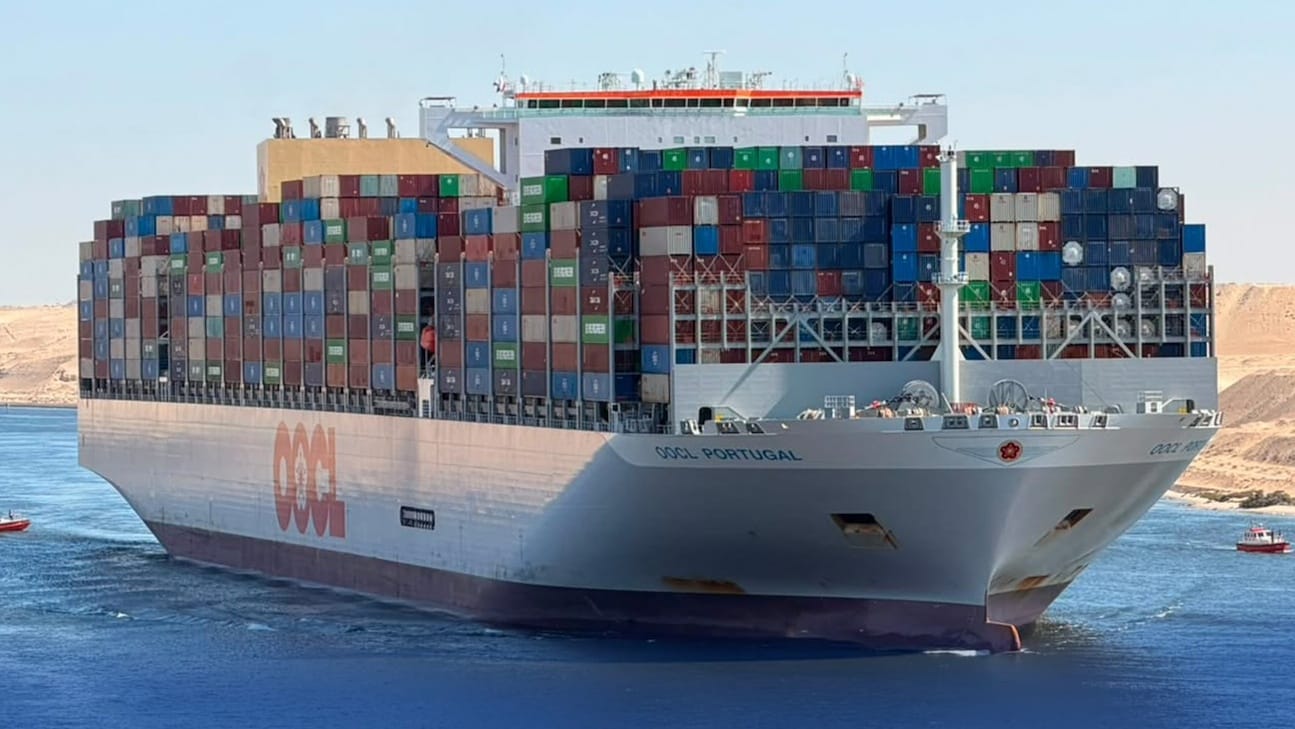
For nearly three years, the Red Sea crisis has quietly but profoundly reshaped global container shipping. Security risks that emerged in late 2023 diverted the bulk of Asia-Europe services away from the Suez Canal and around the Cape of Good Hope. Voyages lengthened by thousands of nautical miles. Transit times stretched by 10 to 14 days or more. Fuel consumption rose roughly 30 percent. And the longer southern route absorbed surplus capacity that would otherwise have flooded the market.
That era is not over. It is evolving.
Major carriers—Maersk, Hapag-Lloyd, MSC, and others—have begun restoring selected services to the Suez route. Gemini Cooperation partners Maersk and Hapag-Lloyd moved additional loops, including AE5, AE11, AE12, and ME2, back through the canal in September 2026. MSC has followed suit on a service-by-service basis. Containership transits through Suez rose sharply through the summer and early autumn.
Yet the recovery remains partial and reversible. One September 2026 estimate placed Suez routing normalization at roughly 27 percent; other analyses suggest the share of Asia-Europe capacity using the Red Sea is closer to one-third. A substantial volume of traffic continues to sail around southern Africa.
Africa sits at the center of this rebalancing. The prolonged diversion has underscored the strategic value of the Cape of Good Hope and the maritime routes that flank the continent. The question now is whether African states and institutions will convert geographic centrality into lasting economic and strategic advantage—or watch ships continue to pass by.
The Incomplete Return to Suez
The commercial logic for returning to Suez is straightforward. The canal shortens Shanghai–Rotterdam voyages by approximately 3,000 to 3,500 nautical miles and cuts transit times by one to two weeks compared with the Cape route. That efficiency frees vessels for other deployments, reduces bunker consumption, and improves schedule reliability for time-sensitive cargo.
Carriers have made clear, however, that every restoration remains conditional on security assessments. War-risk premiums, the possibility of renewed attacks, and the broader Middle East security environment mean that Cape routing has not disappeared. It has become a parallel, permanent option rather than a temporary contingency.
Data from the Suez Canal Authority and liner analysts show genuine recovery. Container ship net tonnage through the canal was up more than 50 percent year-on-year in the first eight months of 2026, and August was the busiest month since late 2023. Yet traffic remains well below pre-crisis levels. The Cape of Good Hope continues to handle a meaningful share of diverted Asia-Europe capacity.
For African ports and policymakers, this hybrid reality is the new operating environment.
Africa’s Double-Edged Geography
The surge in Cape traffic should, in theory, have delivered a windfall: more bunkering, crew changes, repairs, and port calls. Reality has been more mixed.
South Africa’s major gateways—Cape Town, Durban, and Gqeberha—have seen increased vessel movements in their waters, yet many ships simply transit rather than stop. Congestion, aging infrastructure, and operational inefficiencies have limited the capture of high-value services.
Competing hubs have stepped into the gap. Port Louis in Mauritius recorded sharp rises in bunker calls and fuel volumes. Walvis Bay and Lüderitz in Namibia expanded bunkering capacity. Tema in Ghana attracted more direct calls and service deployments on West Africa trades. Smaller, more agile facilities along the West African coast have also benefited from the longer route’s demand for intermediate fuel stops.
East African ports that once depended more heavily on Suez-related feeder and transshipment activity have faced different pressures. The net result is a reminder that geography alone does not generate revenue. Efficient ports, predictable turnaround times, competitive bunkering markets, and reliable hinterland connections determine whether traffic translates into economic activity.
The diversion has also exposed security and environmental dimensions. Higher vessel density along the Cape route expands the operating space for illicit activities even as it increases demand for search-and-rescue capacity, pollution response, and maritime domain awareness. These are not abstract concerns. They are operational requirements that African coastal states must meet if they wish to present themselves as reliable partners in global supply chains.
Strategic Stakes Beyond the Immediate Cycle
The current partial return to Suez does not diminish the Cape’s long-term relevance. Geopolitical risk in the Red Sea, Bab el-Mandeb, and, at times, the Strait of Hormuz has demonstrated that the shorter northern routes can be disrupted for extended periods. In an era of contested chokepoints, the Cape of Good Hope functions as a resilient alternative that cannot be closed by a single actor or event. That resilience has value for global trade, for energy flows, and for the security of supply chains that underwrite economic stability on multiple continents.
For Africa, the stakes are higher still. More than 90 percent of the continent’s external trade moves by sea, yet African ownership of the global fleet remains negligible. The African Continental Free Trade Area is expanding intra-continental commerce. The Revised Maritime Transport Charter and blue-economy strategies provide policy frameworks. Global disruptions have simultaneously raised the profile of African ports as potential bunkering, transshipment, and logistics nodes.
The window to convert these developments into durable capacity—modern terminals, trained seafarers, African-owned tonnage, and integrated logistics corridors—is open but not infinite.
What Must Follow
Three priorities stand out.
First, targeted investment in port efficiency and bunkering infrastructure at key nodes along the Cape route and West African coast. South Africa’s lag relative to more agile neighbors is a warning, not a destiny. Competitive turnaround times and reliable services can still reclaim market share.
Second, stronger maritime security cooperation and domain awareness. The same traffic that creates economic opportunity also creates vulnerabilities. Regional naval and coast-guard collaboration, information sharing, and investment in surveillance capacity are essential if the Cape route is to remain attractive to commercial operators.
Third, deliberate alignment of national and continental maritime strategies with the realities of a dual-route world. Policy frameworks exist; implementation, data, and coordinated investment lag. The African Maritime Council and similar bodies have correctly highlighted the continent’s centrality. Turning that recognition into concrete outcomes requires sustained political attention and private-sector partnership.
The Choice Ahead
The gradual return of selected services to Suez is welcome for global supply-chain efficiency. It does not erase the strategic lesson of the past three years. Africa’s southern and western maritime routes have proven their value as a vital alternative.
Whether that value accrues primarily to the continent’s economies, or continues to flow past its shores, depends on the choices African governments, ports, and industry make in the years immediately ahead.
The ships are still coming. The question is whether Africa is ready to make them stop—and stay.
Andrew Mwangura is a maritime analyst and founder of the Maritime Business Review.