


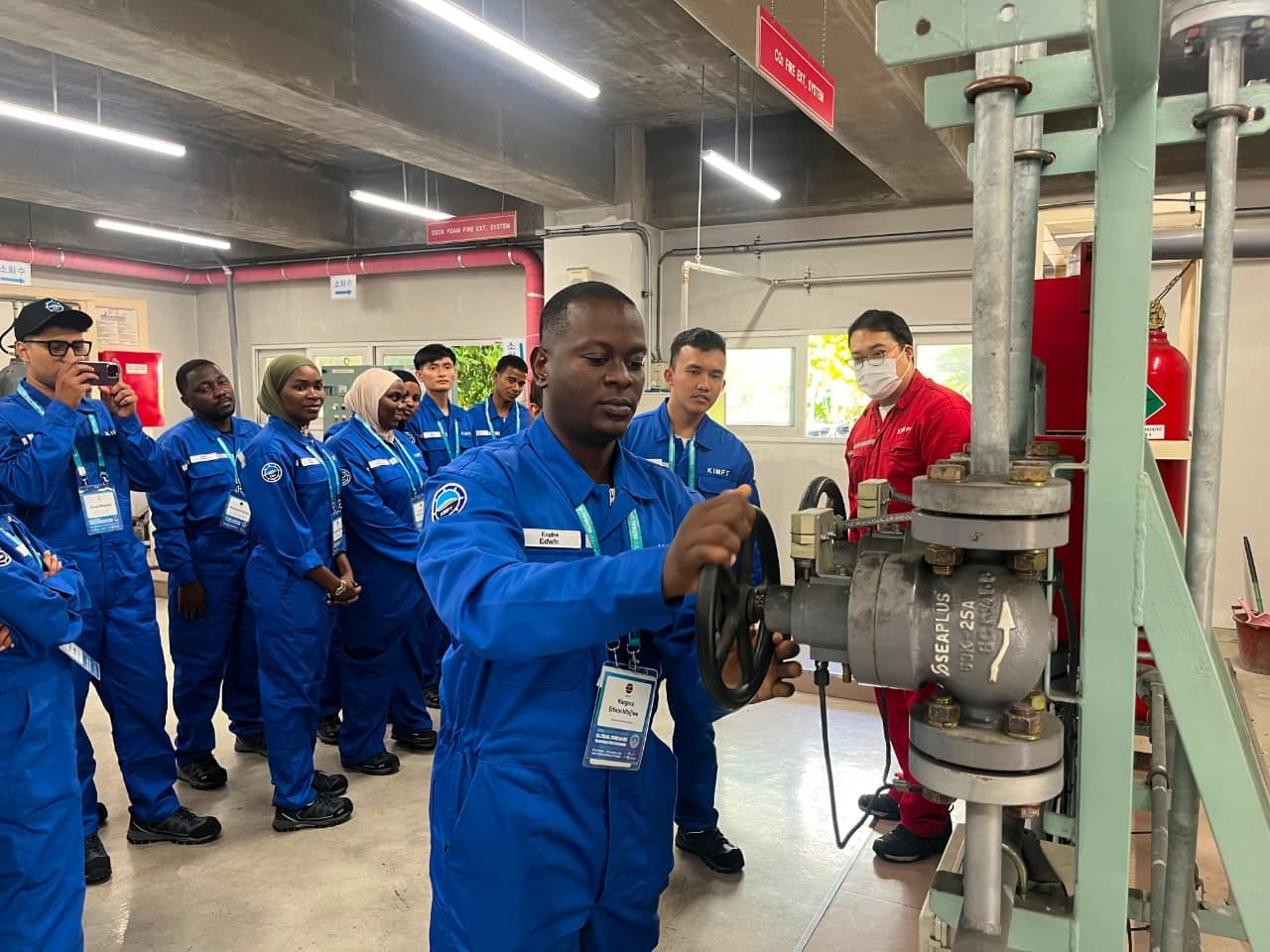
In the crowded waters of global maritime training, symbolism matters. When Bandari Maritime Academy (BMA) Chief Executive Officer Dr. Eric Katana led a delegation to Busan, South Korea, for the Global On-Board Training (GOBT) Welcome Ceremony, the event was more than protocol and photo opportunities. It marked a tangible acceleration of Kenya’s bid to convert its long coastline and strategic Indian Ocean position into skilled human capital, international partnerships, and real training assets.
The ceremony, hosted by Korea Institute of Maritime and Fisheries Technology (KIMFT) President Hyunsoo Yoon and attended by Kenya’s Ambassador to the Republic of Korea, Prof. Emmy Jerono Kipsoi, underscored growing bilateral cooperation in maritime education. Kenya was represented by BMA Cadet Edwin Kiogora among cadets from 14 countries. Parallel to the ceremonial gathering, the delegation witnessed the signing of a Memorandum of Understanding and Deed of Transfer for MV MY DREAM, a training yacht donated by South Korea. The vessel is destined for registration as a Kenyan ship and eventual delivery to BMA in Mombasa, following earlier contractual arrangements with Kenya Shipyards Limited (KSL). The team also inspected the yacht and toured the training ship HANNARA at Korea Maritime University.
These steps are not isolated. They form part of a deliberate pattern: international exposure for cadets, acquisition of physical training platforms, and institutional partnerships that move beyond classroom theory.
From Simulation to Sea Time
Maritime training has long suffered from a critical bottleneck in many developing countries: limited access to actual seagoing experience. Certificates of Competence require documented sea time. Without it, graduates remain stuck on shore. BMA has been systematically addressing this through multiple channels—placements with international operators, the ongoing GOBT programme with KIMFT, and now the prospective arrival of MV MY DREAM.
The vessel is intended to complement BMA’s existing Full Bridge Mission Simulator. It will support practical training in navigation, engine operations, seamanship, safety, cargo handling, watchkeeping, emergency response, and shipboard communication for Nautical Science, Marine Engineering, and Ratings students. Earlier reporting noted that BMA and KSL signed a delivery contract for the South Korean-donated vessel precisely to strengthen experiential learning in Mombasa.
This is pragmatic institution-building. Simulators are valuable and safer for initial exposure, but nothing replaces the sensory reality of a moving vessel, the discipline of watches, and the unpredictability of the sea. A dedicated training yacht under Kenyan registration gives BMA greater control over scheduling and curriculum alignment than relying solely on commercial berths.
Cadet Leadership and Soft Power
Cadet Edwin Kiogora’s participation—and his reported election as Moderator of the GOBT programme, the only African cadet in that role—adds a human dimension. International programmes succeed when participants move from passive recipients to active contributors. Leadership roles build confidence, cross-cultural competence, and networks that outlast any single course. For Kenya, such visibility helps reframe the country from a labour-supply nation to a source of competent, globally oriented maritime professionals.
The presence of the Kenyan ambassador at the ceremony further signals that maritime training has become a recognised strand of bilateral diplomacy. South Korea’s willingness to donate a vessel and host multi-national cadet cohorts reflects a development-cooperation model that emphasises capacity transfer rather than pure commercial transaction.
Broader Context: Kenya’s Blue Economy Push
Kenya has repeatedly identified the Blue Economy—fisheries, maritime transport, coastal tourism, marine research, and related services—as a priority for job creation and economic diversification. Youth unemployment remains a structural challenge. Maritime careers, particularly seafaring, offer relatively high earnings potential once sea time and certifications are secured, yet entry barriers—cost of training, access to berths, awareness—have historically limited participation.
BMA, located in Mombasa, positions itself as a regional centre of excellence. Recent activities—record placements with international shipping companies, collaboration discussions with operators such as Wilhelmsen, accreditation as an Institute of Chartered Shipbrokers teaching and examination centre, and outreach to Lake Victoria counties—show an institution expanding both depth and geographic reach. The South Korea engagement fits this trajectory: it secures high-quality training pathways and physical infrastructure while reinforcing diplomatic ties.
Challenges That Remain
Optimism should be tempered by realism. Delivery and registration of MV MY DREAM still require operational follow-through—flagging, crewing for training voyages, maintenance budgets, insurance, and integration into the academic calendar. Training vessels are expensive to run. Sustainability will depend on government support, industry partnerships, and efficient utilisation.
Sea-time placement volumes, while improving, remain finite relative to the number of aspiring cadets. International programmes like GOBT are selective and time-bound. Scaling impact will require continued expansion of commercial berths, regional cooperation—as seen with Tanzanian cadets in earlier cohorts—and domestic demand from Kenyan-flagged or locally operating vessels.
Quality assurance is equally critical. International recognition of Kenyan certificates depends on consistent adherence to STCW standards and the reputation of institutions such as BMA. One high-profile partnership does not automatically elevate the entire ecosystem.
Strategic Implications
The Busan visit and associated milestones illustrate a shift from aspiration to execution. Kenya is not merely talking about the Blue Economy; it is securing training berths, acquiring vessels, placing cadets in competitive international programmes, and cultivating bilateral relationships that deliver concrete assets.
For Africa more broadly, the episode offers a useful template. Many coastal and island states face similar constraints: abundant youth, underutilised maritime potential, and limited access to modern training infrastructure. Partnerships that combine technical cooperation, equipment transfer, and multi-national exposure can accelerate progress faster than isolated national efforts.
The real test will come after the yacht arrives in Mombasa. If BMA successfully integrates MV MY DREAM into regular training, expands the pipeline of sea-time opportunities, and produces graduates who compete effectively on the global market, then the ceremony in Busan will be remembered as more than a diplomatic highlight. It will mark the moment Kenya’s maritime training capacity began to match its strategic geography.
In an industry defined by global standards and long supply chains of competence, that alignment is the difference between potential and performance. Kenya is taking the necessary steps. The voyage continues.