


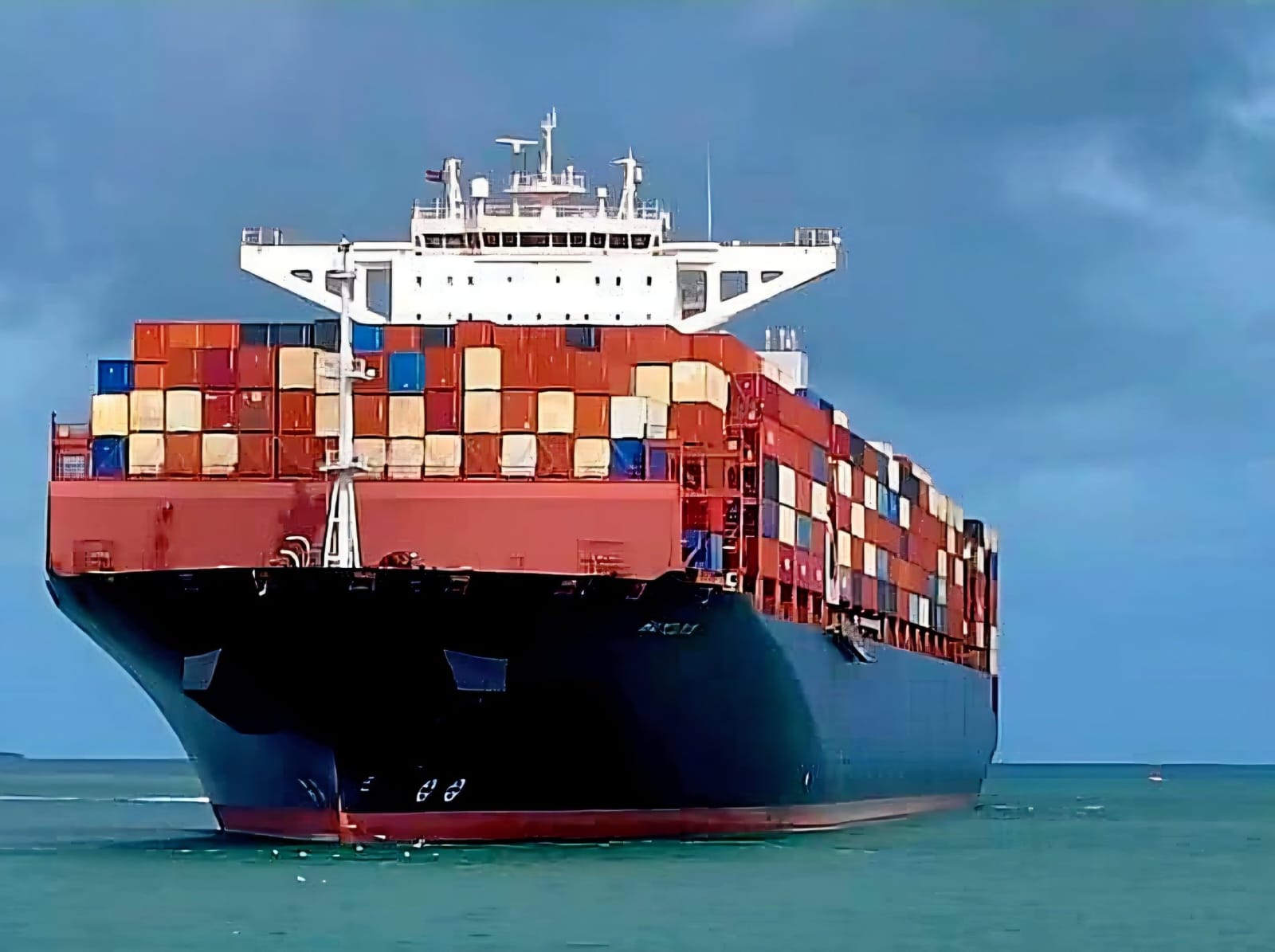
A 366-metre vessel has glided into Lamu Port carrying 5,597 transshipment containers—cargo bound not for Kenya, but for redistribution across the Indian Ocean rim. MV Hamouna is, as the viral posts put it, three and a half football pitches of floating steel. But the more consequential story is not the ship’s size. It is what its arrival reveals about Kenya’s long, fitful, and now suddenly urgent attempt to convert a deep-water berth into a regional transshipment hub—and about the uncomfortable gap between the infrastructure Kenya has built and the economic ecosystem it has not.
The Mechanics of Transshipment
A transshipment port is an intermediate hub. Containers are offloaded from one vessel and loaded onto another to continue their journey. This model exists for four reasons: the absence of direct shipping routes between origin and destination; the economics of scale that make it cheaper for ultra-large carriers to drop massive volumes at a single hub for feeder ships to distribute; the physical limits of regional ports that cannot accommodate ships drawing more than 15 or 16 metres; and the consolidation of small shipments into full container loads. Singapore is the world’s largest transshipment port by volume, moving roughly 35 million TEUs annually in transshipment alone, followed by Port Klang and Tanjung Pelepas in Malaysia and Colombo in Sri Lanka.
MV Hamouna’s call at Lamu—discharging approximately 5,200 TEUs of a total 14,500 TEU load—is a textbook transshipment operation. The containers will be transferred to smaller feeder vessels for onward shipment to destinations that include the United Arab Emirates, Mozambique, Tanzania, Zanzibar, Seychelles, Comoros, and Madagascar. The vessel navigated 14 nautical miles through the Eastern Channel before berthing, a manoeuvre enabled by Lamu’s natural 17.5-metre draft and 500-metre turning basin. Mombasa, by contrast, is limited to vessels of about 323 metres and shallower draft; Lamu’s berths can take ships that Mombasa cannot.
The Kenya Ports Authority has framed the call as a record. “This is the first vessel to discharge over 5,000 TEUs at once,” said KPA Managing Director Captain William Ruto. “Even our Mombasa Port has not surpassed this figure, making Lamu Port the next frontier in the maritime industry.” That statement is technically accurate. It is also a measure of how low the baseline has been.
From White Elephant to Working Port
Lamu Port opened in May 2021 as the first component of the Lamu Port–South Sudan–Ethiopia Transport Corridor, or LAPSSET—one of the most ambitious infrastructure programmes in East Africa. Three deep-water berths were carved into Manda Bay at a cost of $480 million. The plan envisaged 32 berths, railways and highways running to Addis Ababa and Juba, crude oil pipelines from South Sudan and Turkana, and a special economic zone. Kenya Vision 2030 positioned Lamu as the anchor of a second transport corridor to reduce dependence on Mombasa and open northern Kenya to trade.
For years, the port was a cautionary tale. In its first year of operation, it handled just 34,761 metric tonnes of cargo. Throughput collapsed to 6,539 tonnes in 2022, recovered modestly to 37,576 tonnes in 2023, and reached only 74,380 tonnes in 2024. Only 12 ships called in 2021; four in 2022; 36 in 2023; 20 in 2024. The road, railway, and pipeline that were supposed to reach the port never made it past the drawing board. As one analysis put it, “Lamu is still a port with no land behind it.”
Then came the disruption. The blockade of the Strait of Hormuz and congestion at Gulf ports forced shipping lines to reroute. Lamu, far from the conflict zone, became a beneficiary of geography. In 2025, cargo volumes jumped to nearly 800,000 metric tonnes, and the port authority logged more than 120 vessel calls. By late 2026, Lamu had handled over 1 million metric tonnes, with 74 vessels docking in the first months of the year alone. Hapag-Lloyd’s 369-metre MV Baltimore Express called in May 2026, becoming the largest vessel ever to berth at any port in East or Central Africa. MV Hamouna followed in October.
The question is whether this surge represents a durable shift or a temporary windfall. The Red Sea disruptions that diverted traffic to Lamu were not a vote of confidence in the port’s competitiveness. They were an accident of conflict. The real test is whether Lamu can retain that traffic once alternative routes normalise—and whether the Dangote refinery, the port’s most credible industrial anchor, can be delivered.
The Dangote Variable
In September 2026, Aliko Dangote broke ground on a $16 billion, 700,000-barrel-per-day refinery at Lamu, developed in partnership with the Kenyan government. The project is expected to require large-scale crude imports, storage facilities, specialised terminals, and regular exports of refined products—activities that could generate sustained traffic for the port and accelerate development of the LAPSSET corridor.
Dangote’s choice of Lamu over Tanga in Tanzania is strategically significant. Lamu’s natural depth of 17.5 to 18 metres allows it to berth fully loaded crude supertankers; Tanga’s shallower approach does not. Kenya’s market is larger, its banking sector more liquid, and its land more available. The refinery is projected to create approximately 60,000 jobs and could represent about 12 percent of Kenya’s GDP. It would also help reverse Kenya’s 2016 defeat, when Uganda chose the Tanzanian route for its crude oil pipeline.
But the refinery faces unresolved questions. No financing structure has been announced; Dangote has said about 70 percent of the cost, roughly Sh1.4 trillion, would come through debt. Crude supply remains uncertain: Kenya’s commercial oil industry is embryonic, Uganda’s projects have not entered production, and the Democratic Republic of Congo’s producing fields are on the Atlantic coast, thousands of kilometres from Lamu. President Ruto has said supplies could come from Kenya, Uganda, South Sudan, and the DRC, but the logistics remain speculative. The refinery’s timeline, in other words, is anything but assured.
The Competitive Landscape
Lamu’s ambitions must be understood against a crowded and competitive regional field. Mombasa remains East Africa’s largest port, handling 45.45 million tonnes of cargo in 2025—a record. Dar es Salaam processed an estimated 27.7 million tonnes. Djibouti and Port Sudan serve the Horn of Africa and Sudan, while Berbera in Somaliland has attracted Ethiopian interest. Singapore, Port Klang, and Colombo dominate the global transshipment market that Lamu hopes to enter.
Kenya’s transit cargo market share has fallen by 8 to 10 percent over the past three years, with Tanzania’s Central Corridor gaining at the expense of the Northern Corridor. Lamu’s early momentum is anchored in transshipment, a model closer to Djibouti’s than to Mombasa’s domestic-import orientation. But transshipment is a low-margin, high-volume business that depends on connectivity, reliability, and cost competitiveness—none of which Lamu has yet fully established.
The port also faces security challenges. Lamu County has experienced sporadic Al-Shabaab attacks, and its proximity to the Boni Forest and the Somali border makes it vulnerable to infiltration. The UK’s travel advisory warns against visiting Lamu County, excluding Lamu Island and Manda Island. For a port that depends on international shipping lines and their insurers, security is not a peripheral concern; it is a determinant of commercial viability.
The Infrastructure Gap
The most glaring weakness is hinterland connectivity. The Lamu Port–Hindi–Bodhei–Ijara–
Shipping agents have called for urgent modernisation: more equipment at the quay and yard, integration of documentation processes with Mombasa, completion of horizontal infrastructure, and auxiliary services such as warehouses and residential areas. The port currently has three ship-to-shore gantry cranes, three harbour mobile cranes, two rubber-tyred gantry cranes, one tugboat, and a limited fleet of terminal tractors and forklifts. For a port handling 14,500-TEU vessels, that is thin.
The government is pursuing a landlord model, with plans to lease the three operational berths and the Lamu Special Economic Zone to private operators through public-private partnerships. By 2030, the Kenya Ports Authority aims to add 21 berths, with a goal of positioning Lamu as an alternative to Mombasa, Djibouti, and Port Sudan. The port’s three operational berths have a combined annual capacity of up to 1.2 million TEUs. Realising even a fraction of that ambition will require capital, expertise, and sustained political commitment that have so far been in short supply.
What the Ship Does—and Does Not—Prove
MV Hamouna’s arrival is genuinely significant. It demonstrates that Lamu can physically accommodate some of the world’s largest container vessels. It confirms that the port’s deep-water channel and berths are operational. It shows that shipping lines are willing to route transshipment cargo through Lamu, at least under conditions of regional disruption. And it lends political momentum to a project that has spent years in the shadow of its own inflated promises.
But the ship does not prove that Lamu is a competitive transshipment hub. It does not prove that the Dangote refinery will be built on time or at all. It does not prove that the LAPSSET corridor will be completed. And it does not prove that Kenya has solved the hinterland connectivity problem that has kept the port underused since 2021.
Transshipment hubs are not built by ships alone. They are built by reliable feeder networks, competitive handling costs, efficient customs procedures, secure environments, and integrated transport corridors. Singapore, Klang, and Colombo did not become hubs because a large ship once called. They became hubs because decades of investment in connectivity, governance, and logistics created the conditions for sustained commercial confidence.
Lamu has the water. It has the berths. It has the political attention. What it needs now is the land behind it, the rules around it, and the capital within it. MV Hamouna is a proof of concept. It is not yet a proof of business model.