


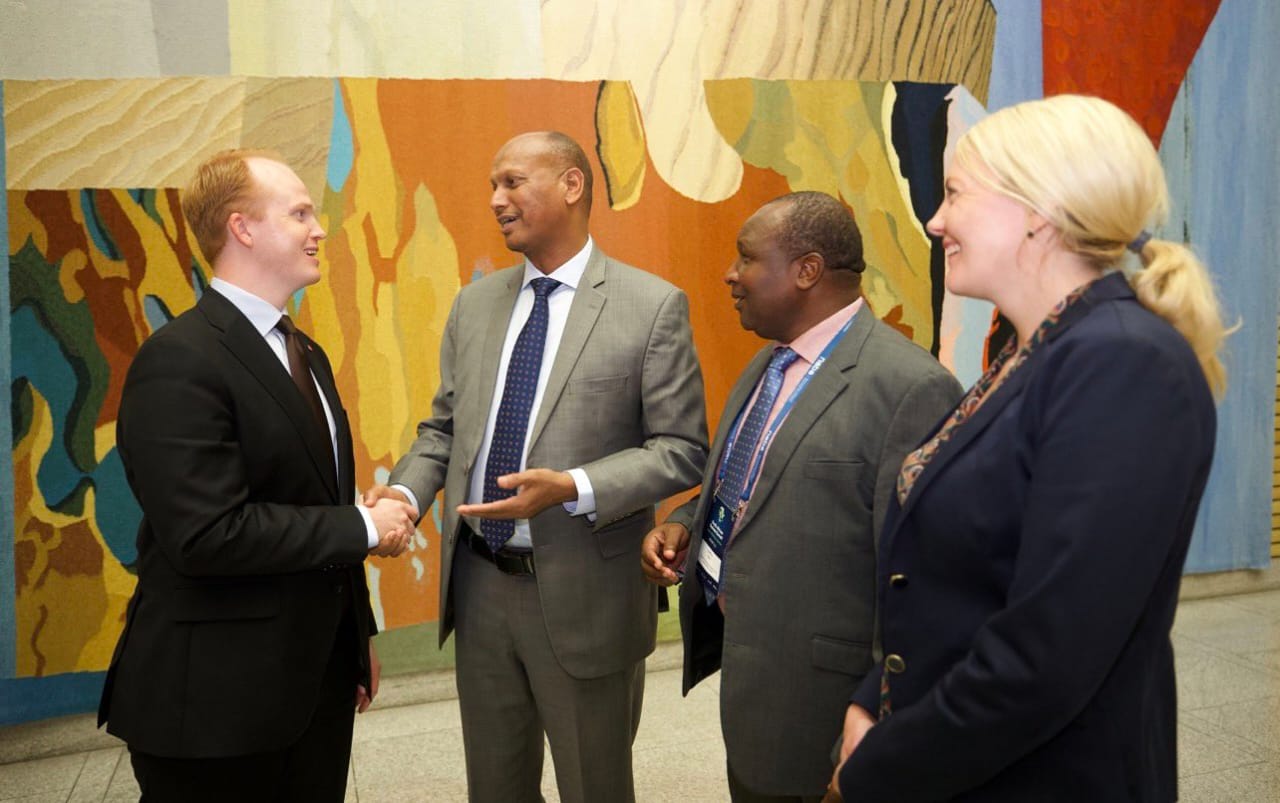
At the Grand Hotel in Oslo, the Cabinet Secretary for Mining, Blue Economy and Maritime Affairs, Hon. Hassan Ali Joho, was represented by the Principal Secretary for Shipping and Maritime Affairs, Mr. Aden A. Millah, on the Trade and Logistics in East Africa panel. He was joined by Kenya Maritime Authority Director General CPA Justus Omae Nyarandi and Kenya’s Ambassador accredited to Norway, H.E. Angeline Kavindu Musili, MBS.
The discussion focused on the Northern Corridor’s central role in connecting East Africa to global markets and the practical opportunities for stronger partnerships with Norway and the wider Nordic region. The presence of the Principal Secretary, rather than the Cabinet Secretary himself, underscores a deliberate approach: high-level political direction is clear, while day-to-day technical and diplomatic engagement is carried by the officials responsible for execution.
The Northern Corridor Remains the Strategic Prize
The Northern Corridor, anchored at the Port of Mombasa, continues to serve as the primary maritime gateway for Kenya and a critical artery for Uganda, Rwanda, Burundi, South Sudan, and eastern Democratic Republic of Congo. Cargo volumes have grown steadily, with recent throughput figures approaching or exceeding 45 million tonnes annually and transit traffic forming a substantial share. Efficiency along this corridor determines the cost of goods, the competitiveness of regional exports, and the reliability of supply chains serving more than 200 million people.
Norway and the Nordic countries bring complementary assets: advanced maritime technology, experience in green shipping and decarbonisation, sophisticated logistics systems, and a strong tradition of maritime education and seafarer development. Recent bilateral progress—including commitments to employ Kenyan seafarers in meaningful numbers and exploratory work on new shipping routes and green corridors—shows that the relationship has moved beyond general goodwill into specific areas of mutual interest.
Africa’s Strengths and the Terms of Engagement
Africa does not come to these tables empty-handed. It brings expanding markets, a young and increasingly skilled workforce, and clear ambition. Kenya’s maritime sector already fields tens of thousands of trained seafarers and has set explicit targets to expand that pool. The priority articulated in Oslo remains straightforward: convert these engagements into efficient logistics, stronger regional connectivity, skills transfer, and investment that creates jobs.
Mutually beneficial partnerships must recognise these strengths. They should deliberately expand African participation in higher-value segments of global trade—ship management, specialised logistics, maritime training, green propulsion technologies, and value-added port services. Skills transfer must go beyond short courses into sustained institutional linkages. Capital should flow into projects that generate local employment and build durable competitive advantages rather than extractive arrangements.
Representation and the Imperative of Implementation
That the Cabinet Secretary was represented by the Principal Secretary is not a diminution of the engagement; it is a signal of seriousness. Political leadership sets the direction. Technical leadership must deliver. Success will be measured by tangible outcomes: shorter transit times and lower costs along the Northern Corridor, more Kenyan seafarers on international vessels, new private-sector investment in maritime infrastructure and services, and measurable expansion of regional trade that remains competitive against alternative routes.
This requires disciplined follow-through—aligning port modernisation, multimodal transport upgrades, digital systems, regulatory reforms, and training capacity so that Nordic technology, expertise, and capital can be absorbed productively. It means treating the Northern Corridor as a regional public good whose efficiency benefits every country it serves.
Africa is building its future. Partners ready to work hand in hand—sharing technology, opening markets, investing in skills, and judging progress by results on the ground—will find willing counterparts in Kenya and across East Africa. The alternative is more panels and fewer measurable gains in efficiency, employment, and value retention.
The conversation in Oslo was useful. The test now shifts to the ports, the training institutions, the border posts, and the investment pipeline. Dialogue has its place. Delivery is the only currency that counts.