


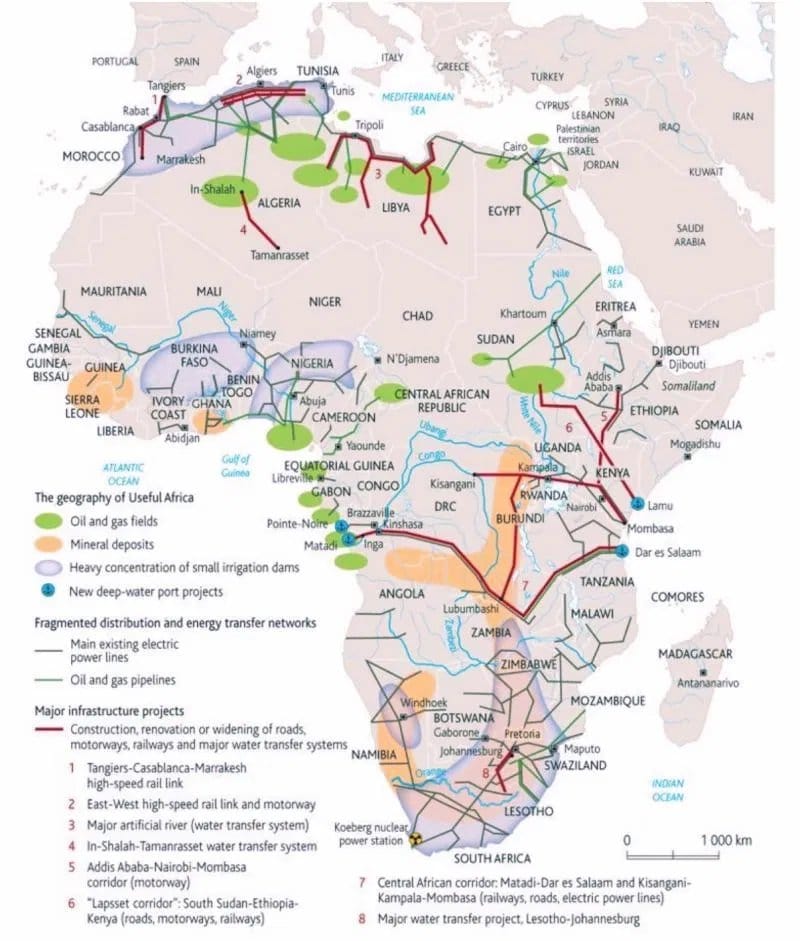
Africa is extraordinarily rich. It holds roughly 30 percent of the world’s critical mineral reserves essential for the energy transition, vast agricultural potential, significant oil and gas resources, and a strategic geography astride major global trade routes. Yet resources alone have never created lasting economic value. The continent’s persistent paradox—geological abundance alongside persistent underdevelopment—stems not primarily from a lack of deposits, but from a lack of connectivity.
The critical question is no longer whether Africa has the resources. It is whether those resources can be efficiently linked to processing facilities, industrial clusters, cities, and export markets. That is the structural investment thesis of our time: the shift from isolated extraction to integrated economic corridors.
From Potential to Systems
Economic corridors are not merely roads or railways. They are integrated ecosystems that connect production centers to domestic, regional, and international markets; create industrial clusters for processing and manufacturing; and provide the physical backbone for deeper intra-African trade under the African Continental Free Trade Area (AfCFTA). When highways, railways, ports, pipelines, power grids, industrial zones, and border posts function as interconnected systems, they transform high-potential projects into institutional-grade investments.
The evidence is already on the map. The Maputo Development Corridor, linking South Africa’s industrial heartland to Mozambican ports, has catalyzed aluminum smelting, agro-processing, ferrochrome production, and gas pipelines. The Abidjan–Lagos Corridor supports a substantial share of ECOWAS economic output. The Lobito Corridor—connecting Angola’s Atlantic port to the Copperbelt of Zambia and the Democratic Republic of Congo—is emerging as a high-profile alternative for copper, cobalt, and other critical minerals, backed by a mix of African, U.S., European, and multilateral capital. Similar dynamics are visible along the Central Corridor, Nacala, LAPSSET, and Mtwara routes.
These projects illustrate a broader pattern: infrastructure becomes transformative only when complementary investments in energy, logistics, processing, storage, and trade finance operate as a single system. The investment opportunity therefore extends far beyond the mine gate. It encompasses transportation networks linking landlocked economies to ports, power generation and transmission that support industrialization, specialized industrial zones that enable local value addition, and the soft infrastructure of efficient borders and digital logistics.
The Scale of the Opportunity—and the Gap
Global demand for energy-transition materials is projected to grow robustly through 2035. Africa’s share of reserves is outsized—cobalt, platinum group metals, manganese, graphite, and others—yet the continent accounts for a far smaller share of actual production and an even smaller share of refining and manufacturing. Logistics costs in parts of Africa remain up to 250 percent higher than global averages; poor connectivity can add 30–40 percent to mining operating expenses. Power reliability remains a binding constraint in many mineral-rich jurisdictions. Annual infrastructure financing needs are estimated at $130–170 billion, against roughly $80 billion in current investment, leaving a persistent gap.
AfCFTA amplifies both the stakes and the returns. Intra-African trade remains low relative to other regions. Realizing the agreement’s potential will require upgraded roads, expanded rail capacity, modern ports, and reliable energy—precisely the assets that corridors can deliver. Freight demand is expected to rise significantly; without corresponding infrastructure, the promised gains in regional value chains will remain largely theoretical.
Geopolitics is intensifying interest. Western governments and companies are seeking diversified supply chains for critical minerals; China continues to invest heavily in extractive and logistics infrastructure; African institutions such as the African Development Bank and AUDA-NEPAD are prioritizing the Program for Infrastructure Development in Africa (PIDA) corridors. The result is a competitive environment in which well-structured, multi-use corridor projects can attract blended finance and private capital at scale.
Beyond Extraction: Value Addition and Local Development
A narrow, mine-to-port model is both inefficient and politically fragile. The higher-return approach designs infrastructure for shared use: secondary roads and feeder networks that link farms and smaller producers; industrial parks that host processing and manufacturing; reliable power that serves mines, cities, and industries simultaneously; and digital systems that reduce border delays and improve logistics visibility. Morocco’s Tanger Med experience shows how port and industrial-zone development can generate tens of thousands of jobs and substantial export value when deliberately paired.
Corridors also offer a practical pathway for addressing governance and risk concerns that deter investors. Concentrating activity along defined routes improves regulatory oversight, facilitates community engagement, and creates clearer revenue streams for public-private partnerships. Open-access rail models, such as those contemplated for Lobito, can reduce single-user dependency and broaden economic benefits.
What Investors and Policymakers Must Do Differently
For investors—private equity, infrastructure funds, commodity companies, and development finance institutions—the opportunity lies in identifying where natural resources intersect with emerging or rehabilitated corridors and then financing the ecosystem around them: power, processing, logistics, and trade finance. Risk allocation, contractual architecture, and local content strategies will determine whether projects achieve institutional-grade status.
For African governments and regional bodies, the priority is coherence. Corridor planning should align with continental power system master plans, industrial strategies, and AfCFTA implementation. Hard infrastructure must be matched by soft reforms—streamlined border procedures, predictable regulation, and credible dispute resolution. Maintenance and last-mile connectivity are as important as new construction; fragmented assets that do not function as networks deliver limited value.
Financing will require greater private-sector participation, blended instruments, and innovative structures that de-risk early-stage development while capturing upside from volume growth and value addition. The capital is available; the bankable, system-oriented projects are still too scarce.
The Defining Transformation
Africa’s next phase of growth will not be defined primarily by the volume of resources extracted. It will be defined by the density and efficiency of the economic corridors that connect production to markets, processing, and people. The map of opportunity is already visible: transport arteries, energy spines, mineral belts, and logistics hubs that, if deliberately integrated, can turn geological endowment into sustained prosperity.
Resources buried in the ground create limited wealth. Resources connected to competitive, multi-use infrastructure create economies. For investors, developers, and policymakers willing to think in systems rather than single assets, that is the real African opportunity of this decade.