


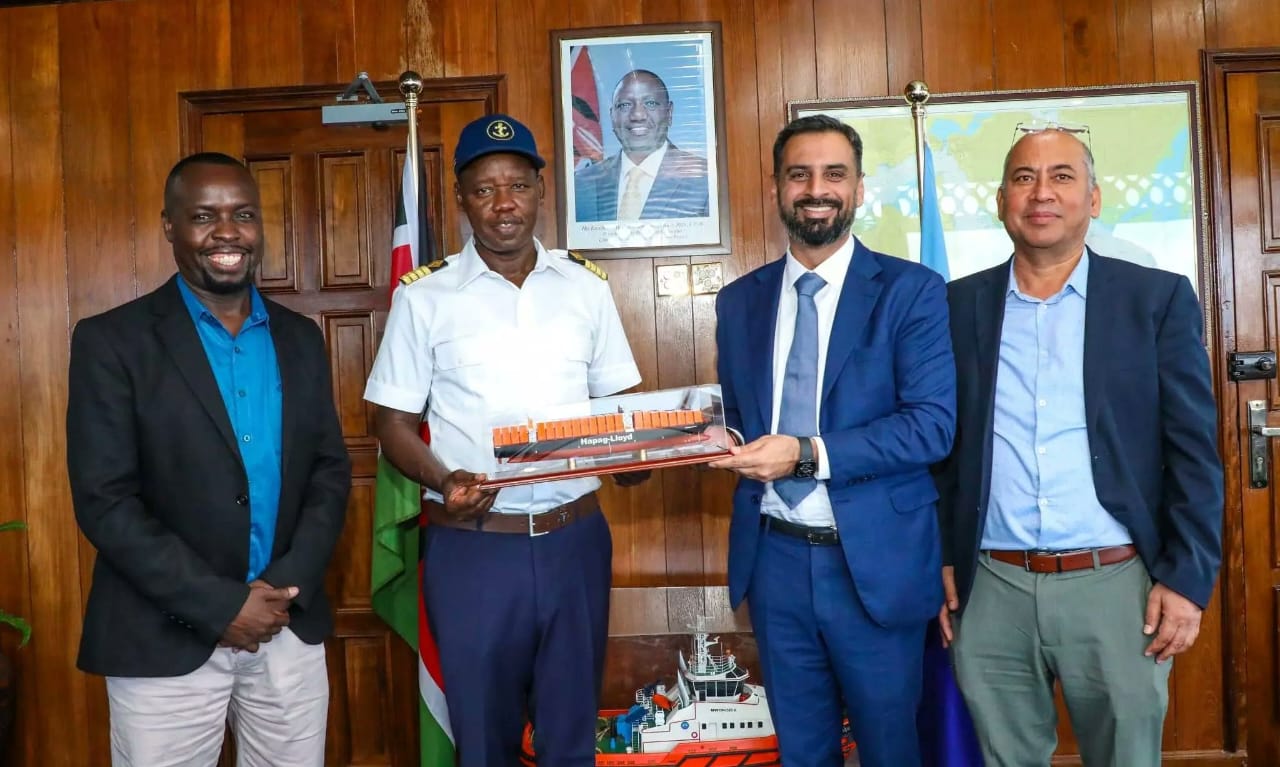
In early August 2026, the Kenya Ports Authority (KPA) and Hapag-Lloyd held a high-level engagement that, on the surface, looked like another polite industry handshake. Beneath the diplomatic language, however, lay a sharper strategic signal: one of the world’s major container lines is doubling down on the Port of Mombasa as its primary East African gateway, while Kenya races to expand capacity, modernise systems, and open its ports to private capital. The implications stretch far beyond berth occupancy. They touch regional trade competitiveness, the future of the Lamu Port–South Sudan–Ethiopia Transport (LAPSSET) Corridor, and the broader contest for influence in one of Africa’s fastest-growing logistics theatres.
A Handshake With Strategic Weight
Hapag-Lloyd already operates two services linking Asia to East Africa via Mombasa and Dar es Salaam, and has been present at Mombasa for nine years. The recent meeting—between Hapag-Lloyd’s Area East Africa Managing Director Altamush Ahmed, Hanseatic Global Terminals’ Dirk van Niekerk, and KPA Managing Director Captain William Ruto—focused on expanding that network, improving operational efficiency, and exploring opportunities around ongoing port expansion, Special Economic Zones, and the Port of Lamu. The commitment was mutual: Hapag-Lloyd wants more capacity and reliability; KPA wants deeper partnerships that turn infrastructure investments into sustained volume growth.
This is not happening in isolation. Hapag-Lloyd has been systematically building its African footprint. It expects volumes on the continent to exceed one million TEUs in 2026. It has secured long-term terminal capacity with DP World in Dakar, Luanda, and Dar es Salaam, and is supporting infrastructure development in Banana (DRC) and Maputo. It has opened or strengthened offices in Kampala, Kigali (serving Rwanda and Burundi), and Walvis Bay. The Mombasa conversation fits a clear pattern: lock in reliable access at key gateways while African trade volumes rise faster than in many mature markets.
Kenya’s Parallel Build-Out
Kenya, for its part, is not standing still. Cargo throughput at Mombasa hit a record 45.45 million tonnes in 2025, up roughly 10 percent from the previous year. KPA is advancing Berth 19B—about 40 percent complete at the time of the meeting—developing Dongo Kundu Berth One as part of the Mombasa Special Economic Zone, upgrading the terminal operating system, and acquiring new cargo-handling equipment for both Mombasa and Lamu. Lamu itself has demonstrated capacity for very large vessels: Hapag-Lloyd’s 369-metre MV Baltimore Express called there earlier, and subsequent large-ship calls have reinforced its deep-water credentials. Freight volumes at Lamu surged dramatically in 2025. Parallel to these public investments, the government has moved key assets—Mombasa Berths 11–14, Container Terminal 1, Lamu Container Terminal, and the Lamu SEZ—toward public-private partnership procurement, aiming to mobilise roughly $1 billion in private capital under a landlord-port model.
The strategic logic is straightforward. East Africa’s hinterland—Uganda, Rwanda, Burundi, South Sudan, eastern DRC, and parts of Ethiopia—depends heavily on coastal gateways. Mombasa has long been the dominant corridor; Dar es Salaam competes aggressively; Lamu is positioning itself as a complementary deep-water and transshipment option along the LAPSSET axis. For a global carrier, reliable, scalable access at these points reduces schedule risk, supports larger vessels, and improves service quality for customers moving goods between Asia, the Middle East, and African markets. For Kenya, attracting and retaining major lines validates the heavy public—and soon private—investment in capacity and efficiency. It also strengthens the case for Special Economic Zones that can capture value addition rather than merely facilitating transit.
The Logic—and the Limits
Yet the opportunity carries real risks and tests. Port congestion, documentation delays, and last-mile inland logistics have historically constrained East African corridors. Even as berths expand and systems modernise, truck transit times, border processes, and rail reliability remain critical variables. Competition among ports is intensifying; carriers will allocate volume to the most predictable and cost-effective options. Private-sector participation via PPPs can inject capital and operational discipline, but only if contracts are transparent, performance-based, and structured to protect the public interest while delivering commercial returns. Over-reliance on a handful of major lines also creates concentration risk if global shipping cycles turn or if geopolitical disruptions alter trade lanes.
There is a larger regional dimension. Stronger liner commitment to Mombasa and Lamu reinforces Kenya’s claim as the primary maritime gateway for a multi-country market. It can accelerate the practical realisation of the African Continental Free Trade Area by lowering the effective cost of moving goods. At the same time, neighbouring countries will continue to develop alternative corridors—Tanzania’s investments, emerging options further south, and potential northern routes. Success for Kenya will depend less on exclusive claims and more on consistently superior performance: faster vessel turnaround, reliable inland connections, competitive tariffs, and seamless digital processes.
From Validation to Execution
Hapag-Lloyd’s engagement is therefore best read as both validation and challenge. Validation that Kenya’s ports remain central to East African trade and that current expansion efforts are attracting serious commercial interest. Challenge because the carrier’s expansion plans will ultimately track measurable improvements in capacity, efficiency, and predictability. The meetings, the infrastructure projects, the equipment purchases, and the PPP pipeline are all pieces of the same puzzle. The test will be whether they cohere into a logistics system that can handle larger vessels, higher volumes, and more demanding supply-chain expectations without the friction that has long characterised regional trade.
East Africa’s maritime future will not be decided by any single announcement. It will be shaped by sustained investment, operational excellence, and the ability of public authorities and private operators to convert strategic geography into reliable commercial advantage. Hapag-Lloyd’s renewed focus on Mombasa is a useful reminder that the window is open—and that the competition for that advantage is already underway.