


When a global shipping giant of Hapag-Lloyd’s scale makes a strategic bet on a region, the ripples are felt far beyond the docks. The German liner’s recent pledge to deepen its footprint in East Africa, anchored on the Port of Mombasa, is more than a routine corporate expansion. It is a calculated wager on Kenya’s ability to evolve from a port operator into a fully integrated logistics gateway — and a signal that the competition for East Africa’s trade flows is entering a decisive phase.
The Strategic Rationale
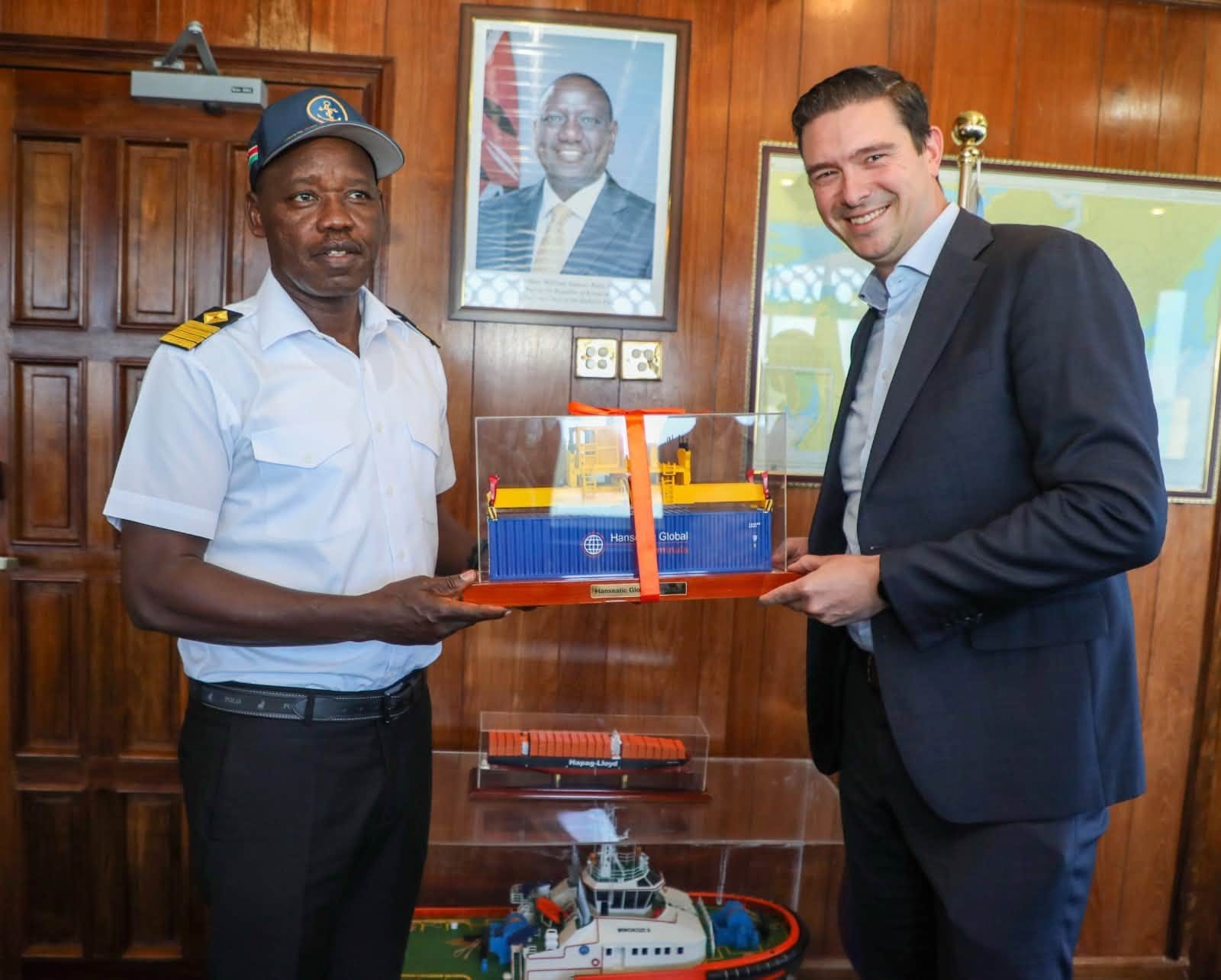
Hapag-Lloyd’s interest in Mombasa is not new. The carrier has operated at the port for nine years and currently runs two services connecting Asia to East Africa through both Mombasa and Dar es Salaam. What has changed is the scale of ambition. During a meeting with the Kenya Ports Authority (KPA), Hapag-Lloyd’s East Africa Managing Director, Altamush Ahmed, and Mr Dirk Van Niekerk of Hanseatic Global Terminals committed to enhancing cooperation to grow their regional network. Discussions covered port expansion projects, Special Economic Zones and opportunities at the Port of Lamu — a clear indication that Hapag-Lloyd is not merely seeking berth space but positioning itself at the centre of Kenya’s broader logistics ecosystem.
The timing is telling. In late Q2 2026, THE Alliance — of which Hapag-Lloyd is a founding member alongside ONE, Yang Ming and HMM — launched a new direct container service linking major Asian ports such as Shanghai, Ningbo, Singapore and Port Klang to Mombasa and Dar es Salaam. The service, dubbed EA3, deploys six modern vessels of approximately 6,000 TEU each, offering shippers improved transit times and schedule integrity. This is not a tentative foray; it is a full-scale commitment to the Asia–East Africa trade lane.
The Competitive Imperative
Hapag-Lloyd’s push comes amid intensifying competition in the East African maritime space. Dar es Salaam has emerged as a formidable rival, climbing to 255th in global port efficiency rankings while Mombasa slipped to 396th. Tanzania has rolled out a Maritime Single Window system to ease congestion, and its ports are aggressively courting transit cargo destined for Zambia, the DRC and other landlocked markets. Kenya is losing between five and eight per cent of high-value transit cargo annually to competing routes, according to government monitoring.
Yet Mombasa retains significant structural advantages. Uganda alone accounts for roughly two-thirds of Mombasa’s transit cargo, and the port handled 10.91 million tonnes of Ugandan cargo in a recent period — a figure that dwarfs Dar es Salaam’s comparable volumes. Rwanda, too, remains a key transit market, with cargo growing by 22 per cent in 2025 to 839,366 metric tonnes. Hapag-Lloyd’s expansion is clearly designed to lock in these relationships while the port upgrades its capabilities.
Infrastructure as the Enabler
The KPA is not standing still. Berth 19B, a Sh19 billion project, is now over 56 per cent complete and will add 300,000 TEUs of annual capacity, accommodating vessels of up to 45,000 deadweight tonnes with a 15-metre draft. A separate Sh8.3 billion transport interchange — including a 1.8-kilometre dual carriageway with 704 metres of elevated viaduct — is 50 per cent complete and scheduled for March 2027, designed to eliminate the bottlenecks that have long plagued cargo evacuation from the port.
Digitisation is proceeding in parallel. KPA has unveiled a Sh1 billion Vessel Traffic Management and Information System (VTMIS) that integrates real-time vessel tracking, radar surveillance and digital port management across three interconnected sites. A smart gate at Gate 24 automates cargo movement, reducing the manual interfaces that slow turnaround times. These investments are precisely the kind of operational improvements that shipping lines like Hapag-Lloyd need to justify deploying larger vessels and more frequent services.
Lamu: The Wildcard
Perhaps the most intriguing dimension of Hapag-Lloyd’s East African strategy is its engagement with the Port of Lamu. In May 2026, Hapag-Lloyd’s 369-metre MV Baltimore Express became the largest vessel ever to call at any port in East or Central Africa when it docked at Lamu from Salalah, Oman. The vessel handled dangerous-goods restows in compliance with International Maritime Organization requirements — a technical achievement that demonstrated Lamu’s capacity to handle ultra-large vessels. Ahmed noted that the Baltimore Express call showed Lamu could “handle scale,” and that Hapag-Lloyd was keen to work with KPA to “turn capabilities into real opportunities”.
Lamu’s 17.5-metre natural harbour depth and 400-metre berths give it a structural edge over Mombasa for next-generation mega-ships. The port has handled over 120 vessels since the start of 2026, and the Dangote Group’s Sh2.2 trillion East Africa Refinery — scheduled for groundbreaking in September 2026 — is expected to transform Lamu into a regional petroleum logistics hub processing 700,000 barrels per day. For Hapag-Lloyd, Lamu represents not just an overflow option but a strategic asset for capturing the growing transshipment and energy-related cargo flows that will define East Africa’s trade profile in the coming decade.
The Hanseatic Dimension
The presence of Hanseatic Global Terminals (HGT) in the Hapag-Lloyd delegation is significant. HGT, Hapag-Lloyd’s independent terminal investment arm, manages a portfolio of over 20 terminals across 11 countries, including key hubs such as Le Havre, Tanger Med and Damietta. Its participation in discussions with KPA suggests that Hapag-Lloyd is exploring deeper involvement in terminal operations — potentially through Kenya’s planned concessioning of Mombasa and Lamu port assets, which moved into procurement in August 2026.
If HGT were to take a stake in a Kenyan terminal, it would mirror the carrier’s strategy in Egypt and Morocco, where terminal ownership has given Hapag-Lloyd greater control over berth allocation, productivity and service reliability. For Kenya, such an arrangement could bring not just capital but also operational expertise and guaranteed cargo volumes. For Hapag-Lloyd, it would transform the carrier from a port user into a port stakeholder — a shift that aligns with the broader industry trend toward vertical integration in logistics.
The SEZ Opportunity
The Dongo Kundu Special Economic Zone, adjacent to the Port of Mombasa, adds another layer to the strategic calculus. The Kenyan government has allocated Sh74.1 billion for enabling infrastructure to fast-track the SEZ’s operationalisation, with the port component alone valued at Sh41.1 billion. Once fully operational, the SEZ is projected to create approximately 5,600 direct jobs and strengthen connectivity between maritime, road and rail networks.
For Hapag-Lloyd, the SEZ represents an opportunity to offer value-added services — warehousing, light manufacturing and distribution — that go beyond pure port-to-port shipping. Shipping lines that integrate into SEZ ecosystems can capture a larger share of the logistics value chain and offer customers more comprehensive solutions. This is particularly relevant for cargo destined for landlocked markets such as Uganda, Rwanda and Burundi, where Hapag-Lloyd has already established a local presence through its new Kigali office serving both Rwanda and Burundi.
Conclusion: A Partnership with Mutual Stakes
Hapag-Lloyd’s East African expansion is not a one-sided proposition. The carrier gains access to a growing market, a strategically located gateway and the operational improvements that KPA is delivering. Kenya gains a global partner that can help fill the capacity of its expanding port infrastructure, attract transshipment traffic and validate its ambitions as a regional logistics hub. The engagement between Hapag-Lloyd and KPA underscores a shared recognition that ports and carriers are not adversaries but co-investors in the same value chain.
The road ahead is not without challenges. Dar es Salaam’s efficiency gains, Tanzania’s aggressive transit-cargo diplomacy and the lingering infrastructure gaps at Mombasa and Lamu will test the durability of this partnership. But if Hapag-Lloyd’s bet pays off, it could catalyse a broader shift: East Africa’s ports moving from competing on price to competing on integrated logistics capability. In that scenario, the real winner would be the trader in Kampala or Kigali who pays less and waits less for goods to cross the Indian Ocean.
The Mombasa gambit is, at its core, a bet on that future.