


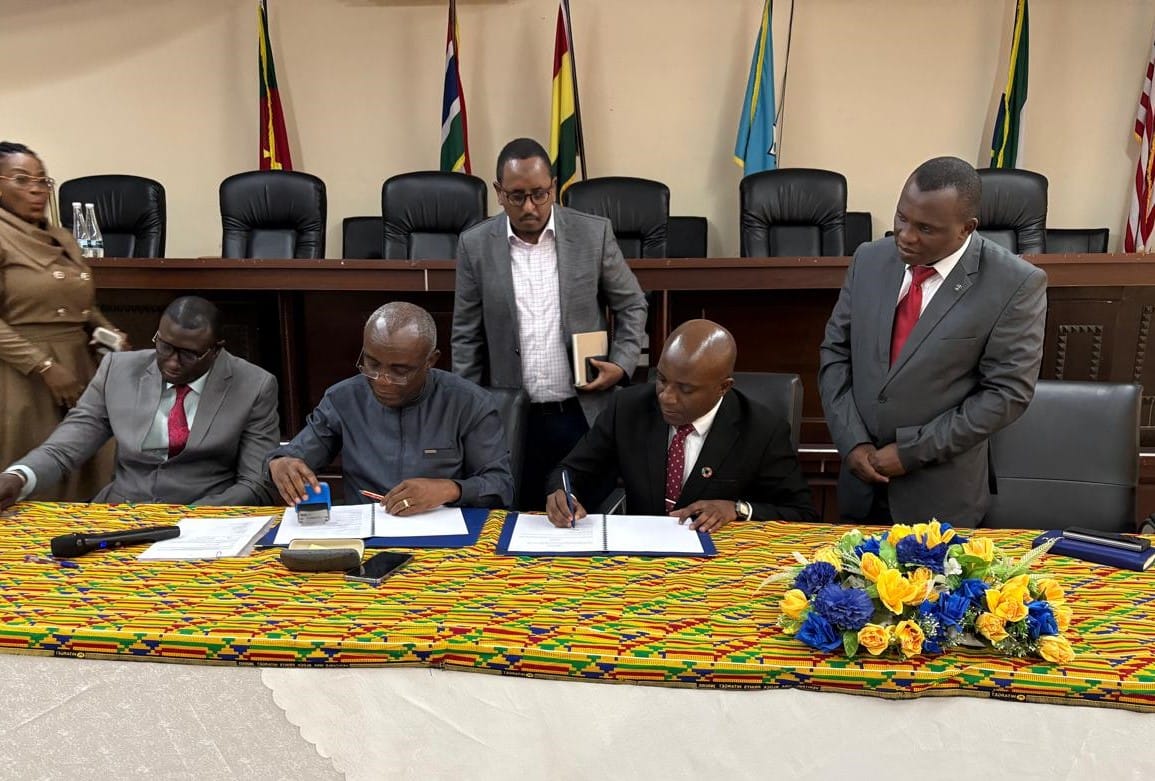
On 10 November 2026, representatives of the Regional Maritime University (RMU) in Ghana and the Lloyd’s Register Foundation met in Accra to renew their commitment to maritime research, education, workplace safety, and professional development. The meeting, which also involved the Institute of Applied Research, was not a ceremonial handshake. It was a deliberate signal that Africa’s maritime institutions are moving from peripheral participation to co-ownership of the global safety and sustainability agenda.
That signal deserves more than polite applause. It deserves serious analysis.
The Partnership in Context
Lloyd’s Register Foundation is an independent global charity focused on evidence-based safety. Its Global Safety Evidence Centre funds rigorous research that identifies what actually works to reduce harm. RMU, one of West and Central Africa’s oldest and most important maritime education institutions, has already demonstrated it can compete for and deliver on that funding.
In July 2026, RMU—together with the Institute of Applied Research—secured a Foundation grant for “Safe Work: A Pathway to Sustainable Blue Economy Development,” aimed at improving occupational health and safety in the maritime sector. In September, RMU led a multi-institutional consortium, including the Dar es Salaam Maritime Institute, the University of Ghana, and Nigeria Maritime University, that won support for the Repository Centre of Excellence on Shipwrecks and Maritime Disasters (ReCESMaD). That project will consolidate records spanning more than two and a half centuries into accessible digital platforms, including GIS tools, so that past disasters inform future prevention.
The November meeting builds on this momentum. RMU Vice-Chancellor Dr Jethro W. Brooks Jr. framed the discussion around institutional capacity and the industry’s evolving demands. Foundation representatives Ben Austin and Candace Bentil, alongside researchers from the Institute of Applied Research, focused on practical next steps rather than abstract aspiration.
This is not charity. It is strategic alignment. The Foundation needs credible local partners who understand African operating conditions—small-scale fisheries, port congestion, limited regulatory enforcement capacity, climate vulnerability, and the realities of mixed formal and informal labour. RMU needs sustained access to rigorous methodology, international networks, and resources that allow it to produce evidence policymakers and operators cannot ignore.
Why This Matters Beyond Accra
Africa’s blue economy is frequently invoked as a development opportunity. Shipping, fisheries, offshore energy, and emerging marine sectors already support millions of livelihoods. Yet the safety record remains uneven. Fishing continues to rank among the world’s most dangerous occupations. Port and shipboard work expose workers to heat stress, mechanical hazards, and inadequate protective systems. Climate impacts are intensifying coastal risks. Decarbonisation and digitalisation will introduce new failure modes even as they promise cleaner operations.
Evidence generated in Europe or North America does not automatically transfer. Vessel types, regulatory maturity, enforcement culture, training infrastructure, and economic incentives differ. Locally led research that is methodologically robust and internationally connected is therefore not a luxury; it is a prerequisite for effective policy and investment.
RMU’s recent grants and this renewed commitment position the university as a regional node capable of producing that evidence. The shipwreck and disaster repository, for example, is not antiquarian. Historical data on groundings, collisions, fires, and foundering events, properly structured and analysed, can reveal recurring patterns in navigation, maintenance, human factors, and regulatory gaps. When those patterns are made visible to African regulators, operators, and training institutions, they become tools for prevention rather than footnotes in annual reports.
Institutional Implications
For RMU, the partnership reinforces a broader trajectory. The university has expanded international linkages, including with the World Maritime University, and continues to develop programmes that respond to blue-economy priorities. Sustained collaboration with a funder that prioritises evidence quality raises the bar for research design, data management, and knowledge translation. It also strengthens RMU’s case for further investment in laboratories, simulators, and postgraduate capacity—investments that Ghana and other member states of the university have repeatedly recognised as strategic.
For the Foundation, the relationship demonstrates a model of engagement that privileges local leadership. Safety evidence is more likely to be used when the people who must implement it have helped generate it. Ocean Centres and related initiatives in Ghana and elsewhere already reflect this philosophy. Deepening the RMU link extends it into the formal maritime education system that trains the next generation of officers, engineers, managers, and regulators.
Risks and Realism
Partnerships of this kind carry risks. Research grants can become ends in themselves if findings are not translated into curricula, standards, inspection practices, or operational procedures. Capacity-building can remain concentrated in a small group of principal investigators rather than institutionalised. Political and funding cycles can interrupt continuity.
The antidote is deliberate design. The November discussions emphasised practical pathways. That emphasis must survive contact with implementation. Clear theories of change, defined pathways from evidence to practice, joint monitoring of uptake, and deliberate investment in the next tier of researchers will determine whether the renewed commitment produces durable impact or another round of well-intentioned reports.
There is also a scale challenge. RMU cannot—and should not try to—solve every maritime safety problem in the region alone. Its value lies in becoming a reliable node: producing high-quality evidence, training professionals who carry that evidence into industry and government, and connecting African priorities to global knowledge systems. Complementary partnerships with other African maritime institutions, as already visible in the multi-country shipwreck project, will be essential.
A Larger Claim
The RMU–Lloyd’s Register Foundation renewal is a small event in the global maritime calendar. Its significance lies in what it represents: the gradual shift from a model in which safety knowledge is largely imported to one in which African institutions help generate, test, and own that knowledge.
Safer ships, safer ports, and safer fishing operations are not abstract goods. They are conditions for the blue economy to deliver on its developmental promise without imposing unacceptable human costs. They are also conditions for African seafarers and maritime professionals to compete on equal terms in a global industry that is becoming more technologically demanding and more tightly regulated.
If the partnership succeeds in producing usable evidence, strengthening professional formation, and embedding a culture of continuous safety improvement, it will have justified the attention it is receiving. If it remains largely symbolic, the opportunity cost will be measured in preventable incidents and unrealised institutional potential.
The meeting on 10 November was a renewal of intent. The real work—and the real test—lies in the research programmes, the curricula, the training outcomes, and the policy conversations that follow. Africa’s maritime future will be safer and more prosperous if that work is done well.
Andrew Mwangura is a maritime safety and security analyst. The views expressed are his own.