


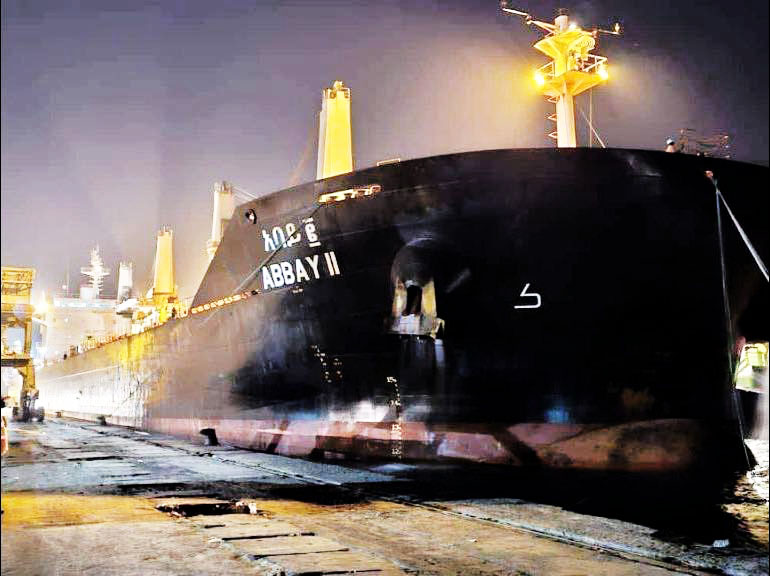
For decades, the story of African national shipping lines has been one of unfulfilled promise characterized by huge debts, political interferences, and strategic drift.
Kenya shares in this fate simply because the Kenya National Shipping Line (KNSL), founded in 1987, eventually succumbed to the same pressures.
Today the argument for revisiting that model is no longer ideological. It is practical, commercial, and increasingly urgent. This is why.
Each year, Kenya transfers an estimated $3 billion in freight payments to foreign carriers — principally global majors such as Maersk and MSC — which dominate cargo moving through Mombasa and the emerging Lamu port.
That is not merely a balance-of-payments concern. It reflects a structural vulnerability in one of Africa’s most dynamic trade economies. A nation that exports tea, coffee, horticulture, and a growing volume of manufactured goods cannot indefinitely outsource the very vessels that carry its economic lifeblood.
But history demands humility. KNSL’s first iteration promised maritime sovereignty but delivered debt and dormancy. The temptation today is either to abandon the idea — as recent dissolution discussions in 2025 suggested — or to revive it in its old, state-heavy form. Both paths carry significant risk.
A more disciplined, phased revival — anchored in commercial logic, institutional reform, and international best practice — offers a credible alternative.
Learning from peers
International experience provides useful guardrails. Denmark’s Maersk, though privately owned, thrives within a policy ecosystem of tax incentives, world-class registries, and strong maritime institutions.
Singapore built a global hub not by owning ships, but by creating a regulatory environment that attracts them. Neither model is directly transferable, but both underscore a core insight: national advantage in shipping does not require full state ownership — but it does benefit from strategic state stewardship.
Closer to home, the Ethiopian Shipping and Logistics Services Enterprise offers a particularly instructive analogy. Despite being landlocked, Ethiopia has built a profitable shipping enterprise by integrating maritime transport with inland logistics, dry ports, and freight forwarding. By controlling the full supply chain from Djibouti’s port to Addis Ababa’s hinterland, it secures cargo volumes and reduces dependence on foreign intermediaries. Value lies not in ships alone, but in the logistics ecosystem around them. That integrated model is one Kenya could adapt to its own coastal geography.
Policy and governance
The policy framework is already taking shape. Kenya’s 2024 Integrated National Transport Policy explicitly supports reviving KNSL, promoting cabotage, and establishing an open ship registry under KenShip. Legislative amendments to the Merchant Shipping Act could introduce calibrated cabotage rules — reserving certain domestic and regional routes for Kenyan-flagged vessels — while remaining consistent with World Trade Organisation obligations.
Priority berthing at Kenya Ports Authority facilities and guaranteed access to a portion of government cargo could provide the initial demand base any national carrier needs to survive its formative years.
Governance, however, will determine success or failure. KNSL must be insulated from the political pressures that undermined its first iteration. A professional, independent board — comprising maritime experts, private-sector representatives, and international advisors — is essential. Performance-based management contracts, transparent procurement, and annual independent audits should be non-negotiable. Without these safeguards, no strategy will withstand the test of time.
Financing and fleet strategy
Financing, often cited as the greatest obstacle, is better understood as an opportunity for innovation. Kenya need not — and should not — commit billions upfront to vessel acquisition. A hybrid public-private partnership (PPP) model offers a more sustainable pathway.
The state could retain strategic oversight (a minimum 51 per cent stake) while inviting an experienced international or regional operator to provide equity, technical expertise, and market access. Multilateral institutions such as the African Development Bank and the World Bank have indicated readiness to support such ventures through concessional financing and guarantees, particularly where they align with regional integration and decarbonisation goals.
Operationally, the strategy should be deliberately modest at the outset. Rather than competing with global carriers on deep-sea routes, KNSL could focus on niche markets where it holds natural advantages: feeder services along the East African coast, bulk transport for essential imports (fuel, grain, fertilizer), and regional trade within the East African Community. Initial operations could rely on bareboat charters — leasing vessels without heavy capital burden — allowing the company to build experience, refine its business model, and generate cash flow before transitioning to ownership via hire-purchase arrangements.
Human capital
Human capital will be decisive. Kenya already produces a growing pool of seafarers through institutions accredited by the Kenya Maritime Authority, but retention remains a challenge. A revived KNSL could anchor this talent domestically, offering structured career paths and competitive remuneration.
Crucially, cadets from local maritime education and training institutions — such as the Bandari Maritime Academy, Technical University of Mombasa and other accredited MET Institutions in Kenya — could gain invaluable sea time aboard the KNSL merchant fleet. This would directly address a persistent bottleneck in African maritime training: the shortage of available tonnage for cadets to complete mandatory seagoing service under the International Convention on Standards of Training, Certification and Watchkeeping for Seafarers (STCW).
In turn, that would create a sustainable pipeline of skilled Kenyan officers and crew, reducing reliance on expensive expatriate personnel and enhancing the fleet’s long-term competitiveness.
Partnerships with international maritime academies and adherence to International Maritime Organization (IMO) standards on greenhouse gas reduction — including support for the IMO’s 2023 Strategy on net-zero emissions by or around 2050 — would further ensure that Kenyan crews and vessels meet global benchmarks. The goal should be clear: a fleet that is not only Kenyan-flagged but substantially Kenyan-crewed and Kenyan-trained.
The logistics ecosystem advantage
Beyond ships and crews lies a broader opportunity. The port of Mombasa, the emerging Lamu port, the Standard Gauge Railway, and an expanding network of highways form the backbone of a regional trade corridor. Integrating KNSL into this infrastructure — linking sea transport with inland depots, dry ports, and digital logistics platforms — could replicate and even surpass the Ethiopian model. The result would be a seamless supply chain capable of moving goods from farm gate to foreign market with reduced friction and improved reliability.
Risks and realism
Sceptics will rightly note the high capital intensity of shipping, the volatility of freight markets, and the dominance of established global carriers. These risks are real, but they are not insurmountable — precisely why a phased, partnership-driven approach is essential.
The failures of past African national carriers — from the East African National Shipping Line to those of Nigeria and Ghana — were not inevitable. They resulted from overreach, weak governance, and isolation from market realities. Kenya has the advantage of hindsight and should use it.
A functional national fleet would help retain foreign exchange, create thousands of direct and indirect jobs, and offer Kenyan exporters greater reliability and bargaining power. It would enhance strategic autonomy during global disruptions — when shipping capacity becomes scarce and expensive — and support Kenya’s ambition to serve as the maritime anchor of East Africa. In an era defined by supply chain competition, influence over logistics is arguably as important as production itself.
The way forward
What is required now is measured momentum. The government should convene a multi-stakeholder task force — bringing together the Kenya Maritime Authority, Kenya Ports Authority, the National Treasury, private-sector players, and international experts — to translate policy into actionable steps. Clear timelines, measurable targets, and public accountability should guide the process from day one.
Reviving KNSL is not about nostalgia, but rather about practical foresight. Kenya stands at a maritime crossroads, with the infrastructure, geography, and trade volumes to support a stronger regional shipping presence.
The question is whether to remain primarily a customer in the global logistics system or to seek a role as a participant with greater agency and influence. With discipline, transparency, and strategic patience, a positive outcome is well within reach.