


In the turbulent and complex maritime domain, leadership is not merely a function of rank—it is a matter of readiness, judgment, and the capacity to act decisively when stakes are highest.
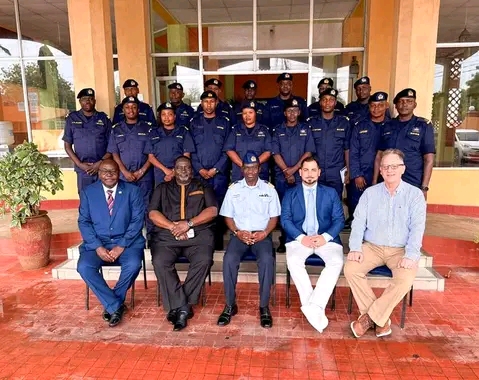
The ongoing five-day Mid-Level Leadership and Command Course for the Kenya Coast Guard Service, which commenced on 20 April 2026 under the sponsorship of the United Nations Institute for Training and Research (UNITAR), is far more than a routine training exercise.
It represents a strategic investment in the human capital that ultimately determines the effectiveness of maritime governance and security along Kenya’s coastline and beyond.
Officially opened by Bruno I. Shioso, the course emphasizes three pillars of modern coast guard success: maritime safety, maritime security, and leadership. Yet beneath these themes lies a deeper reality: mid-level officers are the operational nerve center of any disciplined service.
They translate policy into action, interpret command intent under pressure, and routinely make split-second decisions with national and international implications.
For Kenya—whose maritime domain is both an economic lifeline and a security frontier—the stakes could not be higher. The Port of Mombasa remains a critical gateway for regional trade, while the wider Western Indian Ocean faces persistent threats, namely trafficking, illegal fishing, and evolving forms of transnational organized crime.
In this environment, the effectiveness of maritime enforcement depends not solely on high-level strategy or frontline execution, but on the competence of those in between.
Mid-level leaders are the custodians of discipline and the interpreters of doctrine. They manage teams, coordinate missions, and ensure that standard operating procedures are not only followed but intelligently adapted to dynamic situations.
When a suspicious vessel is intercepted, a distress call received, or intelligence suggests a potential security breach, these officers must assess risk, deploy resources, and maintain command coherence. Their leadership determines whether outcomes are merely adequate or truly effective.
Historically, many maritime institutions across the region have underinvested in this critical tier. Training has often focused on either entry-level skills or senior command courses, leaving a gap in the professional development continuum. The result has been a mismatch between strategic ambition and operational capability. This new initiative signals a recognition that strengthening mid-level leadership is not optional—it is essential.
UNITAR’s involvement adds an important international dimension, underscoring that maritime challenges are inherently transnational and that solutions must be informed by global best practices.
Exposure to international standards, case studies, and peer learning broadens perspectives and enhances interoperability with other agencies and nations. This is especially relevant in a region where coordinated responses are increasingly necessary to address shared threats.
Yet training alone is insufficient. Its true value will be measured by how effectively lessons are institutionalized within the Kenya Coast Guard Service. That requires a deliberate effort to align training outcomes with career progression, performance evaluation, and organizational culture.
Mid-level officers who demonstrate enhanced leadership and decision-making must be empowered, recognized, and given opportunities to influence broader operational frameworks.
Moreover, leadership development must extend beyond technical competence to include ethical leadership, accountability, and resilience. In an era of intense public scrutiny of institutions, the conduct of officers at every level reflects directly on the service’s credibility. Mid-level leaders, positioned between command and rank-and-file personnel, play a pivotal role in shaping this institutional ethos.
The course’s focus on maritime safety and security also deserves particular attention. Safety is not merely about regulatory compliance; it is about cultivating a proactive culture that anticipates and mitigates risks before they escalate. Security demands vigilance, intelligence integration, and the ability to respond swiftly to emerging threats. Both require leaders who think critically, communicate effectively, and act decisively under pressure.
Kenya’s maritime future will be defined not only by infrastructure investments or policy frameworks, but by the quality of its people. Ships, surveillance systems, and legal instruments are tools. It is the men and women who operate them—especially those in mid-level command positions—who determine whether those tools are used effectively.
As this five-day course progresses, it should be viewed as part of a broader, long-term commitment to professional excellence within the Kenya Coast Guard Service. Continuous training, mentorship, and exposure to evolving maritime challenges must become the norm, not the exception. Only then can the service fully realize its mandate of safeguarding Kenya’s maritime interests.
In the final analysis, investing in mid-level leadership is an investment in stability, security, and service delivery. It strengthens the chain of command, enhances operational efficiency, and ensures that decisions made at sea are informed, timely, and aligned with national objectives. For a country whose fortunes are so closely tied to the sea, this is not just a priority—it is an imperative.