


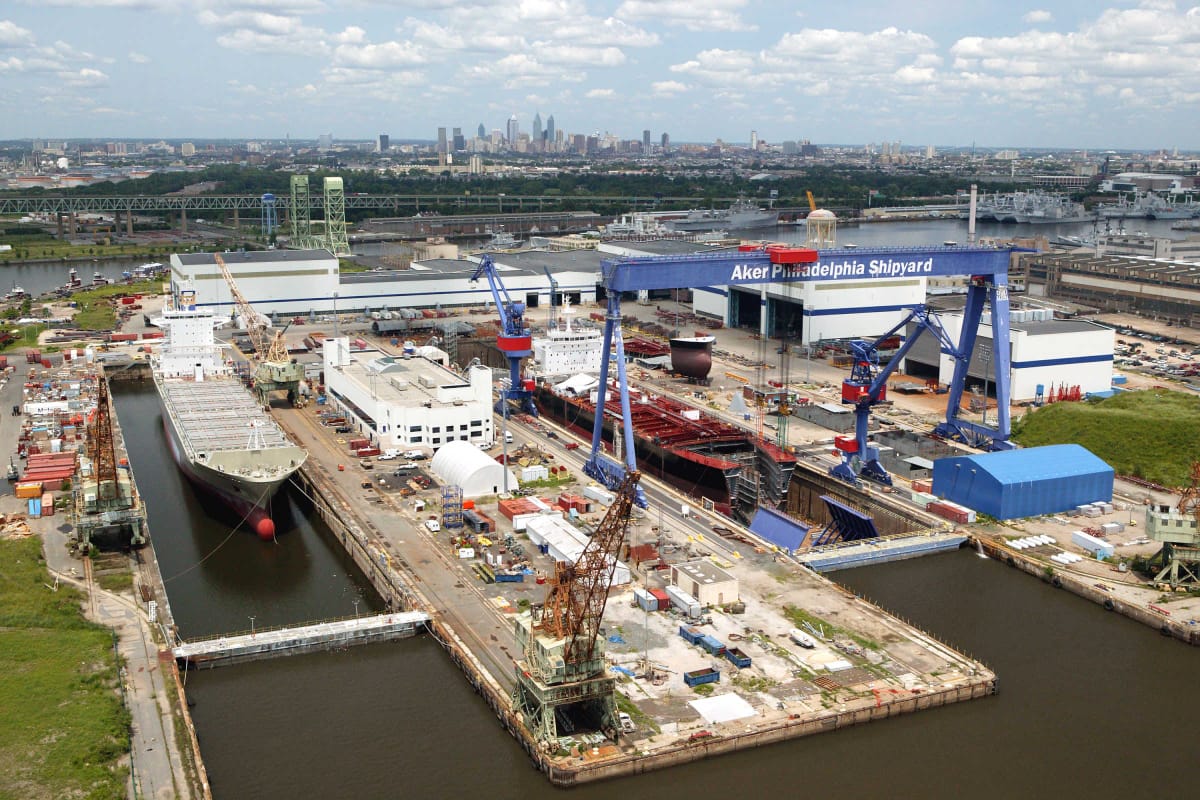
The decline of the U.S. shipbuilding industry is, besides being an industrial failure, a strategic warning for emerging maritime nations, particularly in Africa.
What we are witnessing is a stark reality — a nation that once ruled the world’s shipyards has steadily ceded its maritime industrial base to more agile, state-backed rivals in Asia.
In the aftermath of World War II, the United States stood as an unrivaled shipbuilding powerhouse. Its yards produced vessels at a scale that reshaped global trade and naval power.
But that dominance proved fleeting. Rather than consolidating its advantage, the U.S. allowed its shipbuilding ecosystem to erode under rising costs, inconsistent policy direction, and chronic failure to modernize.
Meanwhile, South Korea, China, and Japan pursued a different path—treating shipbuilding not merely as an industry, but as a strategic national asset. Through coordinated industrial policy, subsidies, workforce development, and relentless technological innovation, they transformed their shipyards into global leaders.
Today, these nations command over 90 percent of commercial shipbuilding, leaving the U.S. with a marginal share of global output.
Why this matters for Africa
For African nations seeking to build or expand their maritime capabilities, the US experience offers critical lessons.
Firstly, shipbuilding is strategic infrastructure. It is the backbone of maritime trade, naval capability, and economic resilience. A continent that cannot build or maintain its own vessels remains dependent on foreign yards—and vulnerable to supply chain shocks.
Secondly, protectionism without innovation fails. The Jones Act, intended to protect U.S. domestic shipping, has paradoxically driven up costs and reduced competitiveness. For African countries considering local content policies, the lesson is clear: protection must be paired with modernization, efficiency, and skills development.
Thirdly, long-term vision beats short-term politics. America’s decline was not sudden—it was a slow unraveling caused by decades of policy neglect, inconsistent funding, and a lack of national consensus. Africa’s blue economy ambitions cannot succeed without sustained, generational commitment.
The human and strategic cost
Shipyards are not just production sites—they are communities and knowledge hubs. Their decline represents lost jobs, eroded technical skills, and the fading of industrial heritage.
For the U.S., this has translated into naval readiness concerns, with submarine and carrier production backlogs now measured in years.
For Africa, where youth unemployment remains acute, shipbuilding offers a pathway to mass employment and technology transfer. Countries like South Africa, Egypt, and Kenya have begun exploring shipyard rehabilitation and construction—but these efforts require patient capital, policy coherence, and regional collaboration.
A way forward for Africa
The collapse of U.S. shipbuilding is not inevitable—it is instructive. It shows that even dominant industries can falter without vision, coordination, and sustained investment.
Conversely, it demonstrates that with the right mix of policy, innovation, and commitment, nations can rise to global leadership.
As Africa expands its blue economy, maritime stakeholders should consider: Regional integration of shipbuilding capacity – No single African nation may achieve scale alone, but collaborative hubs (e.g., in the Indian Ocean or Gulf of Guinea) could change the calculus.
It should also consider deliberate skills pipelines. This is about ensuring that technical and vocational training aligned with shipyard needs must begin now.
They should also consider balanced local content policies, that protection for emerging yards must be time-bound and tied to performance benchmarks.
They should consider strategic partnerships as well. They need to learn from Asian shipbuilders, while avoiding debt traps, requires careful deal structuring.
The seas reward foresight
The oceans have always rewarded those who think ahead. The question for Africa is not whether to invest in shipbuilding, but how to do so intelligently—learning from America’s decline and Asia’s ascent.
The US may yet chart a new course. But for now, its drift serves as a powerful reminder: in maritime affairs, standing still is the same as moving backward.
[Andrew Mwangura is a maritime analyst and commentator on African shipping, trade, and blue economy affairs.]