


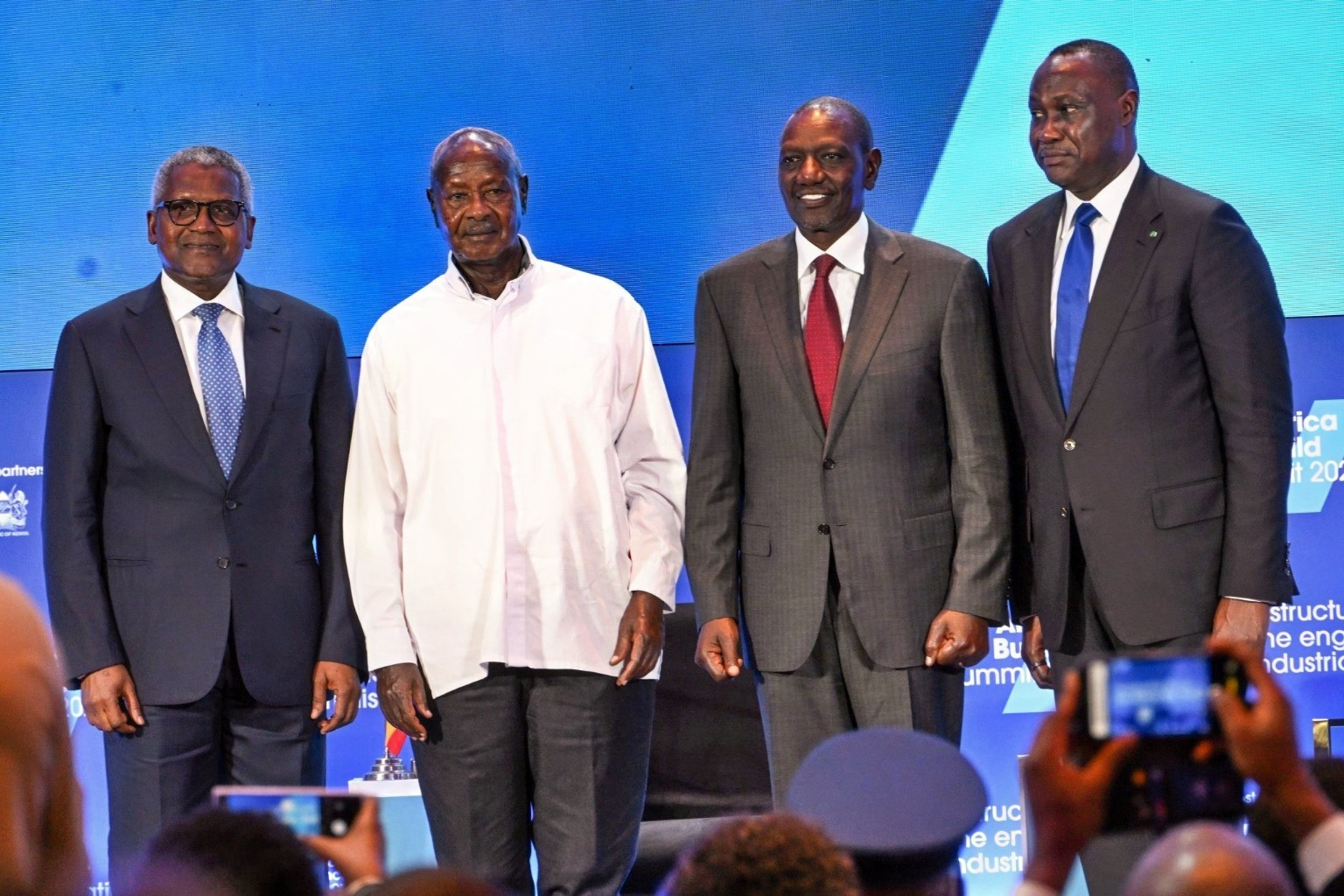
A proposal by the Africa’s wealthiest man Aliko Dangote to build an oil refinery in Tanga offers East Africa a rare sovereign opportunity.
Whether the region seizes or squanders it will define its energy future for a generation.
Dangote’s disclosure at the Africa We Build Summit in Nairobi this week is something that deserves more than the passing notice of a conference communiqué.
President William Ruto, speaking at a gathering convened by the Africa Finance Corporation (AFC), disclosed that Kenya and Uganda are in active negotiations with Aliko Dangote — Africa’s richest man and the architect of the continent’s most ambitious refining project — to build a crude oil refinery in Tanzania.
The proposed facility would be fed by a pipeline from the Kenyan port city of Mombasa to the Tanzanian coastal town of Tanga, processing crude from the Democratic Republic of Congo and South Sudan. This is a proposal of structural consequence for the entire East African region, and it demands both enthusiasm and scrutiny in equal measure.
The strategic logic underpinning the initiative is, at its core, irrefutable. East Africa has long suffered the paradox of energy poverty in a resource-rich neighbourhood. Uganda sits atop proven oil reserves in the Albertine Graben. South Sudan has pumped crude for decades, much of it through pipelines terminating in distant ports.
The DRC holds hydrocarbons of considerable promise. And yet, across the region, petroleum products are largely imported as refined goods—purchased at global market prices, shipped across oceans, offloaded at Mombasa or Dar es Salaam, and then trucked inland at ruinous cost.
The AFC’s own State of Africa’s Infrastructure Report, released concurrently at the summit, underscored this absurdity with characteristic bluntness: approximately 70 percent of Africa’s refined fuel consumption is currently imported, with demand projected to grow by 56 percent by 2040—opening an import gap equivalent to at least two more Dangote-scale refineries.
The opportunity, the report concluded, is particularly pronounced in East Africa, where refining infrastructure remains conspicuously limited.
Into this gap steps the Dangote proposition. The Lagos refinery—operating at 650,000 barrels per day and already supplying refined petroleum to markets including Kenya, Tanzania, Ghana, and Côte d’Ivoire—has proven that African-owned, African-scaled refining capacity is not only achievable but commercially viable.
Dangote himself, at the Nairobi summit, proposed extending that model eastward, framing deeper regional integration as a prerequisite for success. It is a model whose time has clearly arrived. The war in Iran, cited by President Ruto, has once again exposed the volatility inherent in Africa’s dependence on Middle Eastern fuel supplies.
Energy security is not an abstraction; it is felt at the fuel pump, in the cost of goods transport, in electricity generation prices, and in the competitiveness of every industry that relies on petroleum derivatives.
The Mombasa–Tanga pipeline corridor is itself a geopolitically intricate proposition. Kenya and Tanzania have not always moved in lockstep on regional infrastructure decisions. Uganda’s long journey toward oil exports was defined precisely by its 2016 choice to route the East African Crude Oil Pipeline (EACOP) through Tanzania to Tanga rather than through Kenya to Lamu or Mombasa—a decision driven by security concerns, cost calculations, and diplomatic preference.
That pipeline is now under active construction, with all pipes delivered to site as of this month, and first oil anticipated in the second half of 2026. The proposed Mombasa–Tanga link for a Dangote-associated refinery would thus create a complementary east–west infrastructure arc, tying together the region’s two principal Indian Ocean corridor nodes—Mombasa and Tanga—in a common energy value chain. This is not redundancy; it is resilience.
However, enthusiasm must not outpace institutional rigour. Several substantive questions remain unanswered, and the region’s history of announced infrastructure projects languishing between headline and groundbreaking counsels caution.
The first concerns feedstock. While South Sudanese and Congolese crude are cited as inputs, both sources carry considerable geopolitical complexity. South Sudan’s production has been repeatedly disrupted by internal conflict and transit disputes with Sudan.
The DRC’s upstream oil sector remains largely underdeveloped, with meaningful commercial production years away by most estimates. A refinery predicated on these supply streams must be built with full awareness of the logistical and political risks embedded in each.
The second question is governance and ownership structure. The Dangote refinery in Lagos succeeded in part because it was conceived, financed, and executed under a single controlling ownership with a unified commercial vision.
A trilateral East African venture—involving Kenya, Uganda, Tanzania, and a private Nigerian industrial conglomerate—will require governance architecture of considerable sophistication. Who holds regulatory authority? How are off-take agreements structured? What mechanisms exist to prevent any one sovereign party from subordinating commercial logic to short-term political interests?
These are not hypothetical concerns; they are the fault lines along which previous regional energy projects in East Africa have fractured.
Third, the role of Mombasa itself requires clarification. The Port of Mombasa remains the region’s preeminent maritime gateway and the natural origin point for a pipeline spur running south to Tanga. Kenya Pipeline Company already operates one of East Africa’s most developed petroleum product distribution networks, with trunk lines reaching as far as Kisumu on Lake Victoria.
Any new pipeline infrastructure connecting to Tanga must be designed to enhance—not cannibalise—Kenya’s existing infrastructure investment, and to create genuine commercial incentive for Kenyan participation, rather than treating Mombasa merely as a transit point for value capture elsewhere.
President Museveni, also present at the summit, struck a pragmatic note when he announced Uganda’s parallel plans for a smaller domestic refinery with a capacity of 50,000 to 60,000 barrels per day, intended to serve Uganda, parts of Tanzania, and Kenya.
He framed the broader industrialisation imperative in characteristically vivid terms, citing iron ore sold at $45 per tonne being resold abroad at $900. The principle is identical for oil: exporting unrefined crude while importing finished petroleum products is a form of structural self-impoverishment.
No amount of favourable commodity pricing in any single year compensates for the compounding loss of value addition, employment, and technological capacity.
For East Africa, the Dangote proposal—if it progresses beyond the summit stage—represents precisely the kind of catalytic private-sector engagement the region’s energy future requires. But regional governments must approach it not as supplicants grateful for external investment, but as sovereign partners with their own infrastructure, institutions, and long-term interests to protect.
The pipeline route must be agreed on commercially sound terms. The refinery’s governance must be transparent and accountable. Feedstock supply chains must be stress-tested against realistic scenarios, not best-case assumptions. And the benefits—in refined product supply, employment, tax revenue, and technology transfer—must be structured to accrue to the people of East Africa, not merely to those who finance and build the facility.
The Africa Finance Corporation’s report is right: the opportunity in East African refining is particularly strong. But the window is not infinite. Energy transitions underway globally mean the commercial lifespan of new petroleum refining infrastructure must be calculated carefully.
A refinery built today must remain economically viable over a twenty- to thirty-year horizon in a world where electrification of transport and industry is accelerating. This is not an argument against building; it is an argument for building with intelligence and with an eye to flexibility in feedstock and product mix.
The refinery that East Africa needs is one that transforms the region’s relationship with its own resources—capturing value at home, creating skilled employment, anchoring regional energy security, and positioning the Indian Ocean coast as a hub of industrial rather than merely extractive activity.
Whether the Dangote–Kenya–Uganda–Tanzania conversation that began this week in Nairobi ultimately produces that refinery will depend not on the ambition of the proposal—which is considerable—but on the quality of institutions, the rigour of negotiations, and the political will of governments to subordinate short-term positioning to long-term regional interest. The stakes are high enough to demand nothing less.