


There was a time—not so long ago—when the Port of Mombasa was spoken of in regional trade circles with a mixture of exasperation and resignation. Congestion, delays, and inefficiencies were the accepted norms.
Today, that narrative has been decisively retired. The proof came this week, not in the form of a press release, but in the presence of a high-level delegation from West Africa, seated around a table at Mombasa, taking careful notes.
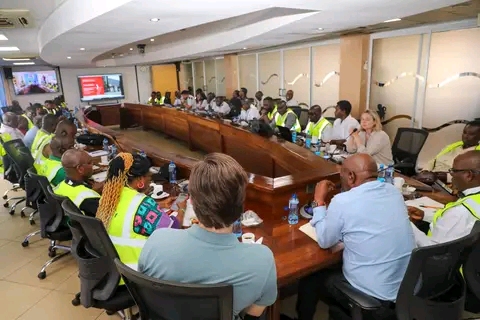
On Tuesday, a delegation from the ECOWAS Commission and the Abidjan-Lagos Corridor member states—Côte d’Ivoire, Ghana, Togo, Benin, and Nigeria—engaged in an insightful, day-long session with key port stakeholders at the Port of Mombasa.
The meeting, spearheaded by TradeMark Africa, was officially framed as an effort to strengthen institutional relations between ECOWAS and the East African Community (EAC). But beneath the diplomatic language lay a more powerful reality: West Africa has come to learn from East Africa’s maritime transformation.
From learning to leading
For decades, trade facilitation discussions across Africa followed a predictable pattern. Best practices were imported from Rotterdam, Singapore, or Dubai. African ports compared themselves to extra-continental benchmarks, rarely looking sideways at one another. That paradigm is shifting.
The ECOWAS delegation’s presence in Mombasa signals a growing recognition that some of the continent’s most practical, replicable trade solutions are being developed right here, by Africans, for Africans.
The Abidjan-Lagos Corridor is one of West Africa’s most vital trade arteries, linking five countries that collectively account for over 70 percent of ECOWAS’ economic activity. Yet the corridor has long been plagued by bureaucratic bottlenecks, inconsistent border procedures, and infrastructure constraints.
In seeking to strengthen the operational effectiveness of Joint Border Committees along that corridor, the ECOWAS Commission identified a natural partner in TradeMark Africa—an organization with a proven track record of transforming East Africa’s trade landscape.
What Mombasa showed
During the engagement, the Kenya Ports Authority (KPA) laid out what has become an increasingly compelling case study in port turnaround. The authority highlighted ongoing infrastructure and operational projects aimed at improving efficiency not only at the Port of Mombasa but along the entire Northern Corridor.
From Berth 19B to electronic cargo tracking systems, from scanner upgrades to streamlined vessel turnaround times, the presentation was less a lecture and more a live demonstration of what focused investment and institutional discipline can achieve.
But the real learning happened in the questions asked. West African officials probed deeply on how Mombasa coordinates with hinterland countries. They also observed how joint border operations are managed between Kenya and Uganda.
Another learning was on how data sharing between the Kenya Revenue Authority (KRA) and the Uganda Revenue Authority (URA) has reduced transit times and improved revenue assurance. These were not academic inquiries. They were the practical concerns of policymakers tasked with making the Abidjan-Lagos Corridor function as seamlessly as the Northern Corridor is beginning to.
The presence of senior officials from both KRA and URA underscored a critical point: trade facilitation is not a solo act. The Port of Mombasa’s efficiency is not an isolated miracle. It is the product of a complex ecosystem involving customs authorities, port operators, logistics providers, and neighboring states. That ecosystem, imperfect as it still is, has matured to a point where it can now serve as a model for other regions.
TradeMark Africa’s quiet revolution
Behind much of this progress stands TradeMark Africa, an organization that has mastered the art of delivering measurable impact without demanding the spotlight. Through capacity-building programmes, knowledge-exchange initiatives, and strategic funding of key projects, TradeMark Africa has helped transform the Northern Corridor from a byword for delay into a benchmark for progressive reform.
The Abidjan-Lagos Corridor Programme, which TradeMark Africa is implementing, represents a bold experiment in cross-regional collaboration. Bringing West African stakeholders to Mombasa was not merely a courtesy visit. It was a deliberate knowledge-transfer exercise designed to accelerate reforms along one of West Africa’s most economically significant trade routes. If even a fraction of Mombasa’s efficiency gains can be replicated between Lagos and Abidjan, the impact on West African trade—and ultimately on the lives of millions of traders and consumers—will be profound.
The deeper Lesson
What makes this moment significant is not just the technical exchange but the underlying principle it represents. Africa’s trade future will not be built solely through partnerships with distant economic powers. It will be built through collaboration between African institutions willing to share successes, admit failures, and learn from one another.
The ECOWAS delegation did not come to Mombasa because Dutch or Chinese consultants wrote a report recommending it. They came because they had heard, through the quiet but persistent grapevine of African trade professionals, that something worth seeing was happening on the Kenyan coast. They came because results speak louder than presentations.
The engagement this week should not be allowed to fade into the archives of diplomatic photo opportunities. It must be followed by sustained technical cooperation, structured knowledge-exchange programs, and measurable targets for corridor improvements in West Africa. TradeMark Africa, KPA, KRA, URA, and the relevant ECOWAS institutions have an opportunity here to institutionalize what began as a promising conversation.
For Kenya, the visit carries its own message. The Port of Mombasa is no longer just a national asset or a regional gateway. It has become a continental reference point—a place where African policymakers come to see what is possible when vision, investment, and collaboration align. That status brings responsibility. The work of continuous improvement cannot pause. The port must keep modernizing, the corridors must keep smoothing, and the data must keep informing better decisions.
The visit by the ECOWAS and Abidjan-Lagos Corridor delegation to Mombasa was brief. But its implications could be lasting. For too long, Africa’s maritime and trade facilitation conversations have looked outward while ignoring the expertise growing in our own backyard. This week, that changed—at least a little.
Mombasa opened its doors. West Africa came to learn. If both sides honor the promise of that exchange, the real winner will be African trade itself. And that is an editorial no one needs to write twice.