


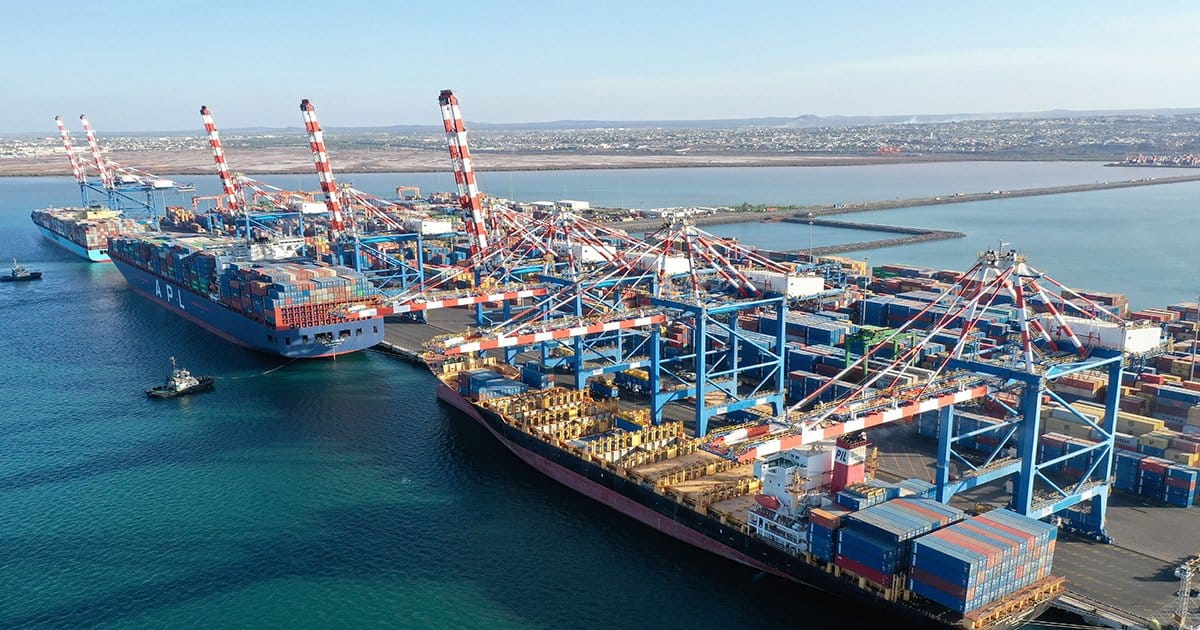
The latest data from Ethiopia’s Ministry of Transport and Logistics tell a story of staggering, unambiguous dominance. In the 2025/26 fiscal year, the ports of SGTD (Doraleh Container Terminal) and DMP/PAID handled 15.34 million tons of maritime cargo destined for or originating from Ethiopia—a staggering 96.71 percent of the total. Djibouti’s northern facility at Tadjourah contributed another 1.23 percent, bringing the country’s total infrastructure share to roughly 98 percent of Ethiopia’s seaborne trade. By contrast, Berbera managed just 2.74 percent, while Mombasa, via the tortuous Moyale corridor, scraped by with a meager 0.56 percent.
These are not marginal differences. They are the hallmarks of structural hegemony.
Ethiopia, Africa’s second-most populous nation and the continent’s largest landlocked economy, moves the overwhelming majority of its external trade through a single neighbour’s ports. The flow is heavily lopsided toward imports—roughly 15.93 million tons against a paltry 1.64 million tons of exports—driven by fuel, general cargo, fertiliser, and dry bulk. Road transport still accounts for the lion’s share of inland movement (about 80 percent), while the electrified Addis Ababa–Djibouti Railway handles nearly 19 percent—and its share continues to grow. The integration of rail spurs directly into the Doraleh terminals has shortened handling times and improved reliability. Recent capacity expansions at SGTD, including additional ultra-large container vessel cranes and expanded yard space, have further cemented the corridor’s operational edge.
Geography, however, is not destiny, even if it helps. Djibouti sits at the southern mouth of the Red Sea, astride one of the world’s busiest shipping lanes. Its deep-water facilities, modern container and multipurpose terminals, and established multimodal links to Ethiopia’s economic heartland around Addis Ababa create a combination that competitors have yet to replicate at scale. Transit times, schedule predictability, and the density of supporting logistics services—trucking, warehousing, and free-zone operations—favour the entrenched route. Even amid Red Sea disruptions and elevated security risks, Djiboutian authorities have prioritised Ethiopian cargo, including fertiliser shipments ahead of the rainy season, reinforcing a reputation for reliability that rivals cannot easily dislodge.
Berbera’s challenge is real but remains limited. Operated with DP World investment and backed by improved highway links, the Somaliland port has modernised significantly. Vessel turnaround times have improved, and container capacity has expanded. Ethiopia’s interest in diversification—evident in political outreach and commercial exploration—has given Berbera a modest foothold. Yet the absence of a completed high-capacity rail connection to Ethiopia’s core markets, combined with a thinner overall logistics ecosystem and persistent political uncertainty surrounding Somaliland’s status, keeps volumes marginal. Mombasa’s share is even smaller; the sheer distance and friction along the northern Kenyan and southern Ethiopian road corridors make it a distant third option for most cargoes.
Djibouti’s dominance is no accident. Decades of sustained investment in port infrastructure, the railway, road corridors, and customs facilitation have created a powerful path dependency. Port and transit activities form a central pillar of Djibouti’s economy. For Ethiopia, the arrangement delivers volume and relative predictability, even as policymakers continue to seek alternatives to mitigate single-route vulnerability and reduce Addis Ababa’s bargaining disadvantage. Diversification efforts—whether through equity discussions at Tadjourah, Berbera corridor development, or longer-term aspirations involving Eritrean ports—have so far produced only incremental shifts. The data make plain that the rhetoric about alternatives has not yet translated into any meaningful reallocation of cargo.
This concentration carries implications far beyond bilateral trade volumes. In a region marked by Red Sea insecurity, shifting great-power presence, and competing corridor ambitions—including Chinese-linked projects in Djibouti and UAE-backed ones in Berbera—the Ethiopia–Djibouti axis remains the operational backbone of Horn of Africa logistics. Transshipment growth at Doraleh, experiments in sea-air connectivity, and plans for deeper hinterland links toward South Sudan and Uganda suggest Djibouti is positioning itself as more than a pure gateway for Ethiopian imports. At the same time, Ethiopia’s rapid population and economic growth will continue to test capacity. Sustained dominance will require relentless investment in efficiency, competitive pricing, and seamless multimodal performance.
Critics of the status quo rightly note the costs of such heavy dependence—both financial and strategic. High logistics expenses relative to export earnings and the risks of concentrated routing are legitimate concerns for Addis Ababa. Yet the numbers demonstrate that alternative corridors have not yet delivered the scale, speed, or reliability needed to displace the incumbent. To say Djibouti is crushing the competition is not merely a slogan; it is the current operational reality.