


The ocean may appear limitless, but its resources are not.
For generations, Africa’s coastal communities have depended on the sea for food, employment, cultural identity and economic survival. Yet beneath the blue horizon lies an increasingly fierce struggle over who controls, monitors and benefits from marine resources.
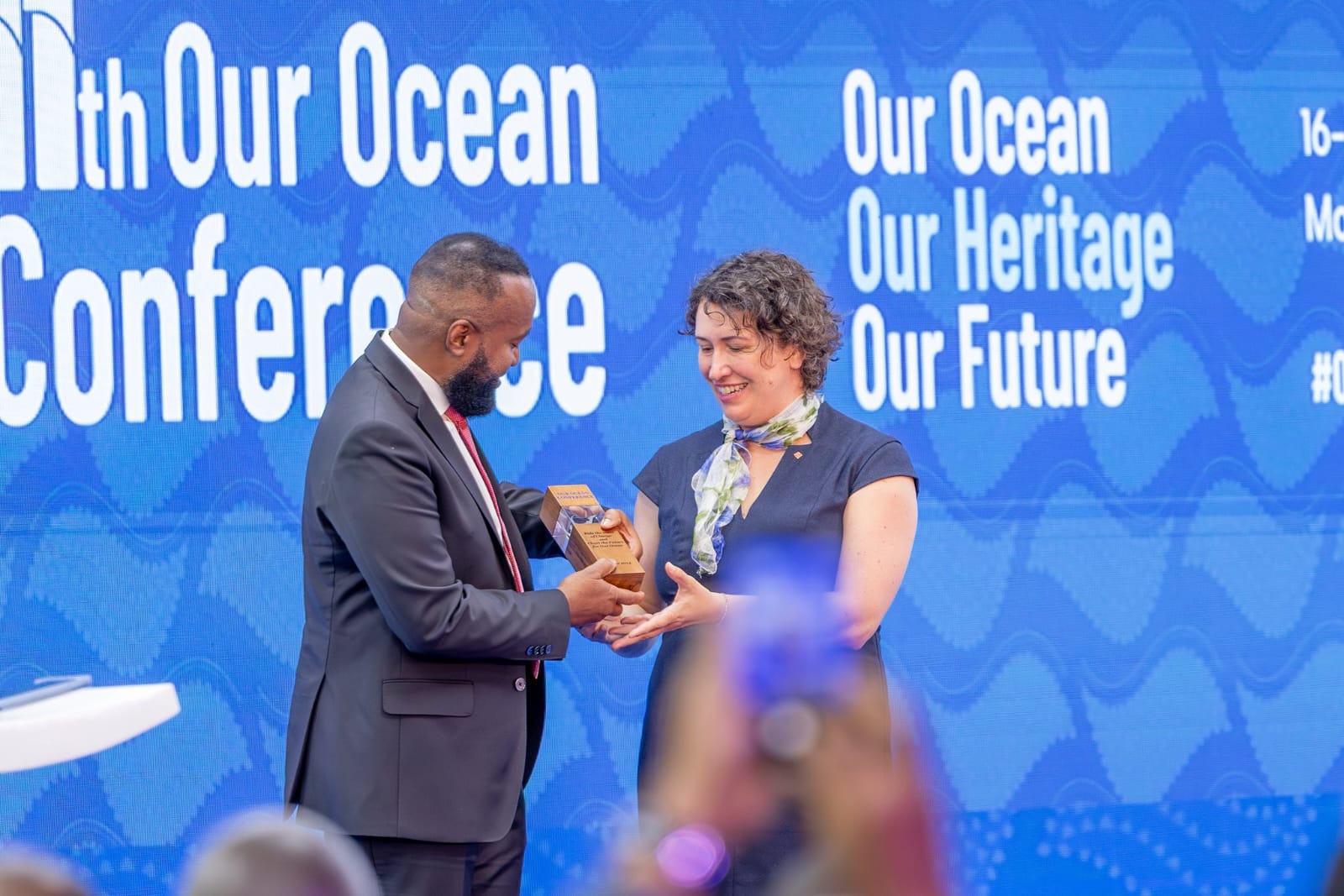
That is why China’s decision not to sign the Mombasa Declaration on fisheries transparency—adopted during the 11th Our Ocean Conference in Kenya in June 2026—deserves far more than diplomatic footnotes. It should provoke a fundamental conversation about transparency, sovereignty, accountability and the future of Africa’s blue economy.
The declaration, signed by seven African countries—Cameroon, The Gambia, Ghana, Guinea, Liberia, the Republic of the Congo and Somalia—together with Belgium, Chile, the Dominican Republic, France, Panama, Papua New Guinea, Peru and South Korea, seeks to strengthen fisheries governance through greater transparency in vessel registries, fishing licences, access agreements, quotas, vessel identification and beneficial ownership.
These may sound like technical bureaucratic measures. They are not.
They go to the heart of whether African countries can genuinely exercise sovereignty over their own waters.
Transparency is the first line of defence
Illegal, unreported and unregulated (IUU) fishing is not simply an environmental problem. It is an economic crime, a food-security threat, a maritime-governance challenge and, increasingly, a national-security concern.
The Food and Agriculture Organization has described IUU fishing as one of the greatest threats to marine ecosystems and has warned that it can be connected with other crimes, including tax evasion, money laundering, smuggling and violations of labour standards.
The damage is particularly severe for developing coastal states.
When industrial vessels remove fish illegally or operate in ways that make their activities difficult to monitor, they do not merely take fish. They take away income from artisanal fishermen, undermine legitimate fishing enterprises, weaken food security, destroy marine habitats and deprive governments of taxes, licence fees and other economic benefits.
This is why transparency matters.
A fishing vessel whose ownership is hidden is difficult to hold accountable. A vessel whose beneficial owner cannot be identified can change flags, companies or registrations and continue operating. A fishing licence that is not publicly accessible cannot easily be scrutinised. A quota whose allocation is opaque creates opportunities for corruption. And a vessel whose movements cannot be independently verified can exploit the vastness of the ocean to operate beyond effective oversight.
The Mombasa Declaration therefore represents something bigger than a fisheries agreement. It is an attempt to turn transparency into a practical instrument of maritime governance.
China’s decision raises legitimate questions
China’s refusal to sign should not automatically be interpreted as proof that every Chinese fishing vessel is engaged in illegal activity. That would be unfair, analytically weak and diplomatically counterproductive.
Nor should Africa turn the issue into an anti-China campaign.
China remains a major economic partner for African countries and an important participant in global fisheries governance. Indeed, an important fact must not be overlooked: China became a party to the FAO Agreement on Port State Measures (PSMA) in April 2025. The PSMA is the first binding international agreement specifically targeting IUU fishing and is designed to prevent vessels engaged in illegal fishing from using ports and landing illicit catches.
That makes the Mombasa question even more interesting.
If transparency is necessary to make fisheries governance work, why should any major fishing nation hesitate to support stronger disclosure of vessel ownership, licences, fishing authorisations, quotas and fishing activity?
The answer should not be presumed. Instead, Beijing should be invited to explain its position openly and constructively.
The issue is not whether China should be singled out. The issue is whether all major fishing powers—China, the European Union, the United States and others—should be held to the same standards of transparency and accountability.
Africa should demand nothing less.
The real victim is the African fisherman
The greatest danger is that this debate becomes another geopolitical argument between powerful states while African fishing communities remain the victims.
The fisherman in Lamu does not care whether a vessel is Chinese, European, Korean, American or African. He wants to know whether the vessel fishing near his traditional grounds has a valid licence. He wants to know whether it is respecting the law. He wants to know whether the fish stocks will still exist tomorrow. He wants to know why catches are declining while large industrial vessels continue operating offshore. And he wants to know why the economic value generated by Africa’s marine resources so often leaves Africa.
These are legitimate questions.
The reported losses from IUU fishing in the Western Indian Ocean illustrate the magnitude of the challenge. ADF, citing WWF estimates, reported that Kenya, Madagascar, Mozambique, South Africa and Tanzania lost as much as $142.8 million annually between 2015 and 2021 from illegal shrimp and tuna fishing.
For countries struggling to finance schools, hospitals, coastal infrastructure, fisheries development and employment programmes, such losses are not abstract numbers. They represent stolen economic opportunity.
There is another uncomfortable truth.
Foreign fishing fleets cannot exploit African waters without African weaknesses. Illegal fishing thrives where monitoring systems are inadequate, where fisheries licences are opaque, where corruption exists, where vessel ownership is hidden, where maritime surveillance is weak and where enforcement agencies operate without sufficient resources.
Africa therefore cannot place all responsibility on foreign fleets. African governments must look inward.
Who issues the licences? Who verifies vessel ownership? Who monitors fishing activity? Who inspects vessels? Who checks catch documentation? Who monitors transshipment at sea? Who investigates violations? Who prosecutes offenders? And, perhaps most importantly, who benefits financially from access to African fisheries?
These questions require answers.
The fight against IUU fishing will not be won through declarations alone. It requires functioning institutions, independent enforcement, reliable data and political courage.
Kenya has a particular responsibility
For Kenya, the Mombasa Declaration carries special significance.
Mombasa is not merely a port city. It is the maritime gateway to East and Central Africa and a strategic centre of the Western Indian Ocean economy.
Kenya’s blue economy ambitions cannot be realised while illegal fishing undermines marine ecosystems and impoverishes coastal communities. The country must therefore move beyond rhetoric and strengthen its fisheries monitoring, control and surveillance architecture.
Kenya should invest in modern vessel monitoring systems, satellite-based surveillance, automatic identification and other lawful maritime-domain-awareness capabilities. It should strengthen cooperation between fisheries authorities, the Kenya Maritime Authority, the Kenya Coast Guard Service, the Kenya Ports Authority, customs, police, environmental agencies and other relevant institutions.
But technology alone is insufficient.
A sophisticated tracking system is useless if authorities do not act on what it reveals. A public vessel registry is meaningless if ownership information is incomplete. A fisheries law is ineffective if violations are rarely prosecuted. And a port inspection regime cannot succeed if enforcement is compromised by political or commercial interests.
Ports must become the gatekeepers
This is where the FAO Port State Measures Agreement becomes particularly important.
The PSMA seeks to prevent vessels engaged in IUU fishing from using ports and landing illicit catches. Its underlying logic is straightforward: make it increasingly difficult for illegally caught fish to enter legitimate markets.
For African ports, this is a powerful tool.
Mombasa, Dar es Salaam, Maputo, Beira, Durban, Walvis Bay, Port Victoria and other Indian Ocean and African ports should not become safe havens for illegally caught fish.
Port State Control and fisheries inspection must therefore be strengthened, harmonised and properly resourced.
The port should become the point where authorities ask difficult questions:
Where did this fish come from? Which vessel caught it? Under which licence? In which waters? Was the vessel authorised to fish there? Who owns the vessel? Was there any transshipment? Can the catch be traced? Does the documentation correspond with independent vessel-tracking information?
If the answers do not add up, the fish should not simply enter the market.
The emerging digital architecture of the PSMA offers opportunities in this regard. FAO has developed information-exchange mechanisms that support advance requests for port entry and the verification of transshipment and landing information. Africa should exploit these systems aggressively.
The flag-of-convenience problem
One of the most important issues raised by the Mombasa Declaration is vessel ownership and beneficial ownership.
A vessel may fly one country’s flag while being owned by a company registered somewhere else and controlled through a complex corporate structure spanning several jurisdictions. This fragmentation can create accountability gaps.
It is therefore essential to distinguish between the flag state, the operator, the registered owner and the ultimate beneficial owner. When a fishing company violates fisheries laws, authorities must be able to identify the person or corporate entity ultimately responsible. Otherwise, enforcement becomes a game of maritime hide-and-seek.
Africa should resist the temptation to register foreign fishing vessels simply because registration fees or other short-term revenues are attractive. A flag is not merely a commercial commodity. It carries regulatory responsibilities.
African flag states must ensure that vessels flying their flags comply with international fisheries obligations, labour standards, safety requirements and environmental rules.
IUU fishing is also a security issue
The fisheries debate must also be integrated into the wider maritime-security agenda.
Where fish stocks collapse, coastal communities lose income. Where livelihoods disappear, desperation grows. Where governance fails, criminal networks can move into the space. IUU fishing can intersect with smuggling, trafficking, corruption, money laundering and other forms of maritime crime. FAO itself notes the connection between IUU fishing and other criminal activities.
This is why fisheries enforcement should not be treated as the exclusive responsibility of fisheries departments. It is a whole-of-government and, increasingly, a whole-of-region responsibility.
The Western Indian Ocean needs stronger cooperation in information sharing, joint surveillance, fisheries enforcement, prosecution and vessel tracking. The Indian Ocean Commission, regional fisheries management organisations, coastal states and maritime-security institutions must work more closely together.
Africa must not choose between China and the West
There is a temptation, whenever China is involved, to reduce every issue to great-power competition. That would be a mistake.
Africa should not have to choose between China and the United States. Nor should African maritime policy become an extension of geopolitical rivalry.
African countries should instead choose transparency, sustainability and sovereignty.
If a Chinese vessel complies with African law, it should be welcomed. If a European vessel complies with African law, it should be welcomed. If an African vessel complies with African law, it should be welcomed.
But if any vessel violates African fisheries laws, it should face the same consequences. That is what genuine sovereignty means.
China can still turn a controversy into an opportunity
Beijing has an opportunity to respond positively.
Rather than allowing the Mombasa Declaration to become a source of suspicion, China could engage with its African partners and explain its concerns while supporting the broader principle that fisheries governance should be transparent and evidence-based.
China’s accession to the PSMA demonstrated that Beijing can participate in binding international fisheries governance. The next step should be greater transparency across the fishing value chain.
China could work with African coastal states to improve vessel identification, strengthen information exchange, enhance traceability and improve compliance by vessels operating in African waters.
Such cooperation would benefit everyone. It would protect legitimate Chinese fishing companies from reputational damage caused by rogue operators. It would give African governments greater confidence in fisheries partnerships. And, most importantly, it would protect the marine ecosystems upon which millions depend.
The Mombasa Declaration must not become another forgotten document
Africa has no shortage of declarations, strategies and conference communiqués. What it lacks is consistent implementation.
The Mombasa Declaration must therefore move from conference halls into fishing harbours, patrol vessels, ports, courts and government databases.
Its commitments should be measurable:
· Governments should publish fishing licences.
· Vessel registries should be accessible.
· Beneficial ownership should be disclosed.
· Fishing authorisations and quotas should be transparent.
· Industrial vessels should have unique identifiers.
· Catch documentation should be verifiable.
· Transshipment should be monitored.
· Port inspections should be risk-based and properly documented.
· Violations should result in meaningful penalties.
· Repeat offenders should not be allowed simply to change names, flags or corporate structures and return to African waters.
The ocean belongs to future generations too
The central lesson from the Mombasa debate is simple: the fight against IUU fishing is ultimately a fight over the future of the ocean.
Africa cannot build a prosperous blue economy on an empty ocean. It cannot create sustainable fisheries while allowing destructive practices to continue unchecked. It cannot promise coastal youth jobs while marine resources are depleted. It cannot attract responsible investment while regulatory uncertainty and opaque ownership structures persist. And it cannot claim maritime sovereignty if it lacks the capacity to know who is fishing in its waters, what they are catching and where the catch is going.
The sea may be vast, but accountability cannot be.
China’s decision not to sign the Mombasa Declaration should therefore be viewed not simply as a diplomatic disagreement, but as an opportunity for Africa to ask much bigger questions about the governance of its marine resources.
Those questions should be directed not only at China but at every foreign and domestic fishing power operating in African waters.
The standard must be universal. The rules must be transparent. The enforcement must be impartial. And the benefits of Africa’s blue economy must flow first and foremost to the people whose lives and livelihoods depend upon the sea.
The future of Africa’s fisheries cannot be negotiated in the shadows. It must be governed in the light.