


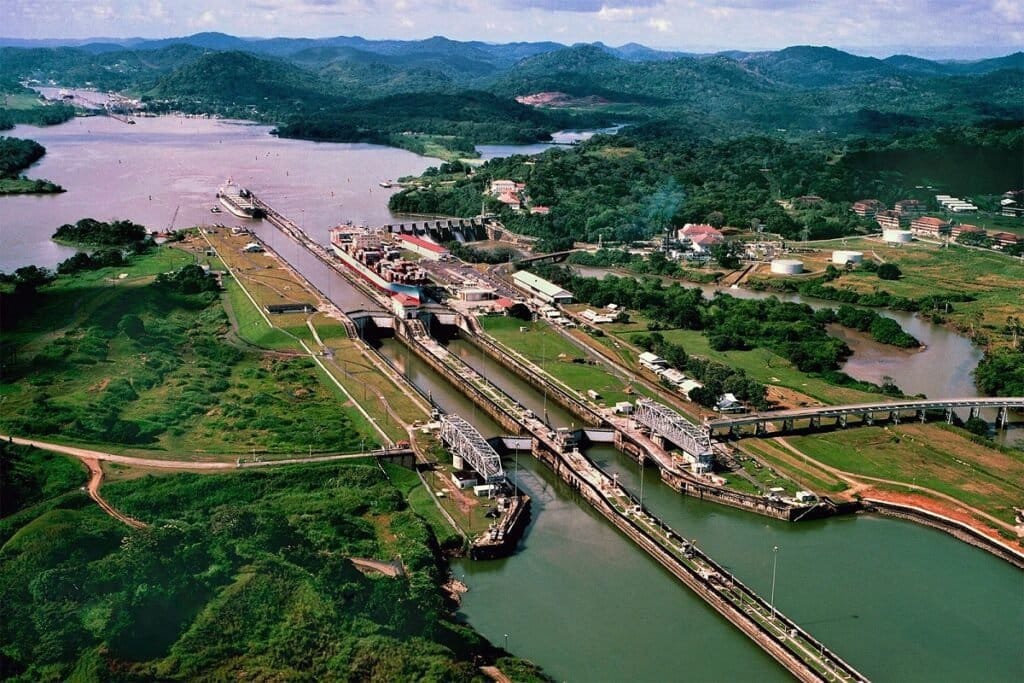
Container shipping is once again treating a genuine operational challenge as an excuse for opaque mark-ups. As drought and El Niño-driven restrictions force the Panama Canal Authority to lower draft limits for Neopanamax vessels, a handful of major carriers have rolled out “Panama Canal Adjustment Surcharges.” The amounts vary widely—from MSC’s relatively modest $100 per TEU to CMA CGM’s eye-watering $500, with Hapag-Lloyd at $130 and Ocean Network Express at $150. Conspicuously absent from every announcement is the one thing shippers actually need: a clear, verifiable explanation of how these figures were calculated and how they relate to the actual extra costs carriers are absorbing.
The underlying physical problem is not invented. Lower water levels mean reduced maximum drafts—already trending toward 14.63 metres and then 14.48 metres—forcing larger ships to lose capacity. An 11,100-TEU vessel on the Gemini Cooperation’s US2 service, for example, can lose roughly 1,100 TEUs of payload. That lost space must be paid for somehow. Auctioned transit slots and higher effective costs per box are real. The Global Shippers’ Forum is right to note that higher canal-related expenses are being spread across fewer containers. No serious observer disputes that carriers face higher unit costs when they cannot load ships to their design capacity.
The dispute is over accountability. Drewry’s Simon Heaney put it bluntly: carriers announce the surcharges “but, as usual, there is little context or justification provided to customers.” His colleague Philip Damas points to a structural peculiarity of the canal’s charging regime—Neopanamax lock fees are essentially per-ship charges, with no scaling factor for cargo volume. Larger vessels therefore generate more revenue for the canal authority while simultaneously suffering greater relative capacity loss under draft limits. Shippers, however, are simply presented with a flat per-TEU surcharge and told to absorb it.
The inconsistencies are already visible within the same alliance. On the Gemini US2 service, Hapag-Lloyd is applying its $130 surcharge while Maersk is not. Using public vessel data, the arithmetic is uncomfortable: on a ship carrying roughly equal shares of cargo for the two lines, Hapag’s customers can end up paying hundreds of thousands of dollars more in surcharges than Maersk’s on the identical voyage—even though the carriers’ underlying canal costs are the same. On a smaller 8,600-TEU vessel, the disparity remains large. This is not cost recovery; it is selective cost recovery dressed up as necessity.
Worse, the pattern is familiar. Container shipping has long specialised in a thicket of accessorial charges—bunker adjustment factors, peak-season surcharges, congestion fees, equipment imbalances—whose precise relationship to actual incremental costs is rarely disclosed in real time or with granular justification. Regulatory constraints prevent carriers from openly coordinating rates, yet the same regulatory environment has done little to force meaningful transparency on how those rates are calculated. The result is predictable: mistrust. Shippers conclude, often with good reason, that they are being charged not for the recovery of documented extra expense but for whatever the market will bear at the moment of announcement.
The Panama Canal Authority has at least stated that the current draft reductions will not cut the number of daily transits—an improvement on earlier capacity rationing that sent auction fees soaring for non-container vessels. That distinction matters. It means the primary impact is payload reduction rather than outright denial of passage. Carriers therefore have a narrower and more measurable cost increase to recover. Measuring it—and then explaining the measurement—should not be beyond the industry’s capabilities.
Further draft restrictions are expected as dry-season effects intensify, and more lines will almost certainly join the four already imposing surcharges. Before that happens, the industry has a choice. It can continue the habitual practice of opaque, take-it-or-leave-it levies that erode what little trust remains between carriers and cargo interests. Or it can treat the Panama Canal situation as an opportunity to demonstrate that surcharges can be calculated, documented, and applied with a degree of fairness and visibility that matches the seriousness of the underlying physical constraint.
Shippers are not asking carriers to operate at a loss. They are asking for the elementary commercial courtesy of knowing what they are paying for. In an industry that moves the majority of the world’s manufactured goods, that request is neither radical nor unreasonable. The water levels in Gatun Lake are outside anyone’s immediate control. The transparency of the surcharges is not.