


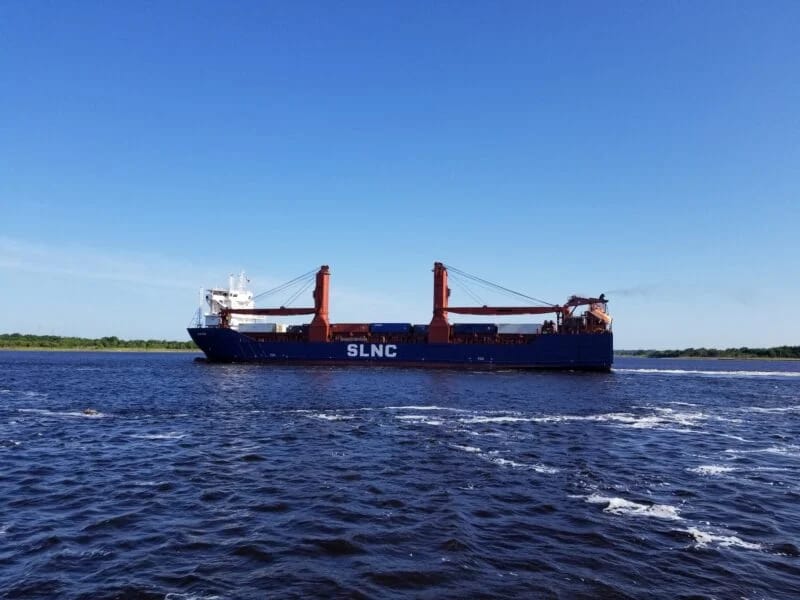
On August 18, 2026, the U.S.-flagged multipurpose cargo vessel SLNC York began flooding in the western Pacific while sailing in ballast from Honolulu to Naha, Okinawa. The 2010-built, 9,500-deadweight-ton Ro-Ro and heavy-lift ship, operated by Schuyler Line Navigation Company, suffered what appears to have been a catastrophic propeller-shaft failure—the shaft sheared or shifted several feet aft, destroying the stern seals and inundating the engine spaces. The 18 crew members fought the ingress, then prudently abandoned ship. They were rescued by the Hong Kong-flagged LPG tanker Pacific Yantai, which diverted to assist. All hands are safe. The SLNC York remains afloat and stable, with salvage coordination underway involving U.S. and Japanese authorities; a Japanese tug is en route.
That is the operational summary. The strategic summary is grimmer.
The SLNC York is no ordinary tramp freighter. It sails under the U.S. flag and participates in the Maritime Administration’s Maritime Security Program (MSP)—the small, commercially operated fleet of militarily useful vessels the Department of Defense relies upon for surge sealift in crisis or war. These ships are meant to be available, crewed by American mariners, and ready to move ammunition, vehicles, and sustainment across oceans when commercial capacity vanishes or access is denied. A shaft failure that forces the complete evacuation of an MSP vessel on a routine Pacific transit is therefore not a commercial inconvenience. It is a readiness signal.
Mechanical casualties happen. Shaft seals fail. Propulsion trains break. What matters is the pattern—and the context. The U.S.-flag deep-sea fleet is already historically and comparatively tiny: roughly 180 self-propelled vessels of size, a fraction of the capacity available to peer competitors or even some allies. The MSP exists precisely because market forces alone will not sustain a militarily useful U.S.-flag presence. When one of those scarce hulls suffers a disabling casualty mid-Pacific and must be abandoned, even temporarily, the margin for error narrows further.
The rescue itself underscores another uncomfortable truth. A U.S. Navy destroyer was reportedly en route, yet the first effective assistance came from a foreign-flag tanker that happened to be nearby. International maritime custom and the professional seamanship of the Pacific Yantai’s crew deserve full credit; lives were protected. But in a high-end conflict in the western Pacific—precisely the theater this ship was transiting—the assumption that neutral or friendly commercial vessels will always be available and willing to divert is optimistic at best. Self-reliance in emergency response is precisely what a robust national fleet is supposed to provide.
None of this is an indictment of the SLNC York’s officers and crew. They did what professional mariners do: controlled flooding as long as practicable, then prioritized human life. The operator’s transparent communications and coordination with Coast Guards on both sides of the Pacific are likewise commendable. The problem is systemic. Aging tonnage, the high cost of U.S. crewing and maintenance, and chronic under-capitalization of the domestic maritime sector produce a fleet that is both indispensable and brittle. A 16-year-old multipurpose ship is not elderly by global standards, yet it still proved vulnerable to a single-point mechanical failure that left it adrift and unmanned in open ocean.
Policymakers who treat the Merchant Marine as a nostalgic afterthought or a regulatory burden should take note. Sealift is not theoretical. In every major contingency since 1945, commercial shipping under effective national control has been decisive. The Pacific is the most demanding theater for that capacity—vast distances, contested logistics, and an adversary that has invested heavily in both military and commercial maritime power. Losing even temporary availability of an MSP vessel on a peacetime run to Okinawa is a reminder that readiness is measured in hulls that can actually complete the voyage.
The SLNC York will likely be towed to port, repaired or surveyed, and returned to service—or not. The larger question is whether the United States will treat this episode as an isolated mechanical event or as evidence that the industrial and policy foundations of its sealift enterprise require serious reinforcement: more modern ships, better sustainment, and a clearer recognition that a U.S.-flag presence on the high seas is a national security asset, not an optional commercial luxury. The ocean does not care about budgets or political cycles. It only tests whether the ships and the people who sail them are ready.