


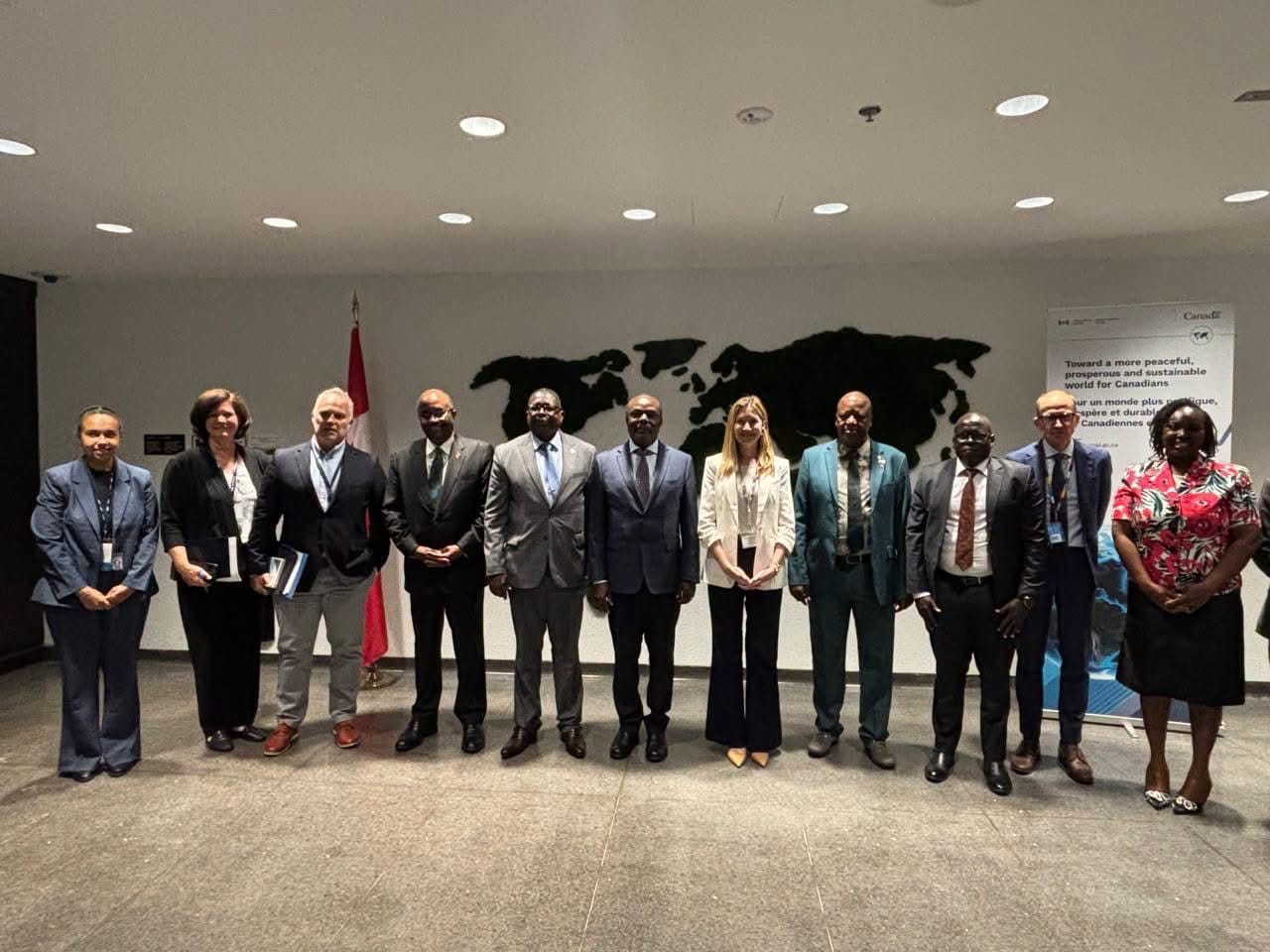
In the quiet industrial town of Wallaceburg, Ontario, a routine-looking diplomatic visit on 12 August 2026 carried outsized significance. Acting High Commissioner of Kenya to Canada, Amb. Geoffrey E. Kaituko, CBS, walked the floors of Lambton Conveyor Limited, a 60-year-old Canadian manufacturer of grain handling, storage and conditioning systems. Alongside a delegation from Mennonite Economic Development Associates (MEDA) led by President and CEO Dr. Dorothy Nyambi, he met company chairman Prashant Pathak and senior officials. The talks centred on a practical proposition: Canadian technology and investment to help Kenya slash post-harvest losses, expand storage capacity, stabilise farmer prices and harden national food systems.
This was not photo-op diplomacy. It was economic diplomacy in its most useful form—converting goodwill into bankable projects that address a structural vulnerability. Kenya’s agricultural sector remains the backbone of livelihoods and a major source of export earnings, yet it continues to haemorrhage value after the harvest. Studies estimate maize storage losses alone at around 36 percent in some analyses—hundreds of thousands of tonnes annually—driven by pests such as the maize weevil and larger grain borer, inadequate drying and poor storage infrastructure. Broader post-harvest losses across food systems are frequently cited in the 30 percent range, with particularly acute impacts in humid zones. Farmers sell at harvest-time lows or watch produce spoil, while consumers face price volatility and the country imports to fill gaps.
Lambton Conveyor brings precisely the capabilities Kenya needs: robust, customisable systems for conveying, elevating, storing and conditioning grain, already deployed across dozens of countries. The proposed partnership targets the weak links—receiving, drying, protected storage and market readiness—so that more of what is grown reaches tables and markets in usable condition. The benefits cascade: higher effective yields without expanding cultivated area, improved price stability for smallholders, reduced aflatoxin and quality-rejection risks, greater national buffer stocks and a more resilient food system against climate shocks. For Canadian firms, it opens a gateway into East Africa and the wider AfCFTA market; for Kenya, it accelerates technology transfer and private investment aligned with national priorities under Vision 2030 and the Bottom-Up Economic Transformation Agenda.
The Wallaceburg engagement fits a larger pattern of deliberate Kenya–Canada outreach. Earlier in 2026, Amb. Kaituko positioned Kenya at the Second Canada–Africa Business Summit in Guelph as a commercial, financial and innovation hub, and a strategic gateway to the East African Community, COMESA and the African Continental Free Trade Area. He stressed the shift “from dialogue to delivery”—projects financed, investments mobilised, enterprises built and jobs created. Sectoral conversations have ranged across affordable housing, renewable energy, infrastructure, healthcare, agri-processing, critical minerals, ICT, manufacturing and tourism. A concurrent Kenya–Canada Trade and Investment Mission, alongside ongoing diaspora engagement, reinforces the same message: the relationship must move beyond traditional aid and modest trade volumes into productive capital and technology partnerships.
Bilateral trade remains modest relative to potential. Canadian exports to Kenya have hovered in the low-to-mid hundreds of millions of dollars in recent years, with cereals, machinery and other goods prominent; Kenyan exports to Canada centre on coffee, tea and related products. Canadian direct investment stock is similarly limited. These figures underscore the opportunity rather than the ceiling. Canada’s strengths in agri-food technology, mining expertise, clean energy and skills development map cleanly onto Kenya’s growth priorities. MEDA’s long-standing work in Kenya—supporting small and medium enterprises, women and youth entrepreneurs, and value-chain development in agriculture—provides an established bridge for inclusive implementation.
Critics of economic diplomacy sometimes dismiss such visits as ceremonial. That view underestimates the practical mechanics of investment facilitation. High-level presence signals seriousness, opens doors inside both governments and private boards, and reduces information asymmetries. Follow-through will determine success: concrete feasibility studies, risk-sharing instruments, local content and skills-transfer clauses, alignment with county-level storage and aggregation centres, and measurable targets for loss reduction and capacity addition. Public-private partnerships and blended finance can de-risk early projects. Integration with existing Kenyan initiatives—warehouse receipt systems, hermetic storage promotion and digital aggregation platforms—will amplify impact rather than reinvent the wheel.
There are risks. Technology must be adapted to Kenyan scales, climates and farmer organisations rather than simply transplanted. Financing must reach beyond large commercial operators to include cooperatives and smallholders if inclusion is genuine. Regulatory clarity, reliable power for conditioning systems and last-mile logistics remain necessary complements. Yet the alternative—continued high losses, volatile prices and under-utilised Canadian comparative advantage—is costlier.
Kenya’s food security and agricultural transformation cannot wait for perfect conditions. Post-harvest waste is a solvable problem with available technology and willing partners. Amb. Kaituko’s Wallaceburg visit illustrates the quiet, persistent work of turning diplomatic capital into productive assets. If Canada and Kenya convert this engagement into operating facilities, trained technicians and lower loss rates, they will demonstrate that economic diplomacy delivers when it prioritises the practical over the performative. The grain that is saved will feed families, stabilise markets and prove that shared prosperity is built one concrete partnership at a time.
The test is delivery. The opportunity is clear.
Andrew Mwangura is a Mombasa based maritime analyst.