


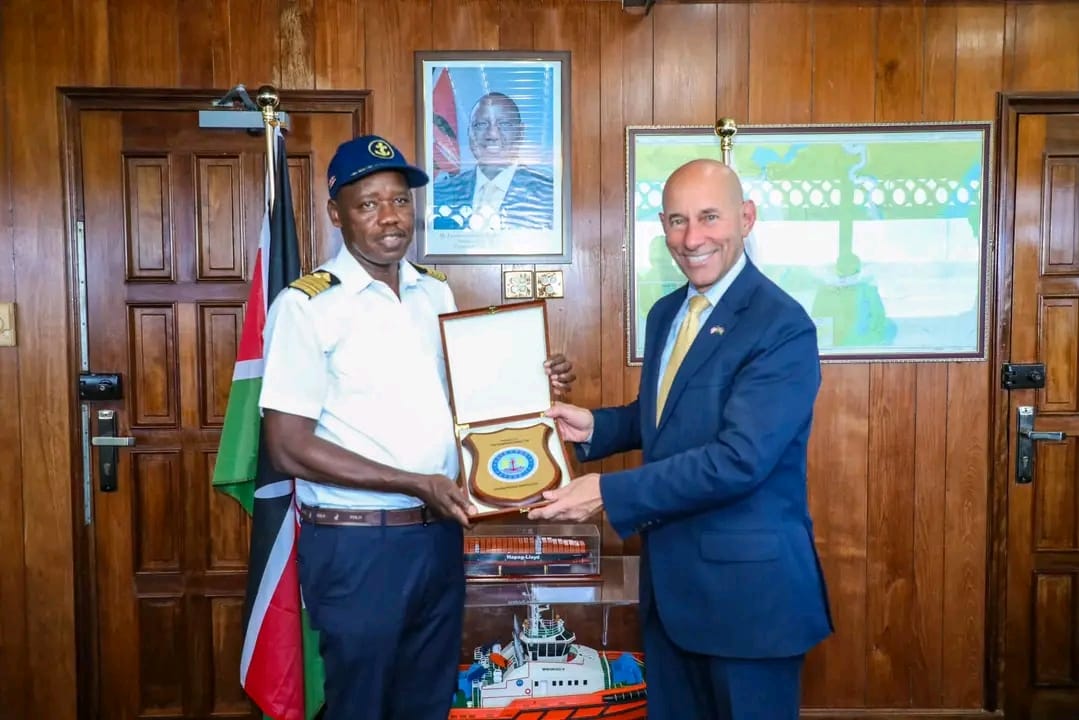
When U.S. Assistant Secretary of State for African Affairs Frank Garcia stood at the Port of Mombasa and praised the Kenya Ports Authority for streamlining operations, it was easy to file the moment under routine bilateral niceties. It was not. In the context of Washington’s recalibrated Africa policy under the Trump administration, the visit—and the language surrounding it—reveals a deliberate strategic bet on Kenya as a commercial and maritime partner at a time when great-power competition in the Indian Ocean is intensifying.
Garcia, sworn in on 1 June 2026, is not a traditional diplomat. A 28-year Navy veteran who rose to captain and later served as chief of staff at the National Reconnaissance Office, he brings an intelligence and operational lens to the Africa portfolio. His personal history with Mombasa dates to a junior-officer port call that, by his own account, sparked a lasting interest in the continent. That biographical detail is more than colour. It helps explain why the Port of Mombasa featured so prominently during his recent East Africa tour, which also included stops in Zambia and Ethiopia and a visit aboard the USS Ross, an Arleigh Burke-class destroyer then in Kenyan waters.
The policy frame Garcia is implementing is explicit: trade and investment over open-ended aid, commercial diplomacy rooted in American interests, and partnerships that deliver measurable mutual benefit. In his confirmation testimony and subsequent remarks, he has criticised past U.S. approaches for fostering dependency and “spreading divisive ideologies.” The new emphasis is narrower and more transactional—expanding two-way trade, securing critical supply chains, and deepening security cooperation with willing partners. Kenya sits near the top of that list.
Why the Port Matters
The Port of Mombasa is not merely Kenya’s economic artery; it is the principal maritime gateway for a large portion of East and Central Africa. Uganda, Rwanda, South Sudan, eastern Democratic Republic of Congo, and parts of Tanzania all depend on it to varying degrees. Efficiency gains at the port therefore have regional multiplier effects. Garcia’s public recognition of KPA’s operational improvements and digitalisation efforts is thus both a compliment and a signal: the United States sees value in a reliable, modern gateway that can handle growing trade volumes without the friction that has historically plagued many African ports.
Capt. William Ruto, KPA’s chief executive, used the occasion to highlight the tangible work underway—port expansion, automation, the ongoing construction of Dongo Kundu Berth 1, and planned channel dredging. Independent reporting confirms the status of the flagship project: as of mid-September 2026, the KSh 41 billion Dongo Kundu Berth 1 stood at roughly 16 percent completion, with an expected operational target of December 2028. The berth is designed as the maritime anchor for the 3,000-acre Dongo Kundu Special Economic Zone, which authorities project could generate around 5,600 direct jobs once fully operational. Ninety-four investors have expressed interest; a handful, including Taifa Gas, have already begun construction on site. Dredging to 15 metres is underway to accommodate larger vessels.
These are not abstract infrastructure talking points. They represent Kenya’s attempt to convert geographic advantage into industrial and logistics capacity. Success would strengthen Nairobi’s claim as the preferred regional hub and reduce the relative attractiveness of competing corridors. Failure—or further delay—would leave the SEZ underutilised and the port more vulnerable to congestion as regional demand grows.
The Strategic Layer
Garcia’s presence at the port, coming days after the USS Ross’s port call and concurrent with professional exchanges between the Kenya Navy and U.S. sailors, underscores a second dimension: maritime security. The Western Indian Ocean remains a theatre of illicit activity, great-power naval presence, and competition for influence. Washington’s interest in a capable Kenyan partner that can host logistics support, participate in exercises such as Cutlass Express, and contribute to maritime domain awareness is longstanding. Under the current administration, that interest is being framed more explicitly in terms of protecting sea lanes and countering influence that Washington regards as corrosive to a rules-based order.
China’s extensive infrastructure footprint across the region, including in Kenya, provides the unspoken backdrop. Beijing has financed and built major projects; Washington is now offering technology, private-sector partnerships, and security cooperation as a different model. The U.S. Trade and Development Agency’s recent engagement with African port officials, including from Kenya, on modernisation and digitalisation technologies is consistent with this approach. Whether American firms can compete on cost and speed with Chinese contractors remains an open question. Garcia’s visit is an attempt to keep Kenya oriented toward the former.
Opportunities and Risks for Kenya
For Nairobi, the attention is welcome. An America First commercial diplomacy that privileges trade and investment over traditional aid aligns with President William Ruto’s own emphasis on jobs, industrialisation, and reducing dependency. The extension of AGOA through 2028 and ongoing reciprocal trade discussions provide concrete platforms. Health cooperation, critical minerals, and defence ties have also featured in recent high-level conversations.
Yet the risks are real. Commercial diplomacy can prove fickle if American private capital does not follow the diplomatic rhetoric. Infrastructure projects such as Dongo Kundu still face the classic challenges of land compensation, utilities, internal roads, and bureaucratic friction—issues Kenyan officials themselves have acknowledged in recent weeks. Over-reliance on any single external partner, whether Washington or Beijing, carries strategic costs. And a purely transactional U.S. approach may leave less room for the softer, longer-term capacity-building that previous administrations sometimes prioritised.
Garcia’s praise of KPA is therefore best read as both recognition of progress and a test. The United States is signalling that it values a modernising, efficient Port of Mombasa and is prepared to deepen engagement around it. Kenya’s response will determine whether that engagement translates into sustained investment, technology transfer, and security cooperation—or remains a series of well-photographed visits. In an era when African ports are becoming nodes in global competition, Mombasa’s ability to deliver results will matter more than any single envoy’s compliments.