


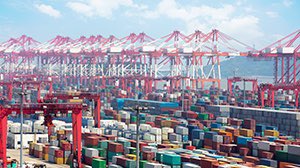
At Yangshan Deep-Water Port’s Phase IV terminal in Shanghai, the future of global trade already runs on rails of code and batteries. Automated quay cranes, fleets of driverless automated guided vehicles (AGVs), rail-mounted gantries, thousands of sensors, and a centralized intelligent terminal operating system coordinate the movement of containers with minimal direct human intervention. The entire operation—from ship to yard—functions as a single, tightly coupled cyber-physical network. Cranes that once required operators in elevated cabins are now controlled remotely, sometimes from control rooms tens of kilometers away. AGVs navigate via magnetic nails embedded in the pavement, path-optimization algorithms, and real-time traffic management. Digital twins mirror the physical terminal so operators and software can anticipate conflicts, reduce reshuffling, and keep the flow continuous.
This is not incremental modernization. It is a qualitative shift: physical infrastructure and digital systems operating as one organism. The terminal has repeatedly set productivity benchmarks—single-crane peaks exceeding 60 moves per hour, annual throughput that has grown well beyond initial design capacity (now reported in the range of 8 million TEUs), labor productivity more than double that of conventional terminals, and workforce reductions on the order of 70 percent for comparable scale. Energy efficiency improves because the heavy equipment is electric; safety rises because humans are removed from the most hazardous zones; and reliability increases because algorithms do not tire, take sick days, or make inconsistent judgment calls under pressure.
The broader implication is straightforward. Global trade has long been constrained by the physical bottlenecks of ports—limited quay length, yard space, labor availability, and the friction of sequential human decision-making. When a terminal behaves more like a giant robot, those constraints loosen. Vessel turnaround times shorten. Shoreline utilization rises. Dwell times fall. Inventory costs downstream decline. Supply chains become more predictable and, in principle, more resilient to labor disruptions or weather-related slowdowns. McKinsey and other analyses have long projected operating-cost reductions of 25–55 percent and productivity gains of 10–35 percent from successful automation; Yangshan and peers in Rotterdam, Singapore, and elsewhere are demonstrating that the upper end of those ranges is achievable when systems are designed and integrated from the start.
Yet the transformation is uneven, and the unevenness matters. Fully or highly automated terminals remain a minority of the world’s roughly 800–850 container facilities. Capital intensity is high—Yangshan Phase IV required billions in investment for civil works, equipment, and proprietary software. Brownfield conversion of existing terminals is harder and more disruptive than greenfield projects. Smaller or lower-volume ports face steeper hurdles in justifying the outlay. In places where labor is relatively inexpensive or unions are strong, the political and social calculus differs sharply from China’s state-backed push for technological leadership.
Consider Nacala Port in Mozambique, one of Africa’s deepest natural harbours and the key maritime node of the Nacala Logistics Corridor linking the hinterland of Mozambique, Malawi, and Zambia. Recent modernization—funded in significant part by Japanese cooperation—has expanded container capacity dramatically (from roughly 100,000 toward 250,000+ TEUs annually), added modern quay gantry cranes, improved depths and berths, and introduced a terminal operating system. Throughput records have been set. The port now handles higher volumes with better equipment and digital tools. But it is not yet a “giant robot.” Operations still rely heavily on human operators, conventional terminal trucks, and more traditional workflows. The image of yellow gantries, stacked containers, and the sheltered bay captures a port that has modernized successfully within the constraints of regional demand, available capital, and institutional capacity. It is progressing—adopting TOS software, improving productivity metrics, and preparing for further concession-driven expansion—but it remains at a different point on the automation spectrum.
This contrast illuminates the real stakes. Automation is not merely a technical upgrade; it redistributes advantage. Ports that master the integration of sensors, autonomous vehicles, remote control, AI scheduling, and digital twins can extract more capacity from the same physical footprint, lower unit costs, and attract the largest vessels and the most time-sensitive cargo. Those that lag risk becoming secondary nodes, handling residual volumes or serving primarily as feeders. For developing-region ports such as Nacala, the path is rarely full Yangshan-style automation in one leap. More realistic trajectories involve selective automation (gates, yard planning, predictive maintenance), stronger data platforms, skilled workforce development, and partnership models that bring capital and expertise without locking in technology that cannot be maintained or adapted locally.
Workforce effects are the most contested terrain. Automation demonstrably reduces the number of traditional dockside roles—crane drivers in cabins, yard truck operators, certain gate clerks. At the same time, it creates demand for remote operators, systems technicians, data analysts, maintenance specialists for complex electromechanical and software systems, and higher-skilled supervisory roles. Evidence from automated terminals in Asia, Europe, and even some U.S. West Coast facilities shows that overall employment can hold or grow when throughput expands, but the skill profile shifts decisively. The transition is not automatic. Without deliberate retraining, social dialogue, and investment in digital literacy, the gains accrue to capital and to a narrower technical elite while traditional longshore communities bear the adjustment costs. Unions in some jurisdictions have therefore treated automation as an existential issue; operators and policymakers who ignore the human dimension invite conflict that can erase efficiency gains.
Environmental and resilience dimensions are clearer. Electrified equipment and optimized routing cut emissions and noise. Continuous operations reduce the need for expansive land take. Predictive systems can better manage congestion and extreme-weather contingencies. Yet concentration of control in software introduces new vulnerabilities—cyber risk, single points of failure in proprietary platforms, and dependence on continuous high-bandwidth connectivity and power reliability. A “giant robot” port is powerful precisely because it is tightly coupled; that coupling is also a potential fragility.
Looking forward, the trajectory is not simply “more automation everywhere.” It is smarter, more adaptive systems. Algorithms that reduce unnecessary container moves, digital twins that simulate scenarios before physical action, hybrid human–machine interfaces that keep humans in the loop for exceptions, and open or interoperable platforms that avoid vendor lock-in will matter more than raw robot counts. The future of shipping is indeed less about ever-larger ships or pure mechanical scale and more about the intelligence layered on top of physical assets.
Yangshan Phase IV shows what is possible when capital, engineering talent, institutional will, and scale align. Nacala and similar ports show the more common reality: incremental modernization that raises capacity and competitiveness without full robotic transformation. The strategic question for every port authority, terminal operator, and national logistics planner is therefore not whether to automate, but how to sequence investment, manage the workforce transition, protect against new systemic risks, and ensure that efficiency gains translate into broader economic opportunity rather than concentrated advantage. Ports that get this balance right will move cargo faster, cleaner, and more predictably. Those that treat automation as either pure technological destiny or pure job threat will underperform. The giant robot is already at work in Shanghai. The rest of the network must decide how—and on what terms—to keep pace.