


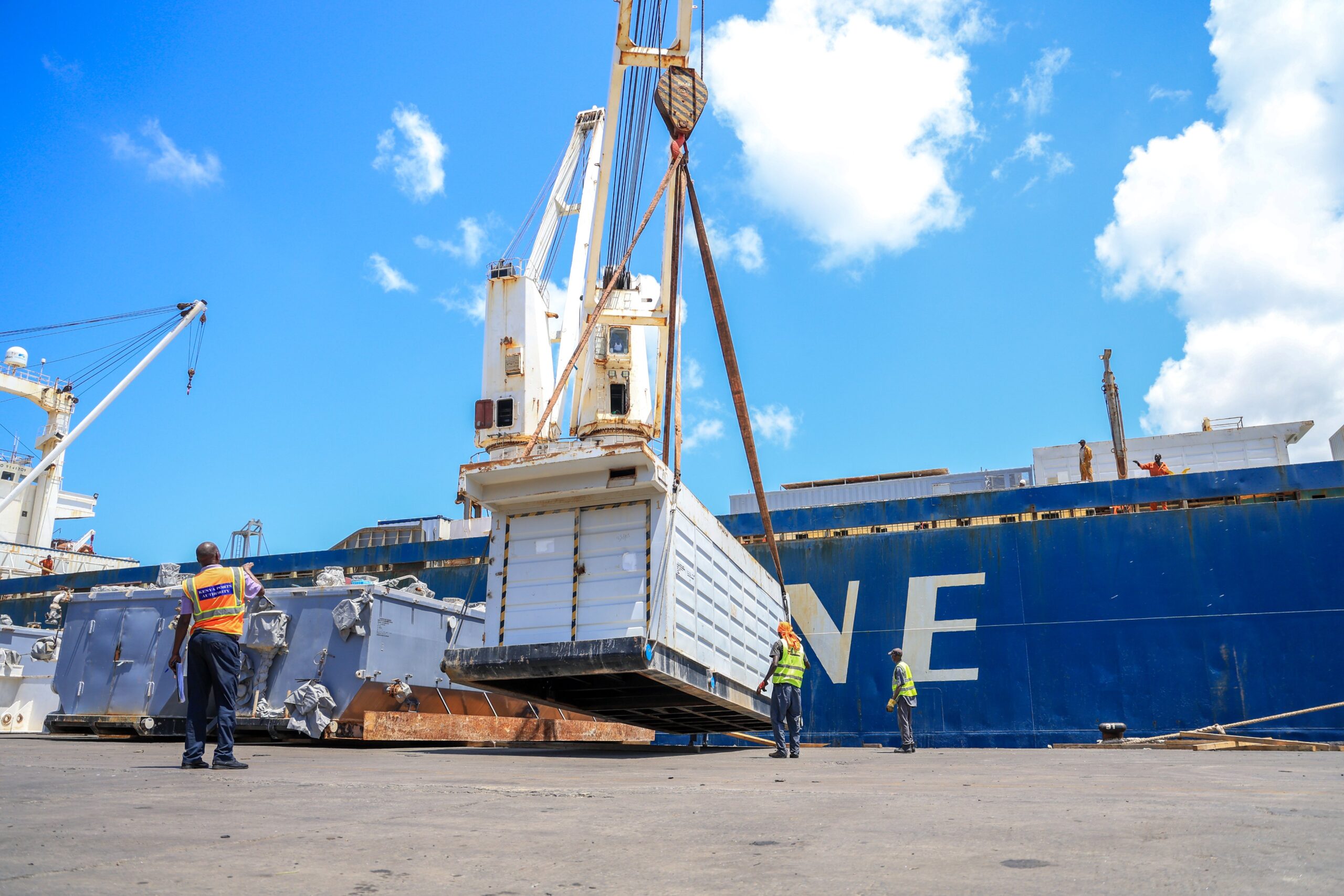
Mombasa Port exported 517,131 tonnes in July 2026 — the highest monthly export figure on record and a 21.3 percent increase over the 426,164 tonnes shipped in July 2025. Total throughput rose 13.4 percent year-on-year to 4.23 million tonnes. These are not cosmetic numbers. They build on a 2025 calendar year that had already set a high bar: 45.45 million tonnes of cargo, 2.11 million TEUs, and 15.88 million tonnes of transit cargo. The 2025/26 financial year went further still, with the Kenya Ports Authority (KPA) reporting 46.4 million tonnes and 2.24 million TEUs.
Celebrate the Record. Then Read the Mix.
Exports finally moved. Imports still dominate.
Containerised cargo supplied almost all of July’s export surge — 511,545 of the 517,131 tonnes. That is the encouraging headline. After years in which Kenya’s export story through Mombasa looked modest next to the import machine, a 21 percent jump in a single month is evidence that tea, coffee, horticulture, manufactured goods, and regional re-exports can still find boxes and sailings when demand and logistics align.
The larger engine, however, remains inbound. Total imports rose 18.9 percent to 3.53 million tonnes. Dry-bulk imports surged 87.9 percent year-on-year to a record 1.03 million tonnes. That is clinker, grain, fertiliser, coal, steel, and other industrial inputs arriving in bulk. It is also a statement about the Kenyan and hinterland economies: they are still consuming and building faster than they are shipping finished value out.
A port that grows this fast on imports is not a failure. It is a mirror. It reflects construction, energy demand, food security stockpiles, and the consumption of a widening East African market. It also locks in a structural imbalance. Throughput records funded by inbound bulk raise customs collections — the Kenya Revenue Authority’s (KRA) Customs unit posted a record Sh92.53 billion in July — but they do not, by themselves, diversify the export base or close the trade gap.
The Transhipment Slump is the Warning Light
Transhipment collapsed 60.5 percent year-on-year to 159,101 tonnes. That single line offsets a meaningful share of the month’s gains and should trouble anyone who talks about Mombasa as a hub rather than a destination port.
Hubs live on relay cargo. Destination ports live on hinterland demand. Mombasa has always been both, but the July split is lopsided: strong domestic and transit imports, a welcome export tick-up, and a sharp drop in cargo that only touches the quay on its way to another ocean. Some of that is cyclical — alliance reshuffles, blank sailings, and competition from Dar es Salaam, Lamu, and emerging Indian Ocean relays. Some is operational: if dwell times stretch and yard density rises, carriers will not park transhipment boxes in Mombasa for sport.
Cogoport’s earlier-year snapshots already showed long transhipment dwell times relative to rail imports. KRA and KPA have since moved to evacuate long-stay boxes, expand pre-arrival processing, and run 24/7 gates. Those are the right instincts. They are also an admission that volume growth is colliding with space.
The Regional Gateway is Working — and That is Why Congestion is the Next Test
Transit cargo was the quiet hero of 2025, up 19.5 percent to 15.88 million tonnes. Uganda remains the anchor; Rwanda, South Sudan, and eastern DRC keep the Northern Corridor relevant. That is Mombasa’s strategic moat. It is also why a single congested month in Mombasa becomes a regional price shock in Kampala and Goma.
Lamu’s jump — from 74,380 tonnes in 2024 to 799,161 tonnes in 2025 — and Kisumu’s inland growth show KPA is no longer a one-harbour story. That diversification is overdue. It does not yet relieve Mombasa of the bulk of East Africa’s deep-sea lift. Berths 19B, 23, and 24, the Dongo Kundu multipurpose berth, SGR links to the Nairobi and Naivasha ICDs, and the Sh8.3 billion port interchange still under construction are the capacity answer. Until they are in the water and on the road, July-style bulk spikes will keep filling yards faster than trucks and trains can empty them.
Digital Kit is Not a Strategy. It is a Necessary Tool.
KPA commissioned a KSh 1 billion Vessel Traffic Management and Information System in July — radar, AIS, VHF, CCTV, hydro-met, and oil-spill detection stitched across the VTS tower, Ras Serani, and Shimanzi. Pair that with TOS upgrades, automated gates, and Advanced Cargo Declaration, and the direction of travel is clear: less paper, more pre-clearance, tighter marine control.
Technology will not invent export commodities. It can, however, decide whether a 1.03-million-tonne bulk month becomes a three-day delay or a three-week pile-up. Vessel turnaround is now the binding constraint as much as berth length. Shipping lines price reliability. Landlocked shippers remember who kept the corridor open last season.
What the Record Should Force Onto the Agenda
First, treat export growth as a policy target, not a residual. A month of 517,000 tonnes is a proof of concept, not a new normal. Cold chain, quality certification, empty-container repositioning, and predictable rail slots matter more to that number than another ribbon-cutting.
Second, do not confuse import-led throughput with industrial depth. Dry-bulk records are consistent with a building and consuming economy. They are not evidence that Kenya has climbed the value chain.
Third, recover transhipment or stop advertising hub status. Hub cargo is discretionary. It leaves first when yards clog.
Fourth, measure success in hours, not only in tonnes: ship-to-berth time, gate turn, rail share, and dwell by cargo type. Volume without velocity is a congestion factory.
July 2026 shows Mombasa can still set records. The composition of those records shows a port that is busy, strategically indispensable, and not yet balanced. The next test is whether Kenya uses the VTMIS era to turn a destination port that occasionally exports into a corridor that consistently does both — without making Kampala wait at the gate.