


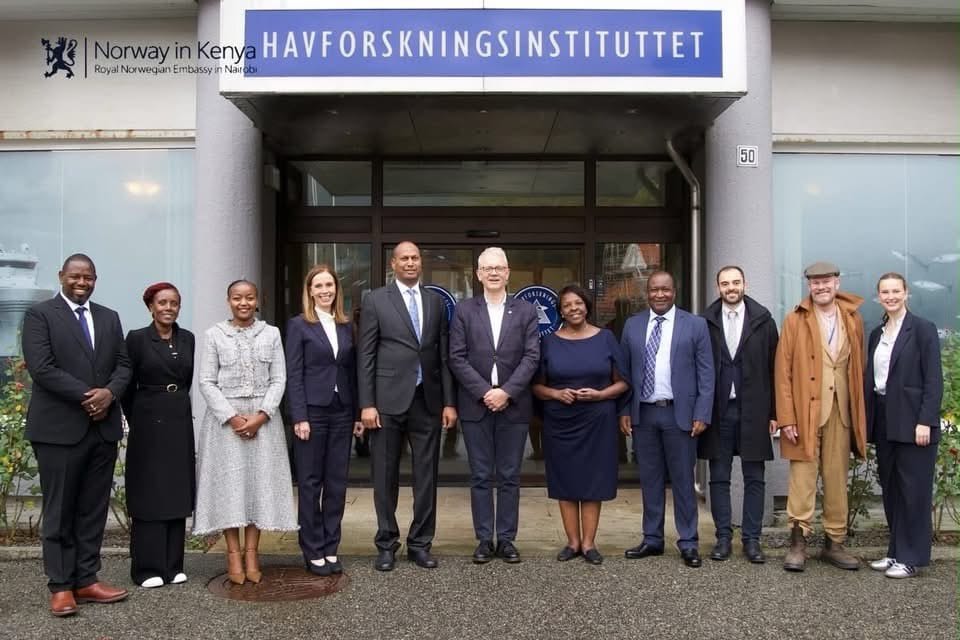
Kenya sits on one of Africa’s most promising blue economy frontiers. With a long coastline, strategic ports at Mombasa and Lamu, a vast Exclusive Economic Zone, and a young population hungry for skilled jobs, the country possesses the geographic and demographic ingredients for a maritime transformation. Yet potential alone does not generate prosperity. Skills, technology, research capacity, capital, and sustained international partnerships do. That is the clear message from Principal Secretary Aden A. Millah of the State Department for Shipping and Maritime Affairs, who recently led a Kenyan delegation on a tour of Norwegian maritime institutions and called for stronger ties to unlock the sector’s opportunities.
Millah’s statement is not diplomatic boilerplate. It reflects a pragmatic recognition that Kenya cannot build a competitive, sustainable maritime and blue economy in isolation. Norway—one of the world’s leading maritime nations—offers precisely the combination of expertise, technology, and institutional experience that Kenya needs: advanced ship management and ownership, green shipping technologies, ocean research capacity, seafarer training systems, and a track record of managing marine resources for long-term value rather than short-term extraction.
The Scale of the Opportunity—and the Gaps
Kenya’s blue economy potential is frequently quantified in ambitious terms. Properly developed deep-sea fisheries in the EEZ alone have been estimated to contribute tens of billions of shillings annually to GDP. Ports and logistics already underpin the country’s trade, while ship repair, maritime training, aquaculture, marine tourism, and emerging green shipping corridors represent further growth areas. President William Ruto’s engagements with Norwegian stakeholders in Oslo earlier in 2026 underscored concrete pathways: new shipping routes linking Mombasa and Lamu to European ports, technology transfer, investment, and a commitment by Wilhelmsen Ship Management and other Norwegian firms to employ 1,000 Kenyan seafarers by 2030, with an initial 120 positions targeted for the near term.
These are not abstract aspirations. They address real constraints. Kenya still faces significant shortfalls in modern maritime training infrastructure, research capacity for sustainable fisheries management, access to advanced vessel technology, and the domestic financing needed to scale the sector. Bandari Maritime Academy’s expansion needs, including a multi-billion-shilling masterplan, illustrate the funding gap. Persistent underfunding risks stalling skills development just as global shipping faces a shortage of qualified seafarers and a rapid shift toward decarbonisation. Without partnerships that bring both know-how and capital, Kenya risks remaining a logistics transit point rather than a full participant in the higher-value segments of the maritime value chain.
Norway’s strengths map directly onto these gaps. Its maritime cluster is among the most sophisticated in the world, spanning shipping, shipbuilding and repair, marine technology, classification societies, and sustainable ocean management. Norwegian institutions and companies have deep experience in cold-water and deep-sea operations, aquaculture, oil-spill preparedness, and the transition to lower-emission shipping. Collaboration through research vessels such as the Dr Fridtjof Nansen, longstanding programmes on ecosystem-based fisheries management, and industry commitments on seafarer recruitment already demonstrate practical channels for knowledge transfer and capacity building.
Beyond Rhetoric: What Effective Partnership Requires
Millah’s emphasis on skills, technology, research, and partnerships is the right framing. Success will depend on moving from high-level declarations to structured, measurable cooperation. Several priorities stand out.
First, skills and employment pathways must be concrete. The pledge of 1,000 seafarer jobs is a start, but it must be matched by upgrades in training quality, certification recognition, and career progression so that Kenyan seafarers can compete for higher-skill, better-paid positions rather than remaining confined to entry-level roles. Joint programmes with Norwegian training institutions and shipping companies, coupled with investments in simulators and survival training facilities at Bandari and elsewhere, are essential.
Second, technology and green shipping offer both commercial and environmental upside. As the global fleet faces pressure to cut emissions, early movers that develop green corridors, alternative fuels readiness, and efficient port operations will capture value. Kenya’s ports and coastal infrastructure can benefit from Norwegian expertise in these areas while contributing to regional supply-chain resilience.
Third, research and sustainable resource management are non-negotiable. Industrial-scale fishing and aquaculture will only deliver lasting benefits if stocks and ecosystems are properly understood and managed. Collaborative oceanographic surveys, data sharing, and capacity building for Kenyan scientists and managers reduce the risk of repeating the boom-and-bust patterns seen in other developing coastal states.
Fourth, domestic financing and private-sector mobilisation must complement international partnerships. Millah has correctly flagged the need for Kenyan financial institutions to engage more seriously with maritime investments. Partnerships that de-risk projects—through blended finance, technology guarantees, or long-term offtake arrangements—can crowd in local capital and ensure that value remains in Kenya rather than leaking abroad.
Risks and Realism
International partnerships are not a panacea. They can become extractive if poorly structured, or produce limited local content if skills transfer is superficial. Kenya must insist on transparent agreements, measurable local employment and training targets, technology localisation where feasible, and alignment with national priorities on sustainability and equity. Funding constraints at home remain a binding constraint; without adequate budgetary support for core institutions such as Bandari Maritime Academy and maritime spatial planning, external partnerships will underperform.
There is also the broader geopolitical and commercial context. Shipping and logistics are strategic. Diversifying partnerships beyond any single country while deepening ties with proven maritime powers such as Norway strengthens Kenya’s position. The same logic applies to other Nordic and European partners with complementary strengths.
A Strategic Choice, Not a Side Project
Kenya’s maritime and blue economy agenda is not a peripheral development project. It is central to job creation for a youthful population, to the competitiveness of the country’s trade logistics, to food security through sustainable fisheries and aquaculture, and to climate resilience through better ocean management. Principal Secretary Millah’s call during the Norway tour is therefore timely and strategically sound. Learning from global best practice and building genuine partnerships is how countries with natural advantages convert them into lasting economic assets.
The test will be execution: translating high-level engagement into operational programmes, measurable skills outcomes, technology adoption, and sustainable resource use. If Kenya approaches this with clarity of purpose, insistence on local value, and sustained political and financial commitment, the blue horizon can become a source of broad-based prosperity rather than another unrealised potential. The waters off Kenya’s coast are already rich. The question is whether the country will develop the capacity—and the partnerships—to harvest that wealth wisely.