


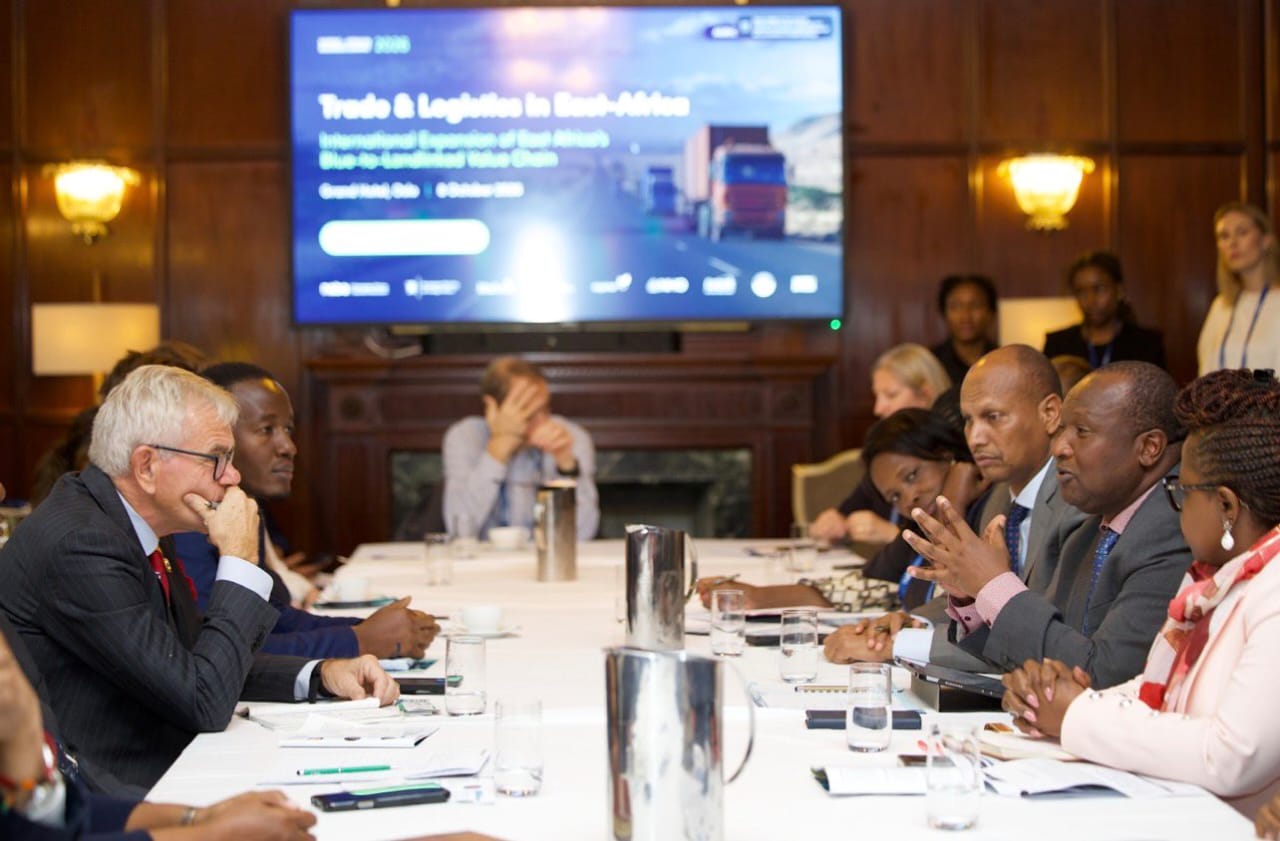
In the elegant setting of Oslo’s Grand Hotel, Kenya’s maritime leadership took its place at the table of global trade. Representing Cabinet Secretary Hassan Ali Joho, Kenya Maritime Authority Director General CPA Justus Omae Nyarandi and Kenya’s Ambassador to Norway, H.E. Angeline Kavindu Musili, MBS, joined the Trade and Logistics in East Africa panel. The discussion centred on a simple but consequential truth: the Northern Corridor is not merely a transport route. It is East Africa’s primary artery to the world’s markets—and a test of whether Africa and its partners can convert dialogue into durable, mutually beneficial results.
The Northern Corridor, stretching from the Port of Mombasa through Kenya into Uganda, Rwanda, Burundi, South Sudan, and eastern Democratic Republic of Congo, serves more than 250 million people. In 2025, Mombasa handled a record 45.45 million metric tonnes of cargo, with transit volumes rising sharply. Uganda alone accounts for the bulk of that transit traffic. Yet efficiency remains uneven. Logistics costs still consume a disproportionate share of cargo value. Border delays, infrastructure gaps further inland, and persistent non-tariff barriers continue to erode competitiveness. These are not abstract statistics. They determine whether a farmer in western Kenya, a manufacturer in Kampala, or a miner in eastern Congo can reach international buyers at viable cost and speed.
Kenya’s shipping and maritime sector has identified clear priorities that flow directly from these realities: more efficient logistics, stronger regional connectivity, skills transfer, and investment that creates jobs. These are not slogans. They are the measurable outcomes by which success must be judged. Efficient logistics reduce the cost of doing business across the region. Stronger connectivity—through improved roads, Standard Gauge Railway extensions, multimodal systems, and streamlined border posts—turns the corridor into a genuine competitive advantage rather than a bottleneck. Skills transfer ensures that Kenyan and East African talent can operate, manage, and eventually innovate within modern maritime and logistics systems. Investment that creates jobs anchors the benefits in communities rather than extracting value for distant balance sheets.
Norway and the wider Nordic region bring complementary strengths that make partnership logical rather than rhetorical. Norwegian expertise in shipping, green maritime technology, ocean governance, and efficient logistics is world-class. Existing cooperation already points the way: commitments by Norwegian shipping companies to employ significant numbers of Kenyan seafarers, discussions around green trade corridors, technology transfer, and possible new shipping links between Kenyan and Norwegian ports. These are concrete openings. They recognise what Africa brings to the table—growing markets, a young and increasingly skilled workforce, and the ambition to participate more fully in global value chains rather than remaining a peripheral supplier of raw materials.
This is the critical shift. Africa is no longer asking for charity or one-sided arrangements. It offers expanding consumer and industrial demand, strategic geographic position, and human capital. Mutually beneficial partnerships must recognise these assets. Greater African participation in global trade means more than higher cargo volumes through Mombasa. It means Kenyan and East African firms capturing more value in logistics services, ship management, maritime training, green shipping solutions, and related industries. It means local content, technology co-development where possible, and deliberate pathways for African professionals into international fleets and operations.
The responsibility now falls on both sides. For Kenya and its regional partners, the work is implementation: translating panel discussions into policy coherence, infrastructure delivery, regulatory predictability, and skills programmes aligned with market needs. For Norway and Nordic partners, it is the willingness to structure investments and collaborations that share risk and reward, prioritise skills and technology transfer, and measure success by tangible benefits for people and businesses on both continents—not merely by the volume of capital deployed.
Africa is building its future. The Northern Corridor is one of the concrete arenas where that future is being contested and constructed. Partners ready to work hand in hand—respecting African agency, recognising African strengths, and committing to results that create jobs and opportunity—will find open doors and serious counterparts. Those who prefer extractive or purely transactional relationships will increasingly find the continent less patient.
The Oslo panel was a useful starting point. The real test begins when the conversations leave the Grand Hotel and return to the ports, borders, training academies, and investment pipelines of East Africa. Efficiency, connectivity, skills, and jobs are the metrics that matter. Everything else is commentary.