


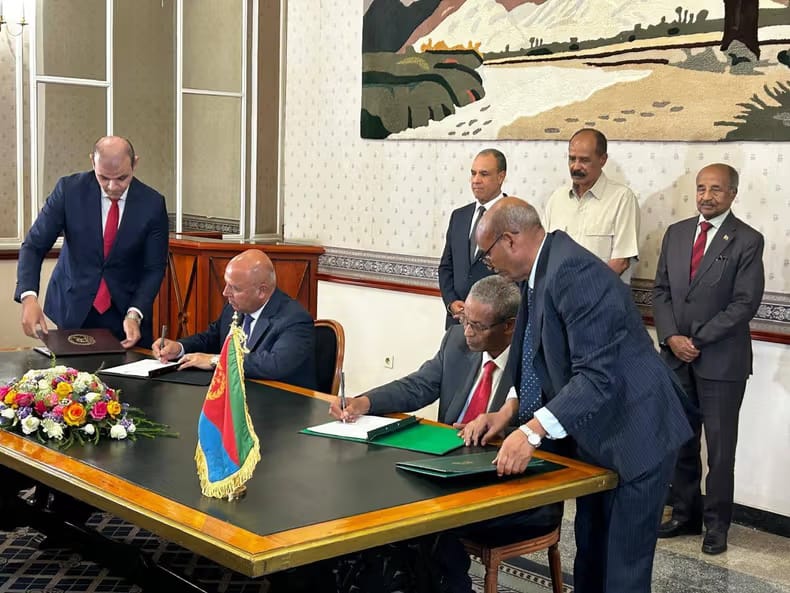
During the launch and related bilateral engagements, senior officials from both countries underscored the initiative’s strategic importance and its potential to reshape trade flows across the Red Sea.
Egypt’s Deputy Prime Minister for Industrial Development and Minister of Transport, Kamel Al-Wazir, described the new shipping line as “a strategic bridge linking African markets through integrated maritime logistics.” He emphasized Egypt’s commitment to expanding regional connectivity via modern ports, efficient shipping services, and enhanced logistics infrastructure to support intra-African trade growth.
Egyptian Foreign Minister Badr Abdelatty stated that the initiative reflects Cairo’s broader vision of strengthening cooperation among Red Sea nations while safeguarding the corridor as a platform for economic development and stability. He noted that sustainable maritime partnerships are essential for securing trade routes and bolstering regional economic resilience.
Eritrean President Isaias Afwerki welcomed the shipping line as a major milestone in his country’s efforts to revitalize its maritime sector and expand economic cooperation with neighbors. According to the president, improved maritime connectivity will unlock new opportunities in trade, port development, fisheries, and regional investment.
Eritrea’s senior presidential adviser, Hagos Gebrehiwet, highlighted the importance of long-term collaboration in transport and logistics, observing that stronger shipping links between Egypt and Eritrea could stimulate industrial growth and facilitate greater movement of goods throughout the Horn of Africa.
Meanwhile, Eritrea’s Minister of Trade and Industry, Nasr El-Din Saleh, stressed that the maritime partnership represents a practical step toward improving commercial efficiency and reducing logistical barriers affecting regional trade. Enhanced shipping services, he added, would contribute to economic diversification and attract increased private sector participation.
From the maritime industry, Egyptian shipping executive Mohamed Abdo Karrar noted that the corridor is expected to strengthen cargo movement between North and East Africa while opening new commercial opportunities for exporters and logistics providers in the Red Sea region.
Shipping and logistics official Ahmed Mohamed Abu Khadra further observed that the initiative aims to create reliable maritime links capable of supporting agricultural exports, containerized cargo, and future multimodal transport services connecting regional ports.
The importance of the Red Sea cannot be overstated. Nearly 15 percent of global trade passes through this corridor, making it indispensable to international commerce. Recent disruptions caused by geopolitical instability and attacks on commercial vessels have exposed vulnerabilities in global supply chains and underscored the urgent need for resilient regional logistics systems. Against this backdrop, new maritime partnerships among coastal states are increasingly becoming strategic necessities rather than optional economic ventures.
Egypt enters this partnership with enormous maritime influence. Anchored by the strategically vital Suez Canal, Cairo has steadily positioned itself as a logistics and transshipment powerhouse linking three continents. Massive investments in port modernization, free zones, ship repair facilities, and logistics infrastructure have strengthened Egypt’s maritime ambitions. For Eritrea, the partnership offers a chance to unlock its underutilized coastal potential and reconnect more actively with regional trade networks after years of relative isolation.
Eritrea’s geographic position is exceptionally strategic. Sitting along the western shores of the Red Sea, close to key shipping lanes, the country possesses maritime assets that, if effectively developed, could significantly boost regional trade flows. Ports such as Massawa and Assab hold historical and commercial significance dating back centuries. However, infrastructure limitations, political challenges, and limited international engagement have prevented Eritrea from fully capitalizing on its maritime geography.
The establishment of a new shipping line thus carries both symbolic and practical weight. Symbolically, it reflects growing confidence in regional economic cooperation. Practically, it promises improved cargo movement, reduced transportation costs, enhanced port activity, and greater trade efficiency between North Africa and the Horn of Africa.
For the broader African continent, this development aligns closely with the aspirations of the African Continental Free Trade Area (AfCFTA), which seeks to enhance intra-African trade by reducing logistical barriers and improving connectivity. One of Africa’s greatest economic paradoxes remains that it is often easier and cheaper for African countries to trade with distant continents than with their neighbors. Weak maritime connectivity has long contributed to this challenge. New regional shipping services can help reverse the trend by creating shorter, more efficient trade routes within Africa itself.
The Horn of Africa in particular stands to benefit immensely from stronger maritime integration. The region occupies one of the world’s most strategic geographic positions, yet intra-regional trade remains relatively low compared to its potential. Better shipping connectivity could stimulate industrial growth, support regional supply chains, encourage investment, and expand opportunities for export-oriented industries.
Importantly, the Egypt-Eritrea partnership also reflects a broader shift across Africa’s maritime sector. African nations are increasingly recognizing that ports are no longer merely cargo handling points—they are engines of economic transformation. Modern ports attract industrial parks, manufacturing zones, logistics centers, and value-added services that create employment and drive national development.
This trend is visible across the continent. From Tangier Med to the Port of Mombasa and the LAPSSET Corridor initiative, African governments are investing heavily in maritime infrastructure as part of long-term economic strategies. The Egypt-Eritrea shipping initiative fits squarely within this continental momentum toward maritime-driven growth.
There are also important geopolitical dimensions to consider. The Red Sea has become an increasingly contested strategic space involving global powers, Gulf states, and regional actors vying for influence. In such an environment, economic cooperation initiatives led by African nations themselves are particularly significant. They demonstrate a growing determination among regional states to shape their own maritime future rather than merely serving as arenas for external competition.
However, the success of this new shipping line will ultimately depend on more than political announcements. Sustained investment in port infrastructure, customs modernization, cargo handling efficiency, maritime security, and trade facilitation will be essential. Shipping lines survive on reliability, efficiency, and commercial viability. Without strong operational frameworks and competitive services, even strategically important routes can struggle to achieve long-term sustainability.
Ultimately, the launch of the Egypt-Eritrea shipping line should be viewed as part of a larger continental awakening to the economic power of maritime connectivity. Africa possesses some of the world’s most strategically located coastlines, yet the continent has historically underutilized its maritime advantages. That reality is beginning to change.
The Red Sea is no longer just a passageway for global commerce; it is increasingly becoming a platform for regional economic integration, African-led partnerships, and maritime transformation. If managed strategically, the growing cooperation between Egypt and Eritrea could become a catalyst for broader trade corridors linking North Africa, the Horn of Africa, East Africa, and beyond.
In an era where supply chains are being reshaped and nations are seeking new economic alliances, maritime connectivity may well become one of Africa’s most powerful development tools. The waters of the Red Sea—long associated with global rivalry and strategic tension—may now also become a channel for African opportunity, economic resilience, and regional prosperity.
Ends.