


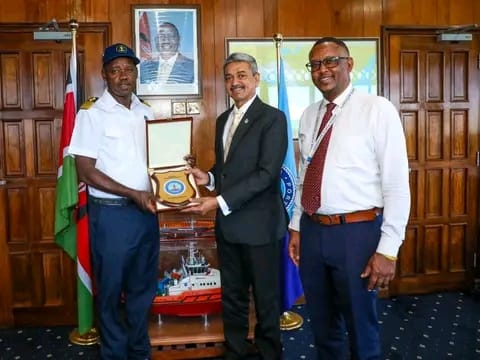
The recent meeting between KPA Chief Executive Officer Captain William Ruto and Institute International Chairman Krishnan Subramaniam at the Port of Mombasa represents something more significant than diplomatic pleasantries. It offers a genuine opportunity to address one of Kenya’s most persistent maritime weaknesses—the troubling gap between possessing a strategically located port and possessing the professional, commercial, and industrial capacity required to exploit that location fully.
For decades, Kenya has demonstrated exceptional competence at receiving ships, handling cargo, and dispatching goods into the hinterland. The harder question is whether Kenya is becoming equally adept at owning, financing, brokering, managing, repairing, building, insuring, crewing, and commercially controlling the ships and maritime businesses that generate that traffic. This is where the real Blue Economy conversation must begin.
From Port Operations to Maritime Commercial Power
Mombasa already stands as one of East Africa’s most important maritime gateways. Yet a busy port does not automatically make a country a maritime power. A nation can handle millions of tons of cargo while foreign companies capture much of the value generated by shipping, ship management, marine insurance, chartering, shipbroking, classification, maritime law, finance, technology, and logistics. This is the paradox Kenya must confront. We have the port, the coastline, the cargo, and a growing pool of maritime professionals. But do we have enough of the high-value maritime businesses that sit above, around, and beyond the physical movement of cargo?
Shipbroking is one such business. Often underappreciated in discussions of international shipping, it sits at the vital intersection of shipowners, charterers, cargo interests, financiers, insurers, and other maritime service providers. Professional shipbroking demands commercial intelligence, market knowledge, contract expertise, freight rate analysis, vessel type familiarity, charter party comprehension, commodity flow understanding, maritime economics, and international shipping practice. These are precisely the skills Kenya needs if it intends to transition from being primarily a port and logistics location into a full-spectrum maritime economy. The KPA–ICS partnership therefore carries the potential to become far more than a training arrangement—it could serve as a building block in the professionalisation of Kenya’s maritime commercial ecosystem.
The Real Question: What Happens After the Training?
Training is undeniably important. But Kenya has accumulated enough seminars, workshops, conferences, strategies, and policy documents to know that training certificates alone do not create maritime jobs. The country requires a deliberate pipeline connecting training to certification, certification to experience, experience to employment, and employment to career progression. That means the partnership should not stop at classroom instruction—it must produce measurable outcomes.
How many KPA employees will acquire internationally recognised professional qualifications? How many young Kenyans will enter shipbroking, chartering, ship agency, maritime logistics, ship management, and related commercial disciplines? How many Kenyan companies will be assisted in developing maritime commercial expertise? How many women and young people will enter professions traditionally dominated by established international players? And, most critically, how many of those trained will find meaningful employment?
These are the questions that should define success. Kenya cannot afford another cycle in which young people are trained, certified, and then left to compete for a handful of opportunities in an industry that has not expanded sufficiently to absorb them. Training must be accompanied by market creation.
Shipbuilding and Ship Repair: The Missing Industrial Link
Captain Ruto’s emphasis on shipbuilding, ship repair, and container construction is particularly significant. For Kenya, these activities represent the difference between simply participating in maritime trade and actually capturing a greater share of its economic value. Every vessel entering Mombasa represents an economic opportunity, and the question is how much of that opportunity remains in Kenya. A vessel requires maintenance, repairs, spare parts, inspection, provisioning, technical services, crew services, waste management, chandelling, insurance, agency services, and numerous other interventions. If these services are systematically provided locally, the port becomes more than a gateway—it becomes an economic ecosystem.
Ship repair, therefore, is not merely an engineering activity. It is an employment generator, a technology-transfer mechanism, and an industrialisation opportunity. Shipbuilding is even more ambitious. Kenya should not imagine that it can immediately compete with the world’s largest shipbuilding nations—that would be unrealistic. But Kenya can identify niches in which it possesses comparative advantages: workboats, fishing vessels, ferries, patrol craft, barges, service vessels, and other vessels suited to regional markets. There is also an enormous opportunity in the repair and maintenance of vessels operating in the Western Indian Ocean. The strategic question is whether Kenya is prepared to develop the infrastructure, financing, technical skills, regulatory environment, and private-sector incentives necessary to make this happen.
The Shipbroking Gap Exposes a Wider Problem
The engagement with ICS also shines a light on a deeper structural weakness. Kenya has traditionally approached maritime development largely through infrastructure—building a port, expanding a berth, constructing a road, developing a logistics corridor, modernising cargo-handling equipment. All these investments are necessary, but infrastructure without human capital and commercial expertise produces only part of the value chain. The next stage of Kenya’s maritime development must therefore be about intellectual infrastructure: building expertise in shipbroking and chartering, maritime finance, marine insurance, maritime law and arbitration, ship management, vessel operations, port economics, maritime logistics, freight and commodity markets, ship agency, maritime digitalisation, maritime environmental compliance, and commercial maritime policy.
This is where institutions such as ICS can make a difference. Kenya needs maritime professionals who can sit across the negotiating table from international shipowners, charterers, financiers, insurers, and logistics companies and understand the commercial language of global shipping. Otherwise, Kenya will remain a market in which other countries and companies make the strategic decisions while Kenyan enterprises provide the supporting services. That is not the maritime future Kenya should aspire to.
The Youth Dividend Must Be Deliberately Engineered
The most compelling element of this partnership is its potential to create opportunities for young Kenyans. The maritime industry has long suffered from a visibility problem. Young people see ships entering and leaving Mombasa but often do not see the thousands of professional careers that make international shipping possible. They know about seafarers, perhaps port workers, but far less about shipbrokers, chartering specialists, maritime economists, ship managers, marine surveyors, maritime lawyers, freight analysts, maritime financiers, vessel operators, and other professionals.
This must change. Kenya’s maritime education and training system needs to be connected directly to the actual needs of the industry. The country should be developing a maritime talent pipeline beginning in secondary schools and extending through technical institutions, universities, professional institutes, and practical industry placements. The KPA–ICS partnership could become an important component of such a system, but the emphasis should be on access, inclusion, and employability. Professional maritime qualifications can be expensive and inaccessible to many young people. If the industry is serious about creating a new generation of Kenyan maritime professionals, scholarship programmes, apprenticeships, internships, mentorship, and structured workplace exposure should accompany professional training. A maritime career must not become the preserve of those who can afford expensive international qualifications.
Kenya Must Stop Exporting Its Maritime Ambition
There is another uncomfortable reality. Kenya has produced talented maritime professionals who have found opportunities around the world because the domestic maritime economy has not always been able to absorb their skills. That is a loss. When Kenya trains a talented young maritime professional only for that person to leave the country because there is no appropriate employment, Kenya is effectively subsidising the human-resource needs of foreign maritime economies.
The answer is not to prevent professionals from travelling—the answer is to make Kenya an attractive maritime labour and business market in its own right. That requires a larger domestic maritime industry. The country must create opportunities not only at sea and at the port but also ashore. A modern maritime economy should generate careers in offices, shipyards, logistics centres, technology firms, financial institutions, law firms, insurance companies, universities, research institutions, and government agencies. This is where the Blue Economy becomes real.
Mombasa Can Become East Africa’s Maritime Professional Hub
Kenya has another strategic opportunity that should not be underestimated. Mombasa can position itself as East Africa’s maritime professional services hub. The city already possesses a port, maritime institutions, shipping companies, logistics operators, seafarers, ship agents, and a deep pool of maritime knowledge. What is missing is the deliberate clustering of these capabilities. Why should a shipping company operating in the Western Indian Ocean have to go to London, Dubai, Singapore, or another international centre for every sophisticated maritime professional service? Why cannot some of these services be developed in Mombasa? Why should East African shipping companies rely overwhelmingly on foreign expertise for shipbroking, maritime consultancy, ship management, and other commercial services?
Kenya should be asking these questions. A properly developed maritime professional-services cluster could attract regional business from Tanzania, Uganda, Rwanda, South Sudan, Ethiopia, Somalia, and the wider Western Indian Ocean region. The economic multiplier could be substantial.
But Partnerships Must Be Measured by Results
There is a danger in celebrating international partnerships simply because they sound impressive. Kenya has entered numerous agreements and partnerships over the years. The real test has never been the signing ceremony—it is what happens afterwards. The KPA–ICS engagement should therefore be built around clear performance indicators. The partners should establish measurable targets covering professional qualifications, internships, apprenticeships, employment, women and youth participation, local consultancy capacity, maritime enterprise development, and the number of Kenyan professionals moving into higher-value positions within the industry.
There should also be a mechanism for tracking whether training is actually changing the composition of Kenya’s maritime workforce. If, five years from now, Kenya has trained hundreds of people but still imports most of its sophisticated maritime commercial expertise, then the partnership will have fallen short. If, however, Kenyan shipbrokers are negotiating international fixtures, Kenyan companies are managing vessels, Kenyan professionals are advising global shipping interests, and Kenyan maritime enterprises are exporting services to the region, then the partnership will have achieved something transformative.
The Blue Economy Needs Commercial Realism
Kenya’s Blue Economy debate has sometimes been dominated by grand language. We talk about oceans, fisheries, shipping, tourism, marine resources, ports, and coastal development. But the Blue Economy is ultimately about value creation. It is about asking a simple question: how much economic value can Kenya capture from every maritime activity taking place within its waters, ports, coastline, and regional trading system?
That is why shipbuilding matters. That is why ship repair matters. That is why maritime education matters. That is why shipbroking matters. That is why maritime finance matters. That is why seafarer employment matters. And that is why professional capacity matters. Kenya cannot build a competitive maritime economy by concentrating exclusively on the physical infrastructure through which cargo passes. It must build the professional and commercial ecosystem that captures value before, during, and after that cargo moves.
From Port of Call to Maritime Centre
The ultimate ambition should be to transform Mombasa from merely a port of call into a maritime centre of gravity for East Africa. That would mean ships coming to Mombasa not only because they need to load or discharge cargo but because Kenya offers competitive ship repair, maritime services, professional expertise, logistics, finance, training, technology, and commercial opportunities. It would mean young Kenyans seeing the maritime sector not simply as a source of port jobs or seafaring opportunities but as a sophisticated professional ecosystem capable of sustaining lifelong careers. It would mean Kenyan companies competing for maritime business across the region rather than simply servicing foreign companies operating through Kenyan territory. And it would mean Kenya finally beginning to capture a much larger share of the wealth generated by its own strategic maritime geography.
The KPA–ICS partnership should therefore be judged against this larger ambition. The goal should not be to train people merely to fit into the existing maritime economy. The goal should be to train, empower, and enable Kenyans to build the maritime economy Kenya has yet to create. That is the real promise of this partnership.
Kenya’s greatest maritime asset is not simply its port—it is its people. But people become an economic force only when skills, capital, institutions, infrastructure, and opportunity converge. The partnership between KPA and the Institute of Chartered Shipbrokers offers a chance to bring those elements closer together. Now the hard work begins.
Kenya must move from conferences to contracts, from training to jobs, from infrastructure to industry, and from being a gateway for other people’s maritime businesses to becoming a serious maritime business centre in its own right. The Blue Economy will not be won by slogans. It will be won by skills, ships, services, investment, innovation, and the ability to capture value. Mombasa has the location. KPA has the gateway. Kenya has the talent. What remains is the national ambition—and the political and commercial discipline—to connect all three.