


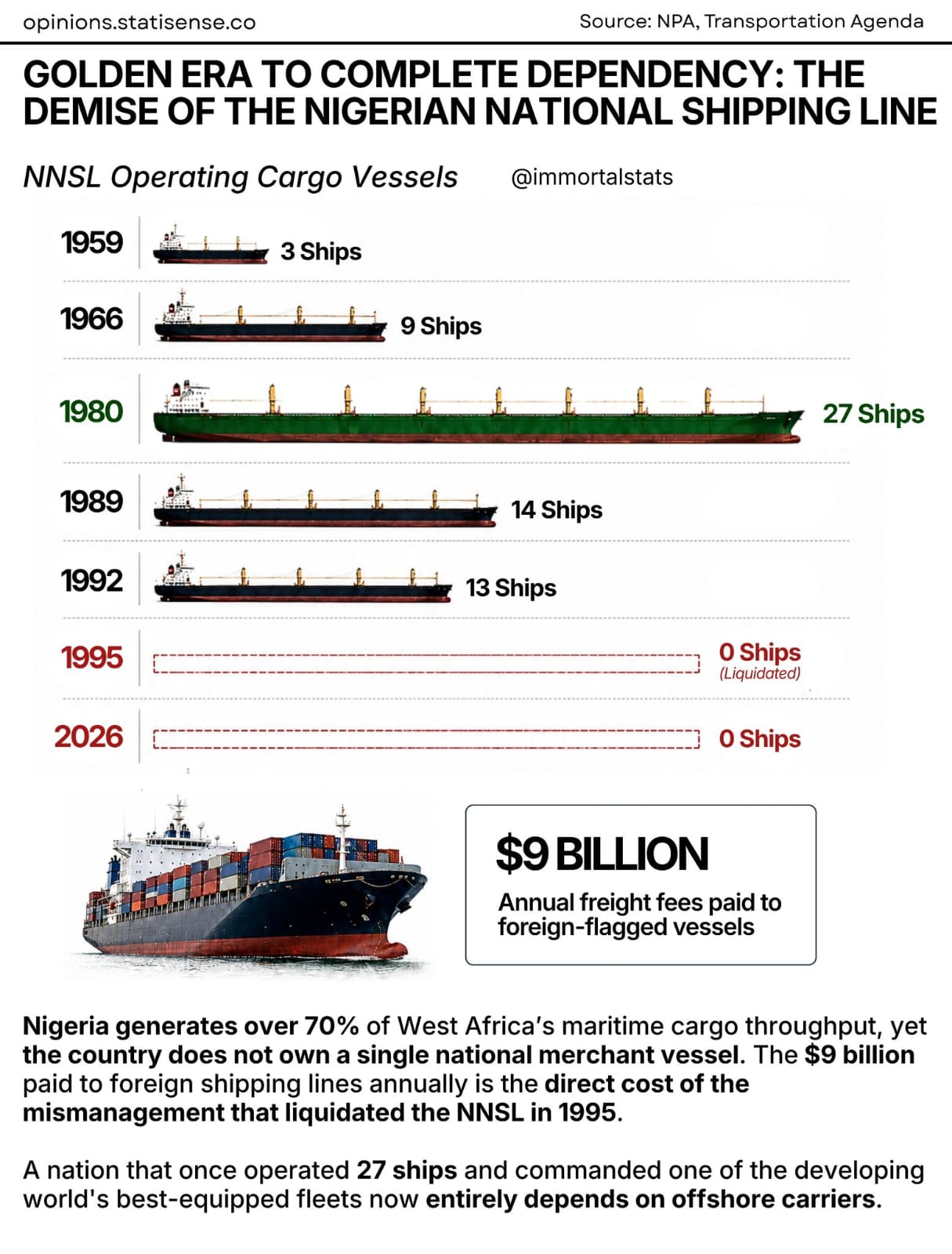
In 1959, on the cusp of independence, Nigeria launched the Nigerian National Shipping Line (NNSL). By 1961, the federal government had assumed full ownership. At its zenith, the line operated roughly two dozen vessels—MV Dan Fodio, MV Oduduwa, MV King Jaja, MV Nnamdi Azikiwe and others—flying the green-white-green across international waters. Yet the fleet’s most enduring legacy was not its tonnage but its human capital: generations of Nigerian deck officers, marine engineers, radio operators and seafarers who gained professional standing and sea time that colonial-era employers had largely denied them.
That chapter closed in 1995. Crippled by ageing vessels, mounting repair bills, chronic government interference, cargo shortfalls and relentless mismanagement, NNSL was liquidated. Its remaining ships were sold off; the successor National Unity Line never evolved into a serious carrier. Three decades later, Nigeria still lacks a meaningful national-flag commercial fleet. Foreign lines carry an estimated 80–90 percent of the country’s seaborne trade, while billions of dollars in freight payments leave the economy annually.
A recent LinkedIn post by the Marine and Energy Professionals Association of Akwa Ibom State revived this history—and posed the right question: Should Nigeria create another state-owned shipping line, or is a privately driven model more sustainable? The answer is unequivocal. Replicating the old state-owned model would be an expensive exercise in nostalgia. What Nigeria needs is a private-sector-led fleet, underpinned by disciplined public policy, genuine cargo support and modern financing instruments—tools the government is only now beginning to unlock.
Why State Ownership Failed Then—and Would Fail Again
NNSL was never purely commercial. It was a nationalist project, a training platform and a symbol of prestige—objectives that repeatedly clashed with the unforgiving economics of international shipping. Vessels require continuous capital for maintenance and replacement; freight markets are cyclical; competition from better-capitalised European and Asian carriers was relentless. Political appointments, frequent management upheavals and pressure to serve non-commercial routes compounded the problems. By the early 1990s, vessels were being arrested in European ports for unpaid debts. Liquidation was inevitable.
The same structural weaknesses persist. Nigeria’s public enterprises have a long record of political interference, weak corporate governance and soft budget constraints. A new fully state-owned line would inherit these risks at a time when global shipping has become even more capital-intensive, technology-driven and consolidated. The state carriers that still succeed elsewhere typically operate in economies with far stronger institutions, clearer commercial mandates and deeper capital markets than Nigeria currently possesses.
The Private Path Is Already Opening
Fortunately, the policy landscape is shifting. The Coastal and Inland Shipping (Cabotage) Act of 2003 reserved domestic trade for Nigerian-owned, -crewed and -flagged vessels in principle. The long-dormant Cabotage Vessel Financing Fund (CVFF)—now estimated at around $700 million—has finally begun moving toward disbursement. Indigenous operators can access facilities of up to $25 million at relatively competitive rates, with government equity support and commercial bank participation. Dozens of Nigerian shipping firms have already applied. If administered transparently, with clear performance conditions and cargo linkages, the fund can catalyse real fleet growth without the state becoming a shipowner itself.
Complementary measures are equally vital. Enforcement of cabotage and local-content rules, especially in the oil-and-gas sector, remains incomplete. Guaranteed cargo for indigenous vessels—through “first right of refusal” on government and NNPC cargoes, or revised terms of trade that shift more lifts to CIF rather than FOB—would give private owners the revenue visibility banks require. Tax and duty incentives for Nigerian-flagged tonnage, preferential berthing and a functional tonnage-tax regime would further level the playing field. The Nigerian Fleet Implementation Committee and successive industry groups have catalogued these reforms for years; implementation, not another committee, is what is needed.
Recent statements from the Ministry of Marine and Blue Economy point toward a public-private partnership model for any new national carrier—a more promising direction than pure state ownership, provided private partners hold real equity, management control rests with professionals rather than political appointees, and the government’s role is limited to enabling conditions and minority participation where necessary. International partners such as major port operators can bring technical expertise and capital, but the core commercial risk and reward must reside with Nigerian private capital and management.
Broader Blue-Economy Logic
Shipping does not operate in isolation. Port efficiency, ship repair and eventual shipbuilding capacity, maritime education and training, insurance and logistics services are all part of the same ecosystem. Nigeria’s new Marine and Blue Economy Ministry has begun to treat these linkages more seriously—port upgrades, revenue reforms and policy coordination are steps in the right direction. A sustainable indigenous fleet will emerge only when these supporting pillars also strengthen. Seafarer training requires sea-time berths; those berths will appear when private Nigerian owners have vessels on long-term charters, not when a state line is artificially kept afloat.
Critics sometimes argue that private Nigerian shipowners lack the scale or sophistication to compete. That underestimates both the talent already present in the industry and the catalytic effect of reliable financing and cargo. Global shipping history demonstrates that commercially driven private fleets, supported by enabling regulation and access to capital, consistently outperform state-managed lines on cost discipline, maintenance standards and operational agility. Nigeria’s own experience with the collapse of NNSL supplies the cautionary evidence.
A Realistic Ambition
Nigeria does not need to recreate the 27-ship fleet of the 1970s and 1980s overnight. It needs a growing number of modern, well-maintained vessels under Nigerian ownership and flag, carrying a rising share of the country’s own cargo, employing Nigerian officers and ratings, and generating returns that can be reinvested. That outcome is achievable through private initiative backed by smart public policy: disciplined release of the CVFF, rigorous cabotage enforcement, cargo preference for qualified indigenous operators, and a regulatory environment that rewards efficiency rather than political connection.
The history of NNSL should be remembered with respect for the seafarers and professionals it produced. It should not be romanticised into a template for the future. The question is no longer whether Nigeria should own ships—it is whether those ships will be owned and operated in a commercially sustainable way. On that test, the private-led model, properly enabled by the state, is the only realistic path.