


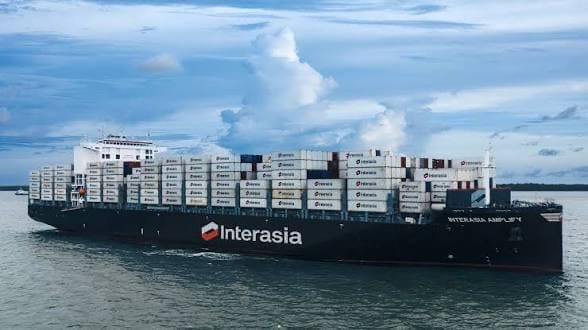
The decision by InterAsia Lines to launch a weekly Asia–Mombasa shipping service is far more than a routine addition to the port’s schedule. It is a definitive market signal: East Africa’s trade volumes have reached a critical mass, and Mombasa is cementing its status as the premier gateway through which Asian goods flow into the region’s heartland.
The Taiwanese carrier is set to deploy vessels of approximately 2,000 to 2,500 TEUs in a strategic partnership with Hyundai Merchant Marine (HMM), Pacific International Lines (PIL), and COSCO Shipping. While industry sources peg the formal launch around mid-October 2026, the commitment of dedicated tonnage by these major Asian lines is already being framed locally as a transformative event. This is not an opportunistic charter; it is a calculated investment in a corridor that is now deemed too vital to ignore.
The true significance of this service, however, lies not in the vessels themselves but in the vast economic hinterland they serve. Mombasa is not merely Kenya’s port; it is the maritime lifeline for Uganda, Rwanda, Burundi, South Sudan, and eastern Democratic Republic of Congo. Each improvement in shipping frequency, schedule integrity, and direct connectivity translates into lower costs and shorter transit times for goods moving across multiple national borders. In this context, InterAsia’s move is as much a regional inflection point as it is a Kenyan milestone.
This development is part of a broader, unmistakable trend. Major players like HMM, COSCO, and PIL are deepening their footprint on the India–East Africa and broader Asia–East Africa corridors, while Ocean Network Express (ONE) has expanded its weekly links between India, the Middle East, and Mombasa. The pattern is consistent: East Africa is no longer a residual market for surplus capacity, but a strategic destination and distribution hub worthy of dedicated route planning and capital allocation.
For Kenya, the upside extends well beyond port dues and stevedoring revenue. More direct and frequent connections to Asia can catalyze multiple sectors of the economy. Manufacturers gain predictable access to machinery and industrial inputs; retailers secure more reliable supply chains for consumer goods; and agricultural exporters—of tea, coffee, horticulture, and meat—benefit from outbound logistics that are crucial for competitiveness in distant markets. Furthermore, Mombasa can strengthen its role as the region’s primary consolidation and redistribution point, bolstering the entire logistics ecosystem—from trucking and warehousing to freight forwarding and insurance.
Yet, this is precisely where Kenya’s real test begins. Additional maritime capacity does not automatically translate into a more efficient economy. The gains from new shipping services will ultimately be realized—or squandered—by what happens after cargo leaves the quay. Seamless integration between the port, the Standard Gauge Railway, road freight corridors, inland container depots, and the wider East African market is non-negotiable. Persistent congestion, opaque charges, and sluggish cargo evacuation can rapidly neutralize the advantage of superior ocean connectivity. A bigger port without a competitive hinterland simply becomes a more expensive bottleneck.
Regional competition sharpens this imperative. Mombasa is locked in a contest with Dar es Salaam and other Indian Ocean gateways for the same landlocked cargo. The emergence of services calling at both Kenyan and Tanzanian ports underscores that shipping lines are positioning themselves around growing trade corridors, rather than committing exclusively to one destination. In this high-stakes environment, efficiency becomes the deciding factor. Lines will gravitate toward reliable berthing windows, fast vessel turnaround, predictable charges, and smooth digital processes. Where these conditions exist, capacity follows; where they falter, it migrates.
The deeper significance of InterAsia’s announcement, therefore, is not the addition of a weekly call, but the validation it represents. It is concrete evidence that international shipping companies now regard East Africa as a market worthy of dedicated investment. This recognition creates a profound opportunity for Kenya, but it also imposes a stringent test. Mombasa’s ability to convert maritime connectivity into sustained economic value will depend less on the next vessel announcement and more on whether Kenya can deliver the hinterland performance that makes additional capacity commercially rational.
If Kenya can close this critical gap—between ocean service and inland efficiency—then the InterAsia service, and others like it, will mark the dawn of a durable, structural shift in the region’s maritime economy, rather than a fleeting uptick in port traffic. The ships are coming; the question is whether the system is ready for them.