


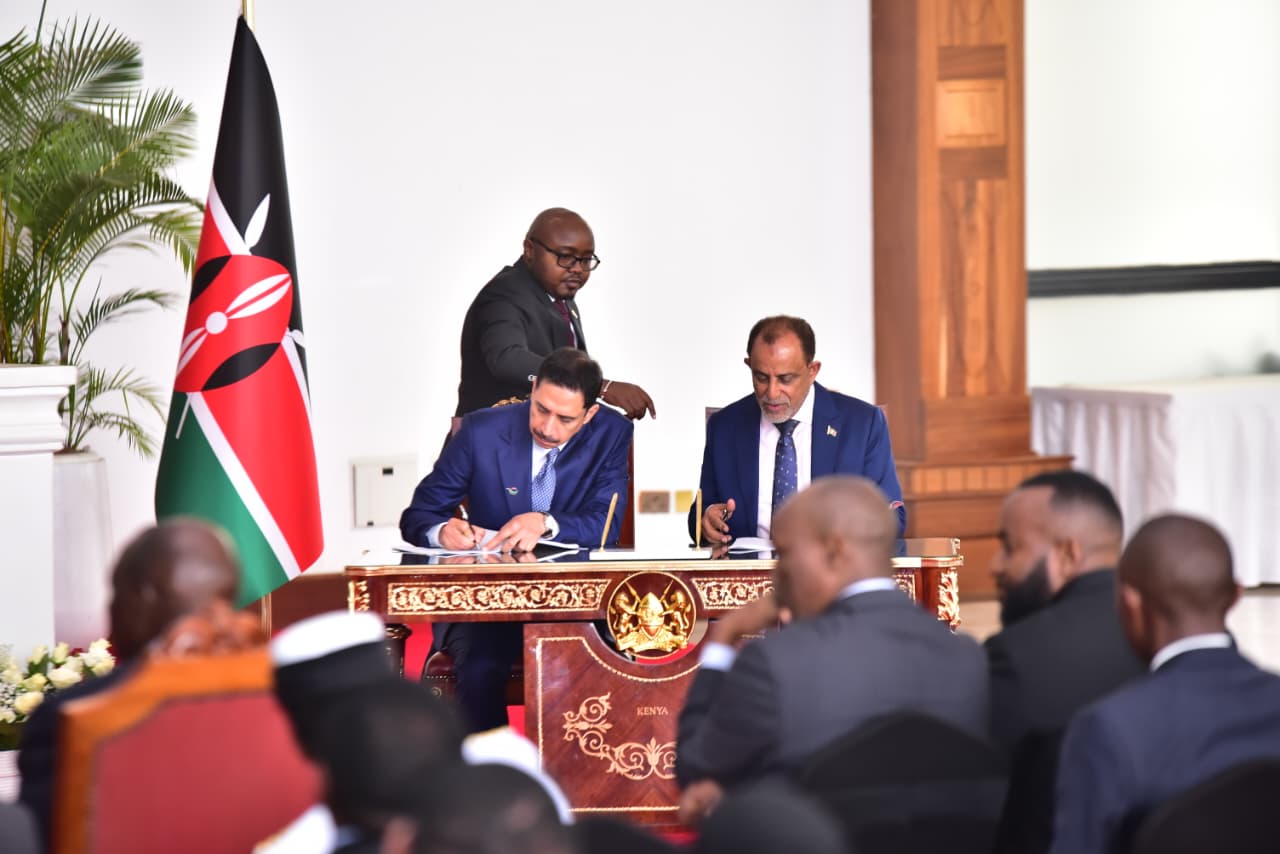
The scene is classic State House theatre: the polished mahogany desk bearing the Kenyan coat of arms, the national flag standing sentinel, and officials in crisp suits bent over documents as an audience bears witness. Suleiman Shahbal, signing on behalf of Mombasa Free Zone Limited and GulfCap Group, and Mohammed Akoojee, CEO of DP World Africa, put pen to paper. Behind them stands a third official, with President William Ruto presiding. On 8 September 2026, the County Government of Mombasa, Mombasa Free Zone Limited, and DP World formalised a tripartite agreement to develop a 535-acre Special Economic Zone (SEZ) in Jomvu.
Yet this is far more than a photo opportunity. It is a calculated wager on whether Kenya can finally transmute its geographic primacy into genuine industrial muscle.
The Deal in Context
Valued at roughly KSh 12 billion (over US$100 million), the project occupies land once used as a Kenya Meat Commission cattle staging ground, now leased from the county. Projections range from nearly 8,000 to 10,000 direct jobs in the first phase, with 67 companies already signalling interest. DP World brings global logistics expertise; GulfCap Group (chaired by EALA MP Suleiman Shahbal) provides the local vehicle through Mombasa Free Zone Limited; and the county supplies land and local facilitation.
President Ruto framed the initiative as part of a broader pivot: from a trading and consumption economy to one that manufactures, processes, and exports. In his remarks, he urged the parties to move “from signatures to implementation; from plans to infrastructure; from commitments to investment; and from investment to factories, exports, and jobs.”
That urgency is well-founded. Mombasa remains East Africa’s premier port gateway, yet it has too often functioned primarily as a transit corridor rather than a production hub. Cargo moves through; value is added elsewhere. The Jomvu SEZ aims to reverse that trajectory by creating an integrated platform for manufacturing, warehousing, assembly, processing, and export-oriented activity within striking distance of the port.
Why This Matters
First, scale and location. At 535 acres, the zone is large enough to host industrial clusters rather than isolated factories. Its proximity to the Port of Mombasa, the Standard Gauge Railway, and regional road networks affords a structural advantage that purely inland industrial parks struggle to replicate.
Second, the partnership model. Pairing a global logistics behemoth with a Kenyan private-sector player and a county government represents a more sophisticated evolution than the pure foreign-direct-investment or state-led models of the past. DP World’s track record in running free zones and ports across Africa and beyond confers operational credibility, while local ownership and county involvement improve the prospects for political durability and community buy-in.
Third, signalling. Coming after years of talk about industrialisation on the Coast, the formal signing under presidential witness raises the political cost of failure. It also positions Kenya more assertively in the regional competition—particularly against Tanzania, where DP World already holds a significant port concession in Dar es Salaam.
The Hard Questions
Optimism, however, must be tempered by realism.
Land conversion and infrastructure delivery will test capacity. Transforming a former cattle ground into a modern, serviced industrial zone demands reliable power, water, roads, digital connectivity, and efficient customs processes. Kenya’s track record on these enablers is mixed; delays here could quickly erode projected timelines and investor confidence.
Job quality matters as much as quantity. “Nearly 8,000 direct jobs” is a headline number. The more critical questions concern skill levels, local content in employment, and whether the zone creates pathways for coastal youth into higher-value roles rather than predominantly low-skill labour.
Governance and transparency will be closely scrutinised. Public-private partnerships of this magnitude invite intense oversight over land allocation, revenue sharing between national and county levels, environmental safeguards, and the precise terms of DP World’s involvement. Clear, published frameworks will be essential to maintain legitimacy and public trust.
Competition is real. Other SEZs and industrial parks are under development across Kenya and the region. Ultimate success will depend less on the fanfare of a signing ceremony and far more on execution speed, regulatory predictability, and the ability to attract anchor tenants capable of generating genuine export volumes.
The Broader Stakes
This agreement sits at the confluence of three strategic currents: Kenya’s industrialisation push under the Bottom-Up Economic Transformation Agenda, the AfCFTA’s promise of expanded regional markets, and the global reconfiguration of supply chains, which increasingly rewards reliable, well-located production and logistics nodes.
If the Jomvu SEZ delivers—factories humming, containers departing with finished goods rather than raw materials, and measurable employment and skills transfer—it will fortify the argument that the Coast can transcend its identity as merely a port city. It will also validate a model combining international expertise, local capital, and devolved government support.
If, however, it stalls in the familiar quagmire of delayed infrastructure, bureaucratic friction, or diluted ambition, it will join a long list of promising announcements that never quite materialised.
The pens have been put down. The documents are signed. The real test begins now: whether the ink on those pages can be translated into steel, concrete, skills, and exports on the ground in Jomvu. Kenya’s industrial future on the Coast depends less on the ceremony captured in the photograph and far more on what happens after the cameras leave.