


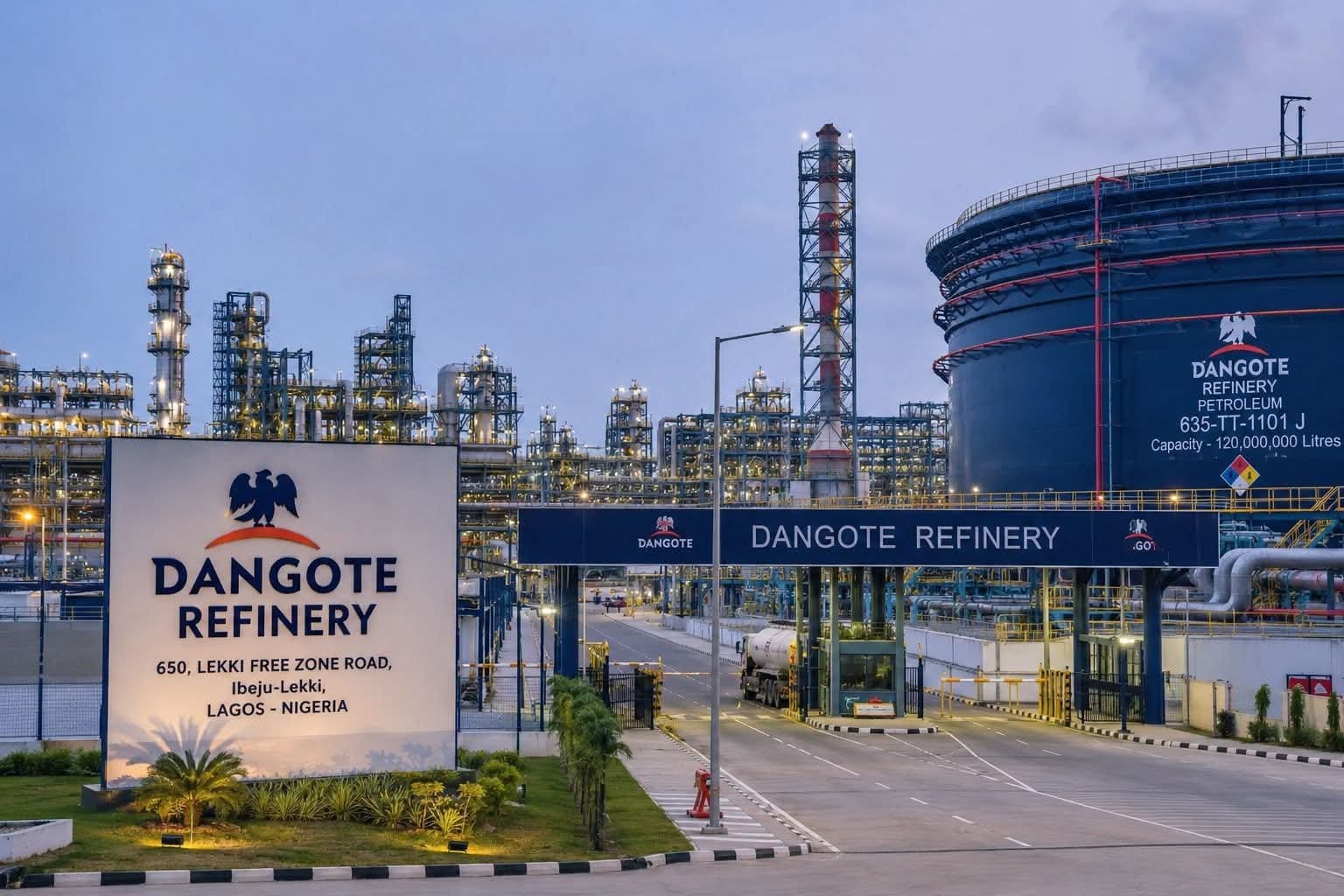
In the fraught history of Africa’s engagement with global financial institutions, few episodes crystallize the prevailing contradictions as sharply as the recent tension between the World Bank and Aliko Dangote’s $20 billion refinery. Zack Mwekassa’s recent video commentary frames the issue with characteristic bluntness: the World Bank is pressuring Nigeria to constrain the very project that has begun to end decades of fuel-import dependency and deliver cheaper petroleum products to ordinary citizens. The framing is polemical, but the underlying facts are not in serious dispute.
Nigeria, Africa’s largest oil producer, spent decades exporting crude while importing most of its refined fuels—an economic absurdity that drained foreign exchange, stoked inflation, and enriched foreign refiners and local middlemen. The Dangote Petroleum Refinery, a 650,000-barrel-per-day single-train facility with ambitions to scale toward 1.4 million barrels, was designed to reverse that pathology. By most measures, it has largely succeeded. Nigeria has moved from near-total import dependence toward self-sufficiency and even net exports of select products. Domestic prices have fallen through aggressive competition. Dangote has publicly cut gantry prices, pledged to restrain pump costs, and clashed openly with importers and regulators accused of enabling substandard or dumped products.
It is against this backdrop that the World Bank’s intervention must be understood. In April 2026, the Bank issued a policy update that effectively recommended reopening petrol imports more freely, citing Dangote’s then-ex-depot price as higher than estimated import parity. The recommendation triggered an immediate and fierce response from Dangote Industries, which argued that unrestricted imports, absent rigorous standards, would invite dumping, undermine domestic refining capacity, and reverse hard-won fuel security. The Bank subsequently withdrew the original note and issued a more conciliatory statement emphasizing sequenced competition that protects product quality and supply reliability. That retreat is telling.
Mwekassa’s analysis places this episode within a broader pattern: international institutions that preach market liberalization and private-sector development often react with unease when an African industrial champion succeeds on a scale that disrupts established trade flows. Dangote’s refinery is not a state-owned white elephant. It is a privately financed, privately operated venture that has absorbed enormous risk, navigated regulatory obstacles, fought for local crude supply (including the controversial naira-for-crude arrangement), and managed to lower prices for Nigerian consumers while exporting to the region and beyond. When that success begins to displace European and other refiners that previously supplied West Africa, the language of “competition” and “efficiency” suddenly appears tactical.
There is a legitimate economic debate here. No single private refinery should enjoy permanent protection from imports if it cannot compete on cost and quality over time. Monopoly power, even when exercised by a domestic industrialist, carries risks of complacency and rent-seeking. Transparent pricing, open access to logistics infrastructure, and credible product standards are necessary. Yet the timing and tone of the World Bank’s original recommendation invited the interpretation that the priority was restoring the old import-dependent model rather than consolidating a genuine industrial breakthrough.
This is not abstract theory. For decades, the combination of dysfunctional state refineries, opaque import licenses, and foreign-exchange scarcity produced chronic shortages, price spikes, and massive fiscal leakages. The Dangote project, for all its imperfections and its owner’s combative style, has begun to rewrite that script. It has also become a regional asset: African countries short of refined products have found an alternative supplier less dependent on Middle Eastern logistics. In an era of geopolitical disruption, that optionality holds immense value.
Critics of Dangote correctly note that the company has sought policy support—preferential crude access, import restrictions when domestic capacity is sufficient, and regulatory enforcement against substandard product. Those demands are neither unique nor illegitimate in the early stages of industrial takeoff. Every successful refining or manufacturing cluster in Asia and elsewhere received strategic protection and infrastructure support while it scaled. The difference is that African attempts at the same strategy are routinely labeled “protectionism” or “cronyism,” while similar policies elsewhere are called industrial policy.
The deeper issue is sovereignty over economic strategy. Nigeria’s government has the right—and the responsibility—to decide whether the priority is short-term consumer price relief delivered by opportunistic imports or the longer-term capacity, employment, foreign-exchange savings, and regional leverage created by domestic refining. International financial institutions can advise. They should not dictate. When their advice consistently aligns with the commercial interests of established exporters of refined products and against the emergence of African refining capacity, skepticism is not only warranted but necessary.
Mwekassa’s video is unapologetically nationalist in tone. It presents the World Bank’s pressure as an attempt to “stop Dangote from selling cheap oil” and thereby keep Africa dependent. The language is maximalist, but the more precise formulation is equally damning: an institution long associated with structural adjustment and market-opening prescriptions is uncomfortable with an African private-sector project that has delivered measurable results precisely by challenging the previous import-dependent equilibrium. The Bank’s partial retreat after public pushback suggests even its own staff recognized the political and economic optics.
The real test lies ahead. Can Nigeria maintain competitive pressure on the refinery so that efficiency gains continue to flow to consumers? Can regulatory institutions enforce quality standards without becoming captured by either the domestic champion or the import lobby? Can the planned expansion to 1.4 million barrels per day proceed without creating new bottlenecks in crude supply or logistics? These are Nigerian questions that demand Nigerian answers.
What should not be in doubt is the principle: Africa’s path out of commodity dependence requires large-scale industrial capacity built and owned on the continent. When that capacity appears and begins to deliver lower prices and greater energy security, the default international response should be encouragement, not quiet pressure to reopen the old import channels. The Dangote refinery is imperfect. The alternative—continued reliance on foreign refiners and the associated foreign-exchange hemorrhage—has been tested for decades and found wanting. Nigeria, and Africa, should be allowed to finish the experiment.