


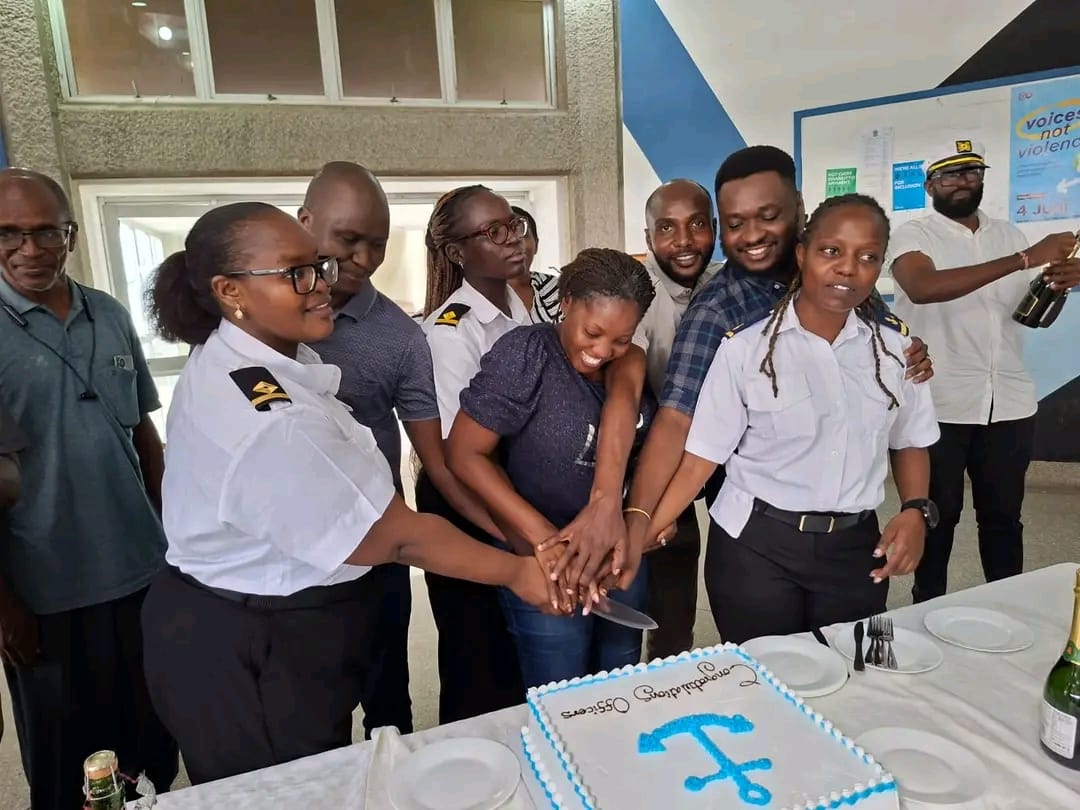
When trainers hold the credentials they teach—and have recent experience of the sea they prepare cadets for—the entire training pipeline gains credibility. Bandari Maritime Academy’s recent recognition of trainers who have secured Certificates of Competency (CoCs) or completed qualifying sea time aboard CMA CGM vessels is therefore more than an internal celebration. It is a strategic investment in maritime education at a moment when Kenya is positioning itself as a serious player in the global seafarer labour market and the wider Blue Economy.
Representing CEO Dr. Eric Katana, Maj. (Rtd.) Franklyne Toniok, Acting Deputy Director for Maritime Training, rightly framed the Certificate of Competency as a heavy responsibility, not a paper qualification. It certifies the knowledge, practical skills and professional judgement needed to protect lives, safeguard the marine environment and operate ships safely under the International Convention on Standards of Training, Certification and Watchkeeping for Seafarers (STCW). Earning one demands rigorous preparation, formal assessment and, critically, verified sea time. By ensuring its own trainers meet or exceed these standards, BMA is closing a gap that has long weakened maritime education in many developing maritime nations: the disconnect between classroom theory and the realities of a working bridge or engine room.
The trainers recognised—Winnie Nyambu and Rashid Kaole on the deck side, and Bridgit Okello, Petterson Kiragu and Linet Maroa on the engine side—embody that bridge. Those who have completed their sea time are now eligible to pursue their CoCs. Their experience aboard vessels operated by one of the world’s largest container shipping lines will feed directly into the classroom, the workshop and the simulator. As Maj. Toniok observed, lessons learned under operational pressure—how teams function in constrained environments, how safety standards are upheld when conditions deteriorate, how theoretical knowledge is applied in real time—cannot be fully replicated by textbooks or shore-based exercises alone. Cadets benefit when their instructors speak from recent, relevant experience rather than distant or purely academic knowledge.
This development sits within a wider institutional trajectory. Transformed from Bandari College into a Semi-Autonomous Government Agency and designated a Regional Centre of Excellence, BMA has steadily expanded partnerships that address the historic bottleneck of mandatory sea time. Its ongoing collaboration with CMA CGM, formalised years earlier, has already enabled cadets to gain the twelve months of shipboard training required for certification. Extending similar opportunities to trainers is a logical and necessary next step. It strengthens the Academy’s capacity at the source: the people who design, deliver and assess the training.
The presence of women among those recognised is particularly significant. Maritime professions remain heavily male-dominated worldwide. Trainers such as Winnie Nyambu, Bridgit Okello and Linet Maroa are visible proof that women can and do succeed in both deck and engine disciplines. Their achievement normalises women’s participation for the next generation of cadets and signals that Kenyan institutions are producing competent professionals regardless of gender. In a sector where global shortages of qualified officers and engineers persist, expanding the talent pool by removing artificial barriers is not merely progressive; it is pragmatic.
Kenya’s broader maritime ambitions depend on precisely this kind of capacity building. The country maintains its place on the IMO’s STCW White List, confirming that its Certificates of Competency meet international standards. Yet translating those credentials into sustained employment on foreign-flagged vessels remains incomplete. Sea time; recognition of certificates by major flag states and shipowners; and a steady pipeline of competent, safety-conscious professionals are all required. When trainers themselves hold current, high-level qualifications and recent operational experience, the graduates they produce are more likely to meet the exacting expectations of international employers.
There are, of course, challenges. Sea time remains scarce relative to demand. Partnerships with a handful of progressive shipping lines, while valuable, must be scaled. Continuous professional development for trainers must become systematic rather than occasional. Simulator technology, however advanced at BMA, cannot fully substitute for time at sea; the two must reinforce each other. And the Academy must continue to balance its dual role: producing seafarers for the global market while supporting the skills needs of Kenya’s own ports, terminals, coastal shipping and inland waterways.
Yet the direction of travel is clear. By celebrating and enabling its trainers’ professional advancement, Bandari Maritime Academy is modelling the principle it teaches: competence is non-negotiable, and continuous development is essential. The knowledge and judgement these trainers bring back from CMA CGM vessels will shape how cadets understand risk, teamwork, environmental stewardship and operational excellence. In an industry where a single error can cost lives and livelihoods, that transmission of hard-won experience is invaluable.
Kenya’s Blue Economy aspirations—job creation, foreign exchange from seafarer remittances, safer domestic waterways, and a more competitive maritime services sector—will not be realised by infrastructure alone. They require people who are properly trained, properly certified and properly mentored. The trainers recognised by BMA are now better placed to deliver exactly that. Their success is not only personal; it is institutional—and, ultimately, national.