


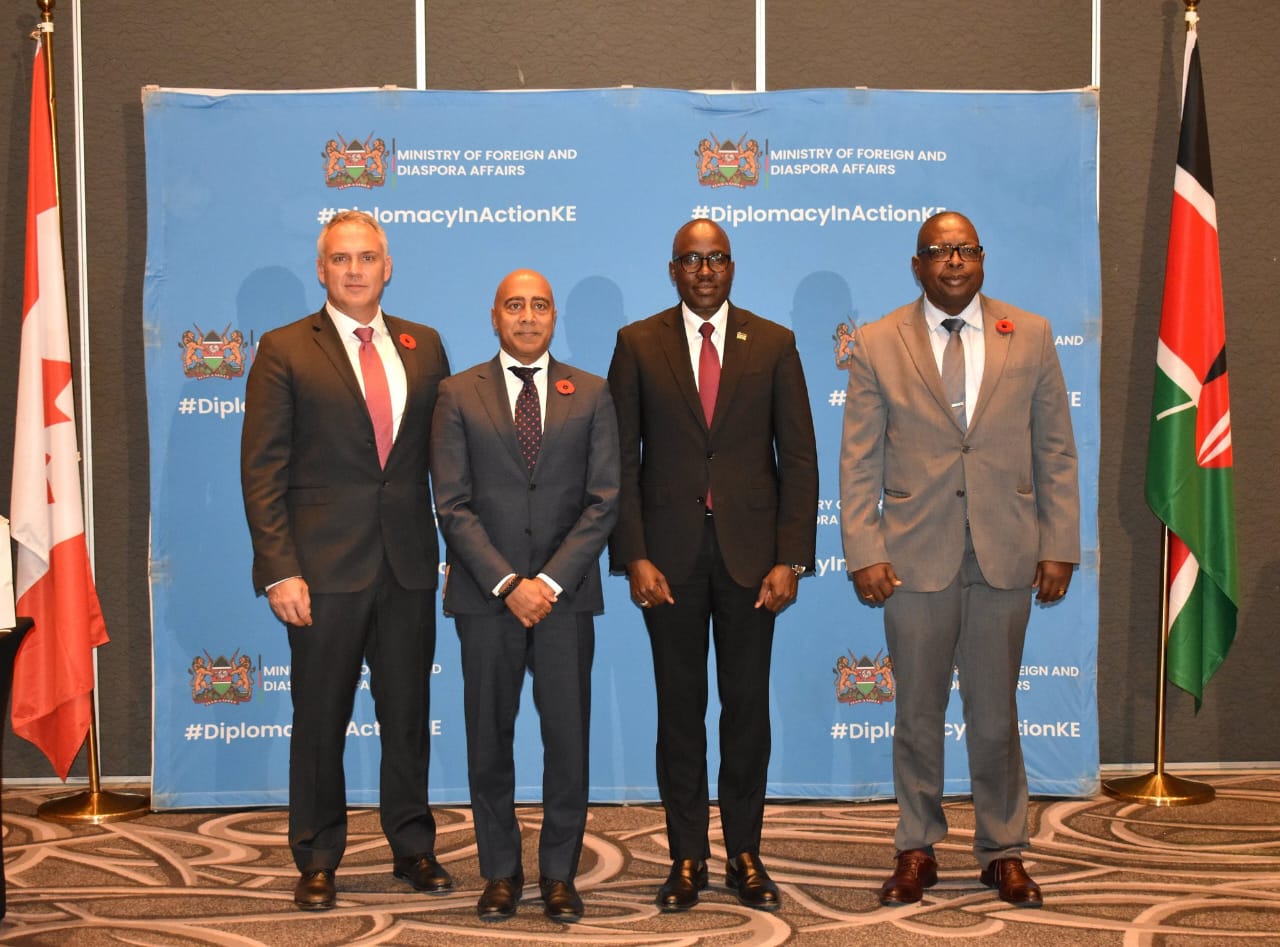
Ambassador Geoffrey Kaituko’s assessment of the recently concluded Fourth Kenya–Canada Binational Commission is refreshingly blunt for a diplomatic dispatch. In his note, the priority is not the pageantry of the Nairobi proceedings or the length of the communiqué, but a single, operational imperative: implementation. He correctly identifies that the true measure of the BNC’s success lies in translating commitments into tangible results in trade and investment.
That framing is necessary, but it is only half the story. The structural reality is that while the BNC provides a vital institutional anchor—established in 2018 to regularize a relationship dating back to 1963—the partnership has for too long punched below its weight in the commercial arena . For Kenya, the strategic value of Canada is not merely as a source of development assistance or a like-minded multilateral voice, but as a potentially significant diversifier of trade and a source of high-value investment in sectors critical to the country’s economic transformation.
The scope of the BNC IV agenda, as detailed by Kenya’s Ministry of Foreign Affairs, is expansive. It covers trade and investment, labour mobility, health, education, peace and security, and climate cooperation . The co-chairs—Principal Secretary Dr. Korir Sing’oei and Canadian Deputy Minister Arun Thangaraj—have laid out a comprehensive menu. However, comprehensiveness can sometimes be the enemy of focus. The critical question is whether the implementation phase will be defined by a few high-impact, bankable initiatives or dissipate into a series of technical working groups that meet, note progress, and adjourn.
The most immediately promising avenue is labour mobility. Kenya’s youthful, educated workforce and Canada’s demographic and labour market needs are structurally complementary. The discussions towards a Kenya–Canada Labour Mobility Framework, engaging both national and provincial governments, represent a concrete mechanism to create mutually beneficial legal migration pathways . If executed with robust safeguards against exploitation and irregular recruitment—a concern Dr. Sing’oei rightly flagged—this could deliver tangible economic benefits to Kenyan families and fill critical gaps in the Canadian economy far faster than traditional trade deals.
Trade and investment, however, remain the harder puzzle. Kenya has correctly invited Canadian capital into agriculture and agri-food value chains, manufacturing, renewable energy, and digital technologies . Canada possesses genuine expertise in these areas, as well as in mining and clean technology. Yet the flow of Canadian foreign direct investment into Kenya remains modest relative to the potential. The BNC must confront the practical barriers: the cost of capital, the perception of risk, and the need for a more predictable regulatory environment. It is not enough to invite investors; the two governments must actively de-risk the pipeline through instruments like the development finance institutions and export credit agencies that sit within the Canadian system.
There is also a geopolitical dimension that deserves more candid acknowledgment. Canada’s engagement with Kenya does not occur in a vacuum. As Ottawa recalibrates its approach to the Indo-Pacific and seeks reliable partners for supply chain resilience and critical mineral diversification, Kenya—a stable democracy and a maritime gateway to East Africa—offers strategic value that extends beyond the bilateral ledger . The BNC is a mechanism to operationalize that strategic convergence. Kenya’s recent diplomatic wins, including the election of Judge Phoebe Okowa to the International Court of Justice, are a testament to its multilateral credibility . Canada should view support for Kenya’s candidacies—such as Justice Njoki Ndung’u for the ICC and Nairobi’s bid for CHOGM 2028—not as favors, but as investments in a shared vision of a rules-based order.
The Ambassador’s appreciation for the co-chairs is well placed. The machinery of the BNC is functioning. But machinery is not momentum. The risk is that the Fourth Session becomes a comfortable ritual of reaffirmation rather than a forcing mechanism for hard choices. The test of BNC IV will not be the elegance of its concluding statement, but whether, a year from now, there are more Canadian ships in Mombasa carrying machinery for a solar plant, more Kenyan nurses and technologists filling Canadian labour gaps under a fair and transparent framework, and a measurable uptick in two-way trade that reflects the true size of the opportunity.
Diplomacy is the art of the possible. But in an era of contested supply chains and shifting global alignments, the possible must be pursued with a sense of urgency. Kenya and Canada have the framework. What they need now is the discipline to execute.