


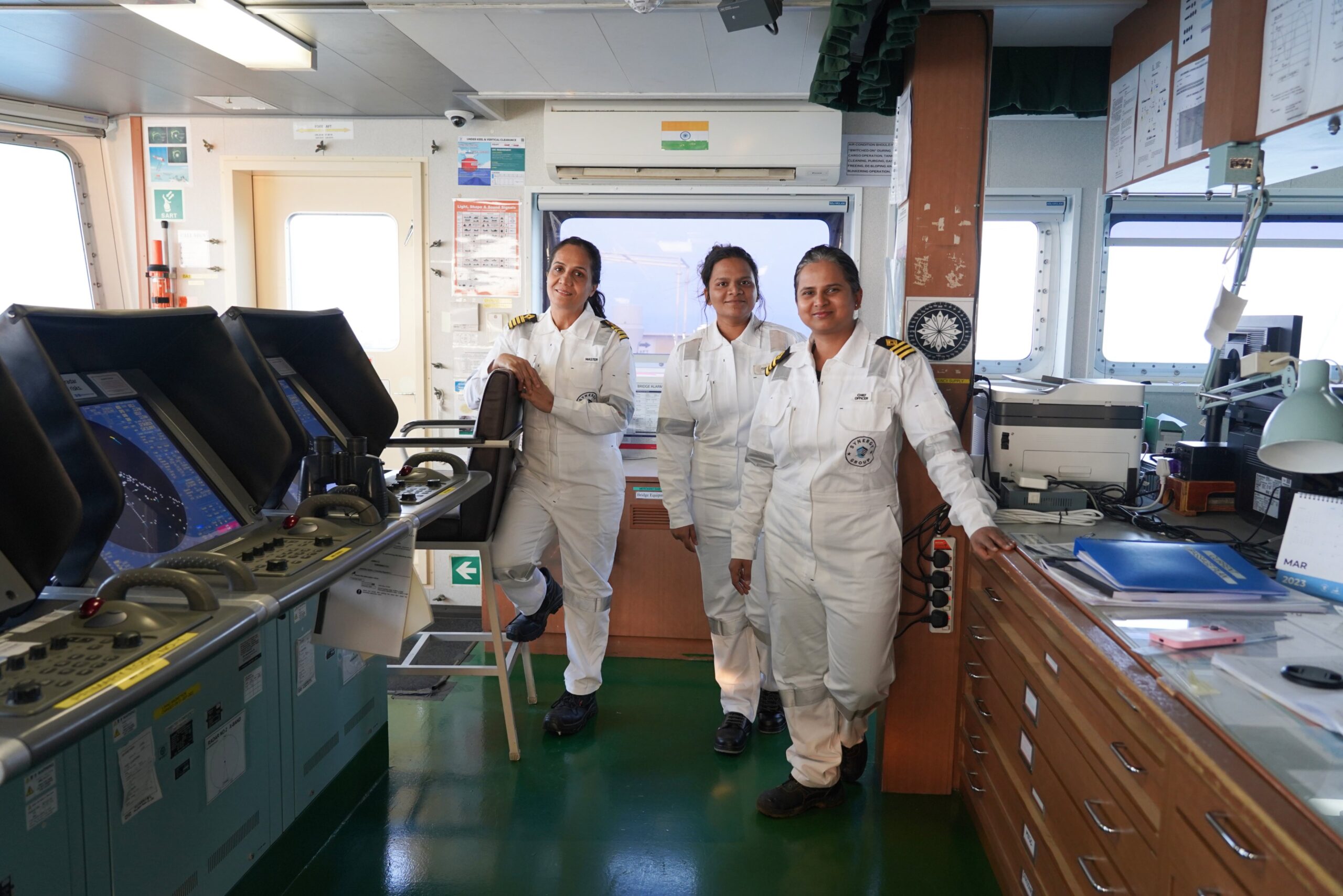
On 10 November 2026, the Regional Maritime University (RMU) in Accra opened its Annual Hafnia Lecture with a clear, uncompromising message: women belong at sea, in ports and across every part of the shipping industry. The four-day programme, part of Hafnia’s sustained investment in maritime education, brought industry practitioners together to share practical knowledge on standards, skills and the future of the sector. Resource persons included Port Capt. Garshol Trond Einar (Director, Cargo Matter Experts and Crewing Development), Bahadur Veeresh and Laibo Gert (Inspector–Owner’s Reps), and Sorensen Bo (Coating Expert–Owner’s Rep). The opening call for more women—and a stronger voice for them—was not ceremonial rhetoric. It was a direct response to one of shipping’s most stubborn structural failures.
The numbers remain stark. Women still make up roughly 1–2% of the global seafaring workforce. Broader maritime employment, shore-based roles included, shows higher but still inadequate representation: recent IMO–WISTA survey data places women at under 19% of the sampled workforce, a figure that has not improved meaningfully and in some datasets appears to have declined relative to earlier snapshots. Shore-side management sits in the high teens to low twenties in many segments, while shipbuilding, engineering and certain technical roles lag further behind. Training pipelines show modest gains—around 5% of seafaring students in some assessments—yet the “leaky pipeline” from classroom and cadetship into sustained careers remains severe. Harassment, isolation, inadequate facilities, family-unfriendly policies, stereotyping and limited pathways into leadership continue to drive women out. A Global Maritime Forum analysis found that 68% of women leaders reported identity-related barriers, compared with 33% of men. With the industry facing a projected officer shortage measured in the tens of thousands, treating half the talent pool as optional is not merely inequitable—it is operationally shortsighted.
Hafnia’s partnership with RMU offers a concrete counter-example. The relationship, formalised through successive Memoranda of Understanding since 2023 (with roots in earlier commitments focused on female cadets), has produced placements, mentoring, guest lectures and a deliberate pipeline from West African training into international tanker operations. Hafnia has also run its Maritime Culture Lab / DEI vessel experiments—crewing multiple ships with at least 50% women to test and normalise mixed crews, improve accommodation design and generate evidence on what actually works at sea. The company has publicly supported maternity policies for seafarers, awards for academic excellence at RMU and broader diversity targets. These are not symbolic gestures. They are operational experiments conducted by one of the world’s larger product and chemical tanker owners.
RMU itself occupies a strategic position. As a regional institution serving West and Central Africa, it trains cadets who can feed both regional fleets and global operators. Partnerships that combine curriculum input, sea-time opportunities, guest expertise and employment pathways turn education into employability. The Hafnia Lecture series—now in its successive annual iterations—functions as one visible node in that system: industry practitioners transmitting current operational knowledge while signalling that women are expected, not exceptional, participants.
Yet lectures and individual company programmes, however well-intentioned, cannot solve a systemic problem alone. Several structural requirements remain clear.
First, culture and safety must be non-negotiable. Psychological safety, zero-tolerance enforcement against harassment and bullying, proper accommodation and privacy, and leadership that models inclusive behaviour are prerequisites, not optional extras. Research and seafarer surveys consistently show that hostile or isolating environments drive attrition far more effectively than recruitment campaigns can reverse it.
Second, the pipeline must be continuous. Recruitment into training is insufficient if sea-time, first jobs and promotion pathways remain closed or precarious. Family-supportive policies—including meaningful maternity and parental leave for seafarers—transparent promotion criteria and active sponsorship, not merely mentoring, matter. Shore-side careers in operations, technical management, chartering and leadership must also be opened systematically; otherwise the industry simply recreates the same under-representation higher up the hierarchy.
Third, measurement and accountability are essential. Vague diversity statements achieve little. Companies, training institutions, and flag and port states need disaggregated data on recruitment, retention, promotion, pay equity and attrition by gender and role. Public reporting creates pressure; internal targets tied to leadership accountability create results. Initiatives such as the All Aboard Alliance and IMO–WISTA surveys provide useful benchmarks; the industry should treat them as minimum rather than maximum standards.
Fourth, regional institutions like RMU should be treated as strategic assets rather than occasional partners. West and Central Africa produce capable maritime talent. Sustained industry investment—simulators, curriculum co-development, guaranteed cadetships and preferential hiring pipelines—can both address global shortages and build local capacity. The reverse is also true: without reliable employment pathways, training institutions risk producing graduates who cannot find berths.
Critics sometimes frame gender-equity efforts as a distraction from “real” operational priorities—safety, decarbonisation, digitalisation, geopolitical risk. This is a false trade-off. A chronically understaffed, demographically narrow workforce is itself a risk. Diverse teams have been shown in other high-stakes industries to improve decision quality and risk perception; at sea, where isolation and hierarchy can amplify problems, the same logic applies. Moreover, younger generations of talent increasingly expect inclusive workplaces. Companies that cannot offer them will lose the competition for skilled officers and engineers.
The Hafnia Lecture’s opening message—that women belong at sea, in ports and across the industry—is therefore both moral and pragmatic. It is moral because excluding capable people on the basis of gender is indefensible. It is pragmatic because shipping cannot meet its staffing, safety and innovation challenges while ignoring half the population. Progress will not come from isolated lectures or single-company experiments, valuable as those are. It will come from the accumulation of measurable, sustained changes in recruitment, retention, culture, policy and leadership accountability across the sector.
RMU and Hafnia have put one practical model on the table in Accra. The rest of the industry should treat it as an invitation rather than an exception. Women already belong in maritime. The remaining task is to make the structures of the industry reflect that fact.
Andrew Mwangura is a maritime analyst and the editor of the Maritime Business Review.