


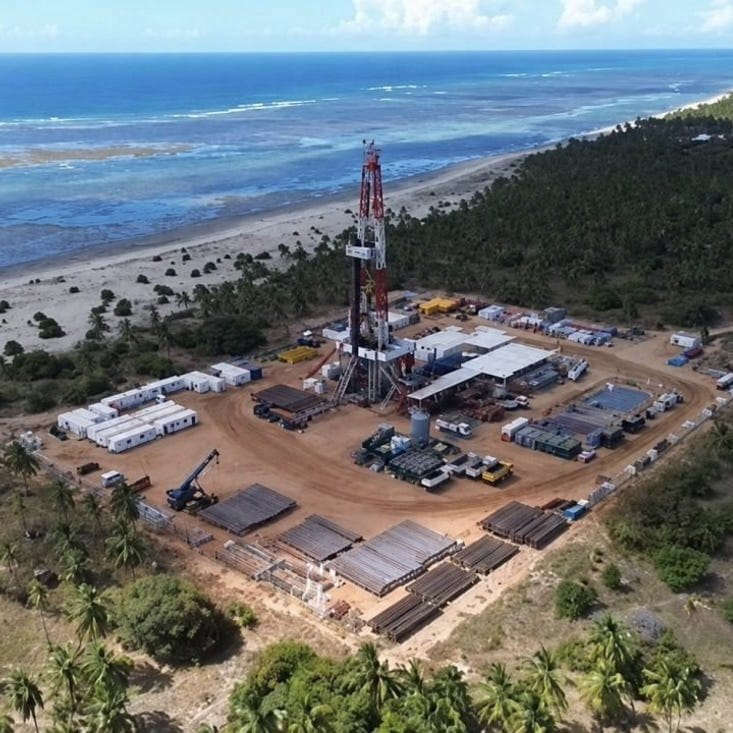
On 27 October 2026, Tanzania’s Energy Minister Juma Homera announced the country’s first natural gas discovery in over a decade: an estimated 223 billion cubic feet at the Kasa-1X ST2 well in the Mnazi Bay area of Mtwara Region. The find, drilled jointly by the state-owned Tanzania Petroleum Development Corporation (TPDC) and French operator Maurel & Prom, is modest by the standards of Tanzania’s existing 57.5 trillion cubic feet of discovered resources. Yet its significance lies less in the headline number and more in what it reveals about realistic energy strategy in Africa.
The well was drilled from land to a reservoir roughly 4.5 km offshore, beneath about 400 metres of water. Maurel & Prom’s own preliminary estimate sits closer to 200 billion cubic feet and has not been classified as proved reserves. Production from Kasa is expected as early as November 2026, with the government projecting around 30 million cubic feet per day for at least a decade and the operator seeing potential for up to 50 million cubic feet per day. Two companion development wells (MB-5 and MS-2) have already lifted Mnazi Bay output to approximately 130 million cubic feet per day, pushing combined potential toward 200 million cubic feet per day. More than 80 percent of the field’s gas already feeds electricity generation at TANESCO plants serving Mtwara and Dar es Salaam.
This is not a transformative offshore megaproject. It is incremental, infrastructure-ready gas sitting inside an established producing area. That is precisely why it matters.
The Value of the Near-Term Over the Spectacular
Tanzania has long held substantial deepwater gas discoveries from the early 2010s, primarily in Blocks 1, 2 and 4. Those resources underpin ambitions for a large-scale LNG export project involving majors such as Equinor, Shell and others—talks that have stretched for years and still face commercial, fiscal and market hurdles. Meanwhile, domestic power demand continues to rise with industrialization, urbanization and efforts to expand manufacturing and transport (including compressed natural gas for vehicles).
The Mnazi Bay addition does not solve the LNG puzzle. It does, however, deliver gas that can reach power plants and industrial users relatively quickly because the pipelines, processing facilities and market relationships already exist. In energy development, time-to-market and utilization of sunk infrastructure often matter more than the absolute size of a resource. A 200-plus billion cubic feet discovery that can produce within weeks is commercially more useful in the near term than multi-trillion cubic feet volumes that remain stranded for a decade.
This pattern is familiar across the continent: countries announce large resource finds, celebrate them, then struggle with the capital intensity, market risk and institutional complexity required to monetize them. Tanzania’s approach here is more pragmatic—drill where infrastructure already exists, bring barrels (or cubic feet) online, and use the cash flow and operational experience to support broader ambitions.
Energy Sovereignty Without Isolation
The LinkedIn post that circulated the announcement framed the discovery in the language of energy sovereignty and Pan-Africanism. Those frames are not empty. Reliable, affordable domestic gas reduces exposure to imported fuels, supports industrial competitiveness, and keeps more of the value chain inside the country. TPDC’s 40 percent interest (up from earlier levels) and the subsequent award of four exploration licences to the state company in its own name signal a deliberate effort to build national capacity and equity participation.
Yet sovereignty is not autarky. The partnership with Maurel & Prom remains essential. French capital, technical expertise and operating experience are what enabled the three-well campaign and the rapid path to production. Effective resource nationalism in the 2020s looks less like wholesale nationalization and more like structured partnerships that transfer skills, secure local content, and retain a meaningful state share of the upside. The government’s reported talks with four investors on small-scale LNG projects point in a similar direction: using existing gas to seed smaller, more flexible monetization options rather than waiting solely for the big export terminal.
The Harder Questions Remain
Optimism should be tempered. The 223 billion cubic feet figure is a government estimate; independent certification is still needed. Commercial viability depends on sustained production rates, well performance, and demand. Comments under the original post rightly raised the classic African resource-management risks: elite capture, weak local content enforcement, environmental oversight, and the failure of resource wealth to translate into broad-based improvements in living standards. Gas that powers industries and households is valuable; gas that primarily enriches intermediaries is not.
There is also the climate dimension. Tanzania, like most developing countries, faces pressure to decarbonize even as it confronts acute energy poverty and industrialization needs. Natural gas is a lower-carbon fossil fuel than coal or heavy fuel oil and can displace dirtier sources while providing the firm power that intermittent renewables still struggle to deliver at scale. Using it for power generation, industrial heat and transport is a rational transitional strategy. Pretending that every new gas molecule is an abandonment of climate responsibility is not.
A Model Worth Watching
Tanzania’s latest discovery will not rewrite the country’s energy balance overnight. It is a reminder that the most useful discoveries are often those that can be brought online quickly, that leverage existing infrastructure, and that serve domestic demand first. In a continent littered with stranded megaprojects and optimistic resource announcements that never quite deliver, the quiet, infrastructure-adjacent win at Mnazi Bay is instructive.
The test will be whether the gas reaches factories, power plants and households at competitive prices; whether local contractors and workers capture meaningful value; and whether the fiscal revenues are managed with the discipline that resource-rich states so often lack. If Tanzania can turn this modest addition into reliable electrons and industrial feedstock while steadily building the institutions and skills for larger projects, it will have demonstrated a form of energy pragmatism that others would do well to study.
Africa does not need every resource announcement to be a transformational jackpot. It needs more discoveries that actually produce—and more governments that treat production, not just announcement, as the measure of success.